

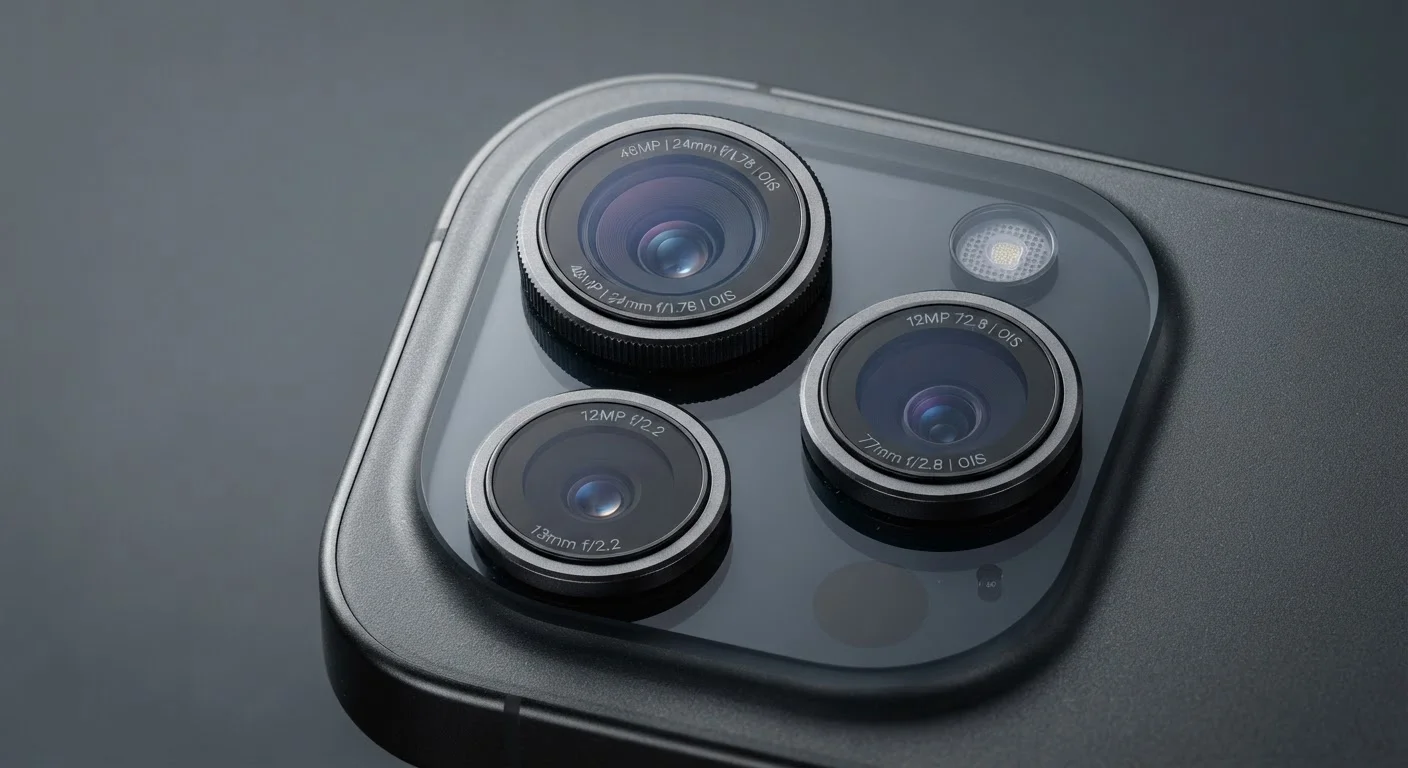
The Three Specs That Shape Every Camera Photo
When you read a smartphone camera spec sheet, three terms appear almost universally: megapixels, aperture, and sensor size. Each describes a different part of how light is captured and turned into a digital image. Understanding what each one actually controls - and what it does not control - helps you cut through the marketing and understand what a camera is genuinely capable of.
For a broader look at the numbers on any device listing, see the Specs Sheet Decoded reference guide, and for plain-English definitions of related technical terms, the Electronic Gadget Glossary is a useful companion.
Megapixels: Resolution, Not Quality
A megapixel (MP) equals one million individual light-sensing points, called photosites or pixels, on the camera sensor. A 50 MP camera captures images with 50 million of these data points. More megapixels produce larger image files and allow you to crop a photo heavily while retaining detail - useful for printing large or zooming in after the fact.
What megapixels do not determine is the overall quality, color accuracy, or low-light performance of a photo. Two cameras can both be labeled 50 MP and produce dramatically different images based on every other factor in this guide. What megapixels don't tell you about image quality covers this distinction in depth.
Many phones also use a technique called pixel binning, where the processor combines several neighboring photosites into one larger effective pixel. A 108 MP sensor might produce 27 MP output images by default, using binning to gather more light per pixel rather than keeping all 108 million data points separate.
Aperture: The Size of the Light Gateway
Aperture refers to the opening in the lens through which light travels to reach the sensor. It is expressed as an f-number (f/1.8, f/2.2, etc.). A key point that trips up many readers: a lower f-number means a wider aperture. An f/1.8 lens admits significantly more light than an f/2.8 lens.
Wider apertures produce two practical effects. First, more light reaches the sensor, which improves photos in dim conditions. Second, a shallower depth of field is created - the area of the scene that appears sharp is narrower, producing the blurred background effect (sometimes called bokeh) common in portrait photography. On most smartphones, bokeh is also simulated in software even when the optical depth of field is limited by the small sensor size.
Fixed vs. Variable Aperture on Smartphones
Unlike traditional interchangeable-lens cameras where the aperture physically adjusts to different f-stops, most smartphone lenses have a single, fixed aperture. Exposure is instead managed by adjusting shutter speed, ISO sensitivity, or using computational techniques. A small number of phones offer a variable-aperture lens that physically switches between two f-stop settings, but this remains uncommon.
Unlike traditional cameras, most smartphone lenses have a fixed aperture - it does not physically adjust. A small number of phones include a variable-aperture lens that switches between two settings, but this is not the norm.
Sensor Size and What It Means for Light Capture
The image sensor is the physical chip inside the camera that converts incoming light into digital data. Sensor size is typically expressed as a fraction (such as 1/1.3") or, less commonly, in millimeters. Larger fractions indicate larger sensors - meaning 1/1.3" is larger than 1/2".
A physically larger sensor can accommodate larger individual photosites or more photosites overall. Larger photosites collect more photons per exposure, which translates directly into better low-light performance, more dynamic range (the gap between the darkest and brightest parts of a scene a camera can capture simultaneously), and less digital noise - the grainy texture that appears in dark photos.
1/1" or larger
Sensor size associated with flagship-tier low-light capability
Sensors at or above 1/1" in diameter are generally found in upper-tier smartphones and deliver notably more light-gathering surface area than typical mid-range sensors.
f/1.4-f/1.8
Common wide-aperture range in smartphone main cameras
Most primary smartphone lenses in this aperture range admit roughly two to four times more light than lenses at f/2.8, all else being equal.
3-5x
Typical photosite count advantage of pixel binning
When a sensor bins a 3×3 grid of photosites into one, each effective pixel covers nine times the area, gathering proportionally more light per exposure.
This is why sensor size is often considered the single most important hardware variable in smartphone camera performance, even though it rarely appears prominently in marketing. To understand how the sensor fits alongside other components inside a phone, Inside Your Smartphone explains the full hardware picture.
If you are newer to interpreting these specifications in context, Everything First-Time Device Shoppers Should Know offers a grounded starting point before diving into spec-by-spec comparisons.
How the Specs Work Together
No single specification tells the full story. A high megapixel count on a very small sensor may produce noisier images than a lower-megapixel camera with a larger sensor. A wide aperture helps in low light, but only if the sensor can capitalize on the extra light efficiently. And increasingly, the phone's image signal processor (ISP) - the dedicated chip that handles computational tasks like noise reduction, HDR compositing, and sharpening - shapes the final result as much as the optics do.
Megapixel (MP)
A unit equal to one million pixels. It describes the resolution of the image a sensor can capture, not the overall quality of the photograph.
Aperture (f-number)
The size of the lens opening that admits light to the sensor. A lower f-number (e.g., f/1.8) means a wider opening and more light - counterintuitively, smaller numbers equal larger openings.
Image sensor
The physical chip in a camera that converts incoming light into electrical signals, which are then processed into a digital image. Larger sensors generally capture more light and produce less noise.
Pixel binning
A technique where the camera processor combines multiple neighboring photosites into one larger effective pixel, trading raw resolution for improved light sensitivity and lower noise.
Dynamic range
The span between the darkest shadow and brightest highlight a sensor can capture in a single exposure. Higher dynamic range preserves detail in both dark and bright areas of the same scene.
Depth of field
The portion of a scene that appears in sharp focus. A shallower depth of field (produced by a wider aperture) creates background blur; a deeper depth of field keeps more of the scene sharp.
Image signal processor (ISP)
A dedicated chip that handles the computational work of turning raw sensor data into a final image, including noise reduction, HDR compositing, color processing, and sharpening.
Bokeh
The aesthetic quality of the out-of-focus blur in a photograph, particularly in the background. It can result from optical depth of field or be simulated computationally by the phone's software.
When comparing cameras across listings, look at aperture, sensor size, and computational features as a system rather than evaluating any number in isolation. For a broader overview of specs across all device categories, the Devices Compared hub provides feature-by-feature breakdowns organized by category.