

Key Takeaways
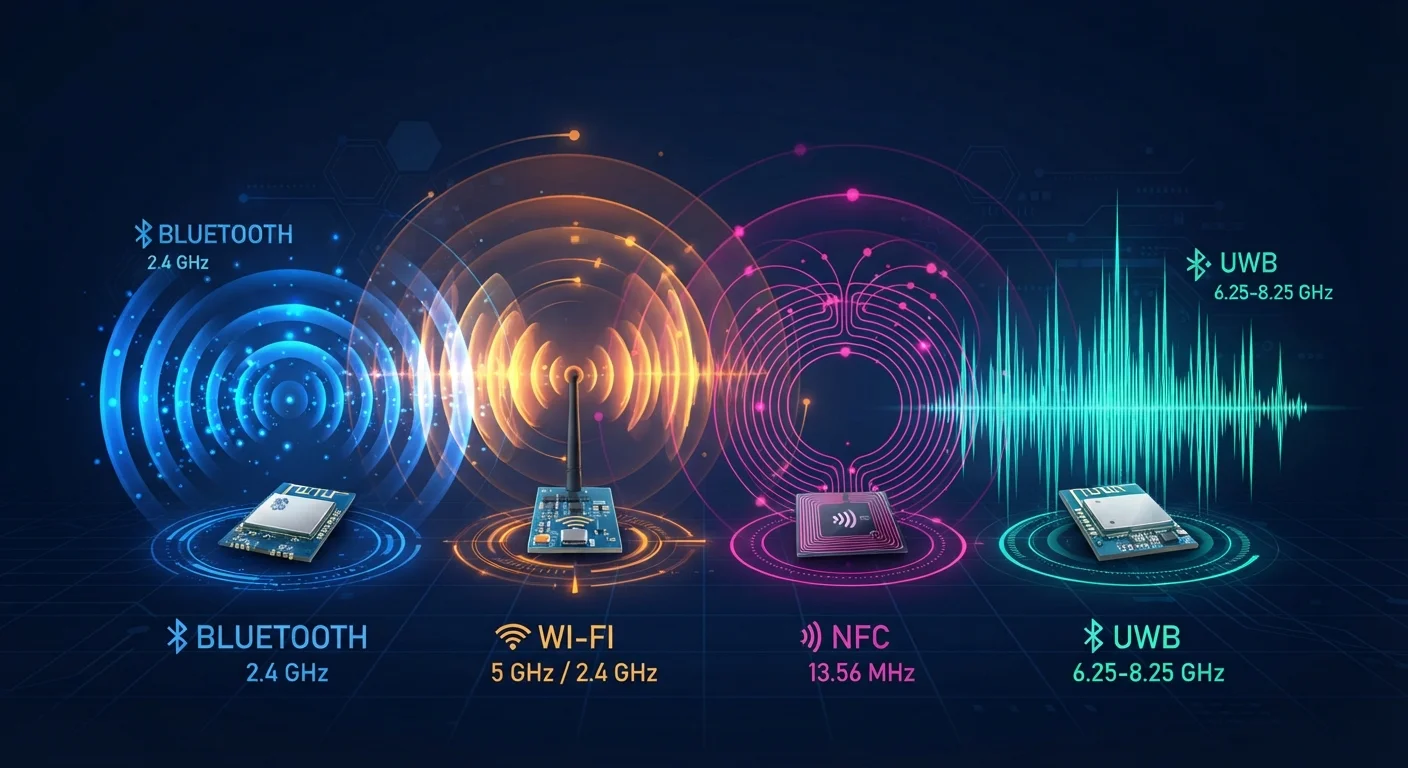
- Bluetooth, Wi-Fi, NFC, and UWB are all radio technologies, but each is engineered for a distinct use case.
- Bluetooth trades speed for low power draw; Wi-Fi trades power for high data throughput.
- NFC works only at centimeter distances, making it inherently secure for tap-to-pay and device pairing.
- UWB uses very wide frequency bands to calculate precise physical location, not just data transfer.
- Modern smartphones often carry all four radios, activating each only when needed to conserve battery.
Start here
Why Short-Range Radio Exists
Core concepts
Bluetooth: Low Power, Steady Connection
Go deeper
Wi-Fi: High Speed at Medium Range
Explore further
NFC: Touch-Close Communication
Advanced
UWB: Precision Positioning
Apply it
Choosing the Right Radio for the Job
Why Short-Range Radio Exists
Every wireless signal is a form of radio wave - an invisible electromagnetic pulse traveling through the air at the speed of light. The difference between technologies like Bluetooth and Wi-Fi isn't magic; it's engineering choices about frequency, power, and purpose.
Long-range cellular networks are designed to reach towers kilometers away, which demands high power and licensed spectrum. Short-range radios take the opposite approach: keep the power low, use unlicensed frequency bands, and optimize for a specific task. The result is four very different tools for very different jobs. For a closer look at how these radios fit into a smartphone's overall hardware, see Inside Your Smartphone.
Frequency band
A specific range of radio frequencies allocated for a particular use. Different bands travel different distances and carry different amounts of data.
Frequency hopping
A technique where a radio rapidly switches between many frequencies to avoid interference and improve reliability.
Throughput
The actual amount of data successfully transferred per second. High throughput means more data moves faster.
Time of flight
The time it takes a radio pulse to travel from sender to receiver. Measuring this precisely allows a device to calculate distance.
Passive NFC tag
A small chip with no battery that temporarily powers on when it enters a reader's magnetic field, then transmits a short data message.
BLE (Bluetooth Low Energy)
A power-optimized version of Bluetooth designed for devices that send small amounts of data infrequently, allowing batteries to last weeks or months.
Bluetooth: Low Power, Steady Connection
Bluetooth was designed in the 1990s to replace short cables - think keyboard to computer, or headset to phone. It operates on the 2.4 GHz band and uses a technique called frequency hopping, which rapidly switches among 79 channels to avoid interference. Its effective range is typically 10-30 meters, depending on the version and environment.
The more recent Bluetooth Low Energy (BLE) variant trades raw data throughput for dramatically reduced power consumption. This is why a small fitness tracker can run for weeks on a coin battery while staying connected. BLE is also the backbone of most item-tracker tags and many smart home sensors.
Use BLE for Always-On Accessories
If you're connecting something that needs to stay paired all day - a smartwatch, fitness band, or wireless keyboard - look for devices that specify Bluetooth Low Energy support. Classic Bluetooth is fine for audio streaming, but BLE is what extends battery life on small wearables. Most modern accessories use both modes automatically.
Wi-Fi: High Speed at Medium Range
Wi-Fi operates on the 2.4 GHz and 5 GHz bands (and the newer 6 GHz band in Wi-Fi 6E), covering ranges of roughly 30-100 meters indoors. Its defining characteristic is high data throughput - modern Wi-Fi standards can move hundreds of megabits per second, making it the right tool for streaming video, video calls, and file transfers.
That speed comes at a cost: Wi-Fi radios consume significantly more power than Bluetooth. This is why laptops and phones turn Wi-Fi off in airplane mode to extend battery life, but leave BLE running for accessories. For a detailed comparison of Wi-Fi against wired connections, see Wi-Fi vs. Ethernet.
NFC: Touch-Close Communication
Near Field Communication (NFC) operates at 13.56 MHz - a much lower frequency than Bluetooth or Wi-Fi - and works only within roughly 4 centimeters. That tight range isn't a flaw; it's the point. When you tap your phone to a payment terminal or tap two phones together to share a contact, the proximity itself provides a form of physical confirmation.
NFC also has a passive mode: an NFC tag (like a sticker embedded in a poster) contains no battery at all. The reader device generates a small magnetic field that powers the tag just long enough to transmit a short data payload. This makes NFC ideal for transit cards, smart labels, and quick device pairing. For spec-sheet context on NFC, see The Specs Sheet Decoded.
NFC Range Is a Feature, Not a Bug
Some users try to extend NFC range by using third-party antennas or signal boosters. This generally doesn't work well and can interfere with the tight coupling that makes NFC reliable. If a tap-to-pay transaction fails, the usual cause is misalignment between the phone's NFC antenna and the terminal - moving the phone slightly usually resolves it.
UWB: Precision Positioning
Ultra-Wideband (UWB) is the newest mainstream entrant among the four. Rather than operating on a narrow frequency slice, UWB spreads signals across a very wide swath of spectrum - typically from around 3.1 GHz to 10.6 GHz. This broad bandwidth allows devices to measure the time of flight of radio pulses with enough precision to determine distance within about 10 centimeters.
That centimeter-level accuracy separates UWB from Bluetooth, which can estimate range only to within a meter or two. Practical applications include directional item-finding (your phone points like a compass toward a lost tag), secure hands-free car access that verifies you're genuinely beside the door, and indoor navigation in large spaces like airports.
Choosing the Right Radio for the Job
These four technologies aren't competitors - they're specialists. Here's a practical summary of when each makes sense:
- Bluetooth / BLE: Accessories, audio streaming, sensors, and anything battery-powered that needs a persistent low-data connection.
- Wi-Fi: High-bandwidth tasks - streaming, downloads, video calls - where a power source is nearby.
- NFC: Tap-to-pay, transit cards, quick pairing, and passive smart tags requiring no battery.
- UWB: Precise spatial location, secure proximity verification, and directional finding.
Modern smartphones carry all four radios and activate each only when needed, which is a significant reason battery management has become a sophisticated balancing act. Understanding what each radio does also helps decode device spec sheets - if a phone lacks NFC, tap-to-pay won't work regardless of software. For broader tech vocabulary, Core Tech Terms is a useful companion reference.
Wi-Fi, Ethernet, and Mobile Data Explained
Understand how Wi-Fi fits into the broader picture of internet connectivity alongside Ethernet and cellular data. Useful context after learning how Wi-Fi works as a short-range radio.
Inside Your Smartphone: Hardware Guide
A plain-language tour of every major chip, sensor, and radio inside a modern smartphone - including how Bluetooth, Wi-Fi, and NFC coexist on the same device.
Core Tech Terms Reference
A foundational vocabulary guide covering terms like bandwidth, firmware, and NFC - a helpful companion for readers building general digital literacy.