

Key Takeaways
- The SoC is the brain of a smartphone, combining CPU, GPU, and often a modem on a single chip.
- RAM determines how many tasks a phone can handle simultaneously without slowing down.
- Sensors like accelerometers and gyroscopes track motion; others measure light, proximity, and biometrics.
- Cellular modems handle mobile data; separate radios manage Wi-Fi, Bluetooth, NFC, and GPS.
- Battery capacity (measured in mAh) and charging circuitry are distinct hardware components.
- Camera hardware quality depends on more than megapixel count - sensor size and aperture matter too.
Smartphone Hardware
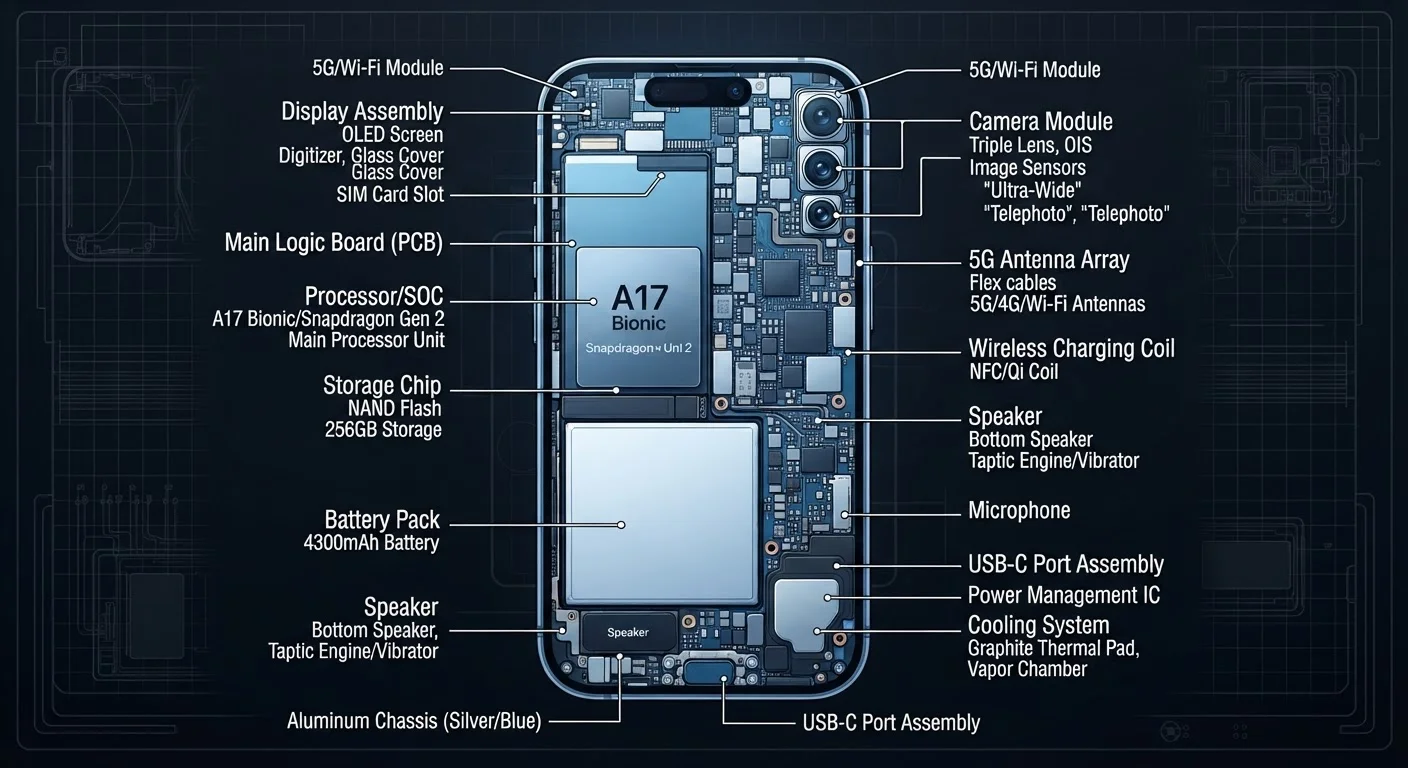
Smartphone hardware refers to all the physical components inside a phone - the chips that process information, the sensors that detect the physical world, and the radios that send and receive signals. Each component has a distinct job, but they work together seamlessly through software coordination. Understanding what each piece does helps you interpret spec sheets and make more informed decisions about the devices you use.
Most modern smartphones integrate many of these functions onto a single package called a System on a Chip (SoC), which combines the processor, graphics unit, modem, and other subsystems onto one die to reduce size and power consumption.
The SoC: One Chip to Run It All
At the center of every smartphone is the System on a Chip, or SoC. Unlike a desktop computer where the processor, graphics card, and memory controller are separate components, a smartphone SoC combines all of these - plus additional specialized engines - onto a single piece of silicon roughly the size of a fingernail.
Inside the SoC, you'll find:
- CPU (Central Processing Unit): The general-purpose processor that runs apps, manages the operating system, and handles logic. Modern SoCs use multiple CPU cores at different speed and efficiency levels to balance performance and battery life.
- GPU (Graphics Processing Unit): Renders visuals for the display, games, and video playback. The GPU also assists in camera processing.
- NPU (Neural Processing Unit): A dedicated engine for AI tasks such as voice recognition, photo enhancement, and on-device language processing.
- ISP (Image Signal Processor): Processes raw data from camera sensors into the final photo or video you see.
The SoC's manufacturing process - measured in nanometers (nm) - affects how efficiently it runs. Smaller process nodes generally mean more transistors in less space, translating to better performance and lower heat output. For a deeper look at how these specs appear on product listings, see The Specs Sheet Decoded.
~10 billion
Transistors in a modern smartphone SoC
Advanced mobile SoCs manufactured on leading-edge process nodes pack billions of transistors into a chip smaller than a thumbnail.
6-16 GB
Typical RAM range in current smartphones
Mid-range phones commonly ship with 6-8 GB of RAM, while flagship devices often offer 12-16 GB for multitasking-heavy workloads.
10+
Sensors found in a typical flagship phone
Beyond the camera, a modern smartphone may include an accelerometer, gyroscope, barometer, magnetometer, proximity sensor, ambient light sensor, and biometric sensors.
Memory and Storage: RAM vs. Flash
Two types of memory coexist in every smartphone, and they serve very different roles.
RAM (Random Access Memory) is fast, temporary working memory. When you open an app, it loads into RAM so the processor can access it quickly. More RAM means more apps can stay loaded simultaneously - reducing the lag you experience when switching between them. Typical modern phones carry between 6 GB and 16 GB of RAM.
Internal storage (usually UFS or NVMe flash memory) holds your photos, apps, music, and operating system permanently - even when the phone is off. It's slower than RAM but retains data without power. This is the "64 GB" or "256 GB" figure you see in listings.
RAM vs. Storage: A Quick Way to Remember
Think of RAM as your desk - the larger it is, the more projects you can work on at once. Internal storage is your filing cabinet - it holds everything you own, but you have to pull items onto the desk to use them. A bigger desk (more RAM) keeps things accessible; a bigger cabinet (more storage) just means more room to keep files.
Understanding this distinction also helps explain why device slowdowns happen: as storage fills up or as RAM becomes fragmented over time, performance can degrade even on otherwise capable hardware.
Sensors: How Your Phone Perceives the World
Smartphones contain a surprisingly large array of sensors, each measuring something specific about the physical environment or the user's interaction with the device.
- Accelerometer
- Detects linear motion and tilt. Used for screen rotation, step counting, and shake gestures.
- Gyroscope
- Measures rotational orientation. Enables precise motion tracking in games, AR apps, and video stabilization.
- Proximity sensor
- Usually an infrared emitter and detector near the earpiece. Turns off the display when you hold the phone to your ear during a call.
- Ambient light sensor
- Adjusts screen brightness automatically based on surrounding light conditions.
- Barometer
- Measures air pressure, improving altitude accuracy in GPS and weather apps.
- Fingerprint sensor
- Either optical (under-display camera) or capacitive (physical button), maps the ridges of a fingerprint for biometric authentication.
Many phones also include a magnetometer (compass), a heart-rate sensor, or a UV sensor. The specific sensor suite varies by device design and intended use case.
Radios: The Wireless Layer
A smartphone is, at its core, a radio device. It communicates using several distinct wireless technologies, each handled by its own dedicated radio subsystem.
- Cellular modem: Manages voice calls and mobile data over carrier networks (4G LTE and 5G). On many SoCs, the modem is integrated into the same chip package; on others, it's a separate component.
- Wi-Fi radio: Connects to local wireless networks. Modern phones support Wi-Fi 6 (802.11ax) or Wi-Fi 6E, which adds the 6 GHz band for higher throughput in congested areas.
- Bluetooth: Short-range radio for accessories like headphones and keyboards. Bluetooth 5.x offers improved range and data rates over earlier versions.
- NFC (Near Field Communication): Operates at very short range (a few centimeters) for contactless payments and device pairing.
- GPS and GNSS: Receives signals from satellite constellations to determine location. Many phones also use assisted GPS (A-GPS), which uses cell tower data to speed up position fixes.
For a detailed breakdown of how Wi-Fi, Bluetooth, NFC, and UWB differ in range and use case, see our plain-language guide to short-range radio.
Antenna Design Is a Real Engineering Challenge
Fitting antennas for five or more wireless technologies into a thin metal-and-glass enclosure requires careful engineering. Metal frames can interfere with radio signals, which is why many phones use antenna breaks - thin lines of non-conducting material - around the edges. The placement and tuning of antennas directly affects real-world signal quality.
Camera Hardware: More Than Megapixels
The camera system in a modern smartphone is a collaboration between dedicated hardware and sophisticated software processing - and the hardware side is more nuanced than a single megapixel number suggests.
Key camera hardware components include:
- Image sensor: A grid of light-sensitive photodiodes that captures photons and converts them to electrical signals. Larger sensors capture more light, improving low-light performance.
- Lens and aperture: The aperture (expressed as an f-number) controls how much light reaches the sensor. A lower f-number (e.g., f/1.6) means a wider opening and more light.
- OIS (Optical Image Stabilization): A mechanical system that physically moves the lens or sensor to compensate for hand tremor during capture.
- Multiple rear cameras: Most phones combine a main camera with an ultrawide lens and a telephoto lens, each using separate sensors optimized for their focal range.
The ISP inside the SoC then processes raw sensor data through noise reduction, HDR compositing, and computational photography algorithms. See Decoding Smartphone Camera Specs for a complete walkthrough, or explore what megapixels don't tell you for context on why raw numbers can mislead.
Battery and Power Management
The battery is a lithium-ion or lithium-polymer cell rated in milliampere-hours (mAh) - a measure of stored charge. A larger mAh value means more energy available, but real-world battery life also depends heavily on display size and brightness, SoC efficiency, network activity, and software behavior.
Alongside the battery, a power management integrated circuit (PMIC) regulates voltage levels delivered to each component, ensuring the CPU, display, radios, and sensors each receive the correct power. The PMIC also governs charging: it controls current flow from a charger into the battery to prevent overheating and preserve long-term cell health.
Fast charging technologies work by increasing the voltage or current delivered during the early phase of a charge cycle, when the battery can safely accept higher power. Wireless charging uses electromagnetic induction - a transmitter coil in the charging pad generates a field that induces current in a receiver coil inside the phone.
If you're comparing smartphones on spec sheets and want to understand how all these components are presented, our guide for first-time device shoppers provides a grounded starting point.