

Key Takeaways
- No single budgeting method works for everyone - the best fit depends on your income structure and habits.
- Most frameworks share one goal: aligning spending with priorities before money disappears.
- Switching methods is always an option; consistency matters more than picking the perfect system.
- Understanding several approaches helps you mix and adapt strategies to your real life.
Why the Method You Choose Matters
A budget is only useful if you actually stick to it. That sounds obvious, but it explains why so many people set up a spreadsheet in January and abandon it by March. The format matters - not just the numbers.
Different budgeting frameworks suit different people. Some need rigid category limits to stay on track. Others do better with a single rule applied to each paycheck. Knowing what's out there lets you choose deliberately rather than by default. If you're new to the terminology, the Personal Budgeting Glossary is a useful starting point before diving in.
Below are six well-established budgeting methods explained plainly - what each one involves, how it works in practice, and the kind of person it tends to suit.
The 50/30/20 Rule
This method divides your after-tax income into three broad buckets: 50% toward needs (housing, utilities, groceries, minimum debt payments), 30% toward wants (dining out, entertainment, subscriptions), and 20% toward savings and extra debt repayment.
Its appeal is simplicity - three categories cover everything, so there's little tracking overhead. It works well for people with stable salaries who want a loose framework without granular line items. The trade-off is that 50/30/20 can be too rough for those with high fixed costs or irregular income. For a deeper look at how it compares to a stricter alternative, see Zero-Based Budgeting vs. the 50/30/20 Method.
Three broad buckets cover everything without requiring granular line-by-line tracking.
Zero-Based Budgeting
Zero-based budgeting (ZBB) requires that every dollar of income be assigned a job - spending, saving, investing, or debt repayment - so that income minus all assignments equals zero. Nothing is left unallocated.
This method forces intentionality. You must actively decide where each dollar goes rather than letting it drift. It suits detail-oriented people and those who feel their money disappears without explanation. The downside: it's time-intensive to set up and maintain, especially if your income or expenses vary month to month. Understanding fixed vs. variable expenses is particularly helpful when building a zero-based plan.
Every dollar is assigned a purpose, so nothing is spent - or saved - by accident.
Envelope Budgeting
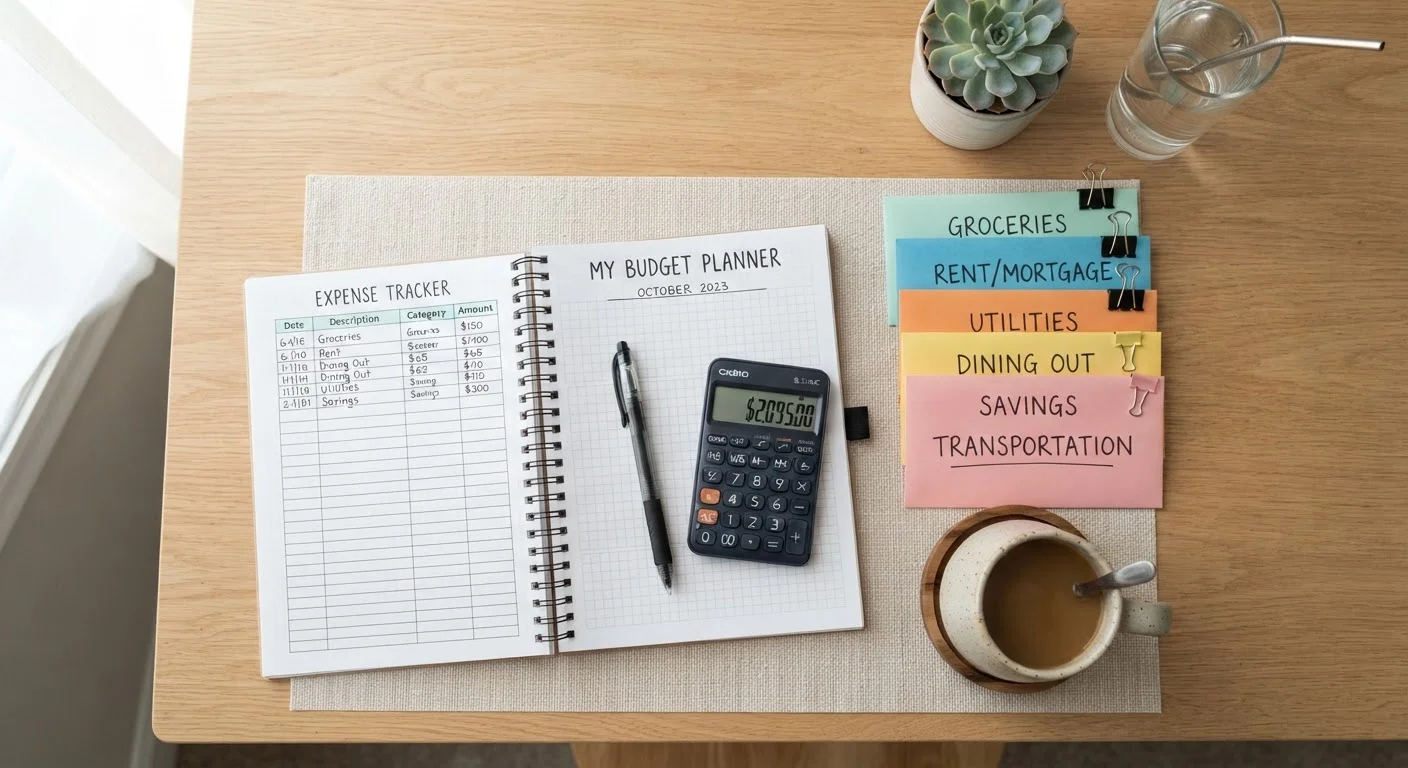
Originally a cash-based system, envelope budgeting means dividing physical cash into labeled envelopes for each spending category - groceries, gas, dining, entertainment. When the envelope is empty, spending in that category stops for the month.
The tactile nature of handling cash reinforces limits in a way that swiping a card simply doesn't. Research in behavioral economics consistently suggests people spend less when paying with physical money. Modern apps now replicate this system digitally for those who rarely use cash, preserving the psychology without requiring actual envelopes.
When the envelope is empty, spending stops - a hard limit that digital tracking rarely enforces.
Pay-Yourself-First Budgeting
This approach inverts the usual order: instead of saving whatever's left after spending, you transfer a fixed savings amount the moment your paycheck arrives - then live on what remains. Automating the transfer removes the need for willpower.
Pay-yourself-first is particularly effective for building an emergency fund or long-term savings because it treats saving as a non-negotiable expense rather than an afterthought. It pairs well with any of the other methods listed here for the spending side. The limitation is that it doesn't address how you spend the remainder.
Automating savings before spending removes willpower from the equation entirely.
The Anti-Budget
Coined by personal finance writer Paula Pant, the anti-budget is a simplified version of pay-yourself-first. You set one savings rate, automate it, pay all fixed bills, and spend the rest freely without tracking categories.
It suits people who find detailed budgets suffocating or unsustainable over time. The method works best when your fixed expenses - rent, utilities, insurance premiums, loan minimums - are well understood and stable. Those with significant debt obligations or variable income may find it too loose to make meaningful progress.
One savings rate automated upfront, then spend freely - no categories, no spreadsheets required.
Values-Based Budgeting
Rather than starting with categories, values-based budgeting begins with a question: what do I actually care about most? You map your spending to your stated priorities and cut ruthlessly in areas that don't align, while spending generously in ones that do.
This framework is less a mechanical system and more a decision-making lens. It tends to resonate with people who feel alienated by rigid numeric approaches or who find that following a standard budget doesn't reflect their actual life. The challenge is that it requires honest self-reflection and regular review - without structure, it can become a rationalization for spending rather than a guide for it.
Spending is guided by personal priorities rather than preset category percentages.
Finding Your Starting Point
Reading about a method and actually using it are different things. If you're unsure where to begin, a step-by-step monthly budget walkthrough can help you move from concept to a working plan. From there, you can layer in whichever framework fits your situation.
Start Simple, Then Refine
If you're choosing a method for the first time, resist the urge to build a complex system on day one. Start with the simplest framework that addresses your biggest pain point - overspending, undersaving, or lack of visibility. You can add structure gradually once the habit is established.
It's also worth pairing your chosen method with habits that reinforce it - like a regular end-of-month review. A structured monthly budget review checklist keeps the process honest and helps you adjust before small drift becomes a big problem.
This article is for general informational and educational purposes only and does not constitute personalized financial advice. Consider consulting a qualified financial professional for guidance tailored to your individual circumstances.