

| What 'Hz' measures in displays | Screen refreshes per second (e.g., 60Hz, 120Hz, 144Hz) |
| Typical IP rating for water-resistant phones | IP67 or IP68 (IEC Standard 60529) |
| Common audio codec formats | AAC, MP3, FLAC, aptX, LDAC |
| What 'nits' measures | Screen brightness (candelas per square meter) |
| Latency threshold for perceptible lag | Generally above 100ms feels noticeable to most users |
| SoC examples by device type | Used in smartphones, tablets, smart TVs, wearables |
Why Technical Gadget Language Matters
Walk into any gadget review, spec sheet, or product listing and you'll encounter a dense thicket of abbreviations and engineering terms. Words like codec, latency, and thermal throttling aren't there to intimidate - they describe real, measurable qualities that affect how a device performs in your hands. Understanding them means you can evaluate claims critically rather than taking marketing language at face value.
This glossary covers 40 of the most frequently encountered terms across electronics coverage - from display technology to audio, connectivity to processing. For foundational vocabulary beyond gadget hardware specifically, Core Tech Terms Every Digital User Should Recognize provides a useful companion reference. And if you're preparing to read a device's specification page, The Specs Sheet Decoded walks through the numbers you'll encounter there.
Specs Sheets Use These Terms Too
Many of the terms in this glossary appear directly on product specification pages, where they're often listed as bare numbers without context. Understanding what each term means makes those numbers interpretable. For a fuller walkthrough of how spec sheets work, see our guide for first-time device shoppers.
Display, Audio, and Camera Terms
These categories generate some of the densest jargon in consumer electronics. Below are definitions for the most commonly misunderstood terms in each area.
| What 'Hz' measures in displays | Screen refreshes per second (e.g., 60Hz, 120Hz, 144Hz) |
| Typical IP rating for water-resistant phones | IP67 or IP68 (IEC Standard 60529) |
| Common audio codec formats | AAC, MP3, FLAC, aptX, LDAC |
| What 'nits' measures | Screen brightness (candelas per square meter) |
| Latency threshold for perceptible lag | Generally above 100ms feels noticeable to most users |
| SoC examples by device type | Used in smartphones, tablets, smart TVs, wearables |
Display
- OLED vs. LCD: LCD (Liquid Crystal Display) uses a backlight behind a panel of crystals; OLED pixels emit their own light. OLED delivers deeper blacks and better contrast; LCD is often brighter at lower cost.
- HDR (High Dynamic Range): A display or content standard that supports a wider range of brightness levels between the darkest shadows and brightest highlights, making images appear more lifelike.
- Pixel Density (PPI): Pixels per inch - a higher number means a sharper image at the same physical screen size.
- Refresh Rate: See glossary. Common values are 60Hz (standard), 90Hz, and 120Hz or higher (smoother, often found in gaming-oriented devices).
- PWM Dimming: Pulse-width modulation - a method some screens use to control brightness by rapidly flickering the backlight. At low brightness, this can cause eye strain in sensitive users.
Audio
- Codec: See glossary. Bluetooth audio codecs like AAC, aptX, and LDAC determine how much audio data is transmitted wirelessly and at what quality.
- Driver Size: In headphones and speakers, the driver is the component that converts electrical signals into sound. Larger drivers can move more air, which can contribute to fuller bass, though driver size alone doesn't determine overall quality.
- ANC (Active Noise Cancellation): Uses microphones to detect ambient sound and generates an opposing waveform to cancel it out before it reaches your ears. Effective for steady background noise like engines or HVAC systems.
- Frequency Response: The range of audio frequencies a speaker or headphone can reproduce, expressed in hertz (e.g., 20Hz-20kHz matches typical human hearing range).
Camera
- Aperture (f-stop): The opening in a camera lens through which light passes. A lower f-number (e.g., f/1.8) means a wider opening, letting in more light - useful in dim conditions.
- Sensor Size: Larger image sensors capture more light per pixel, generally improving low-light performance. Sensor size is often a more meaningful indicator of photo quality than megapixel count alone.
- OIS: See glossary. Distinct from EIS (Electronic Image Stabilization), which crops and shifts the digital frame in software rather than moving physical components.
For a deeper look at camera-specific specs on smartphones, see Megapixels, Aperture, Sensors: Decoding Smartphone Camera Specs.
Processing, Connectivity, and Power Terms
The hardware that makes devices tick - and how they connect to the world - comes with its own vocabulary. These definitions cover the terms most commonly found in processor and networking coverage.
Processing
- CPU (Central Processing Unit): The primary processor handling general computing tasks - running apps, managing system processes, executing instructions.
- GPU (Graphics Processing Unit): Handles rendering images, video, and visual interfaces. In mobile SoCs, the GPU is integrated on the same chip as the CPU.
- Cache: Small, extremely fast memory built close to the processor that stores frequently used data so the CPU doesn't have to retrieve it from slower main memory repeatedly.
- TDP (Thermal Design Power): A measure of how much heat a processor generates under sustained load, in watts. Devices with higher TDP chips generally require more robust cooling.
- Thermal Throttling: See glossary.
Connectivity
- Wi-Fi 6 / Wi-Fi 6E: The sixth generation of Wi-Fi (802.11ax), with 6E adding support for the 6GHz frequency band. Both offer higher throughput and better performance in congested environments than earlier standards.
- Bluetooth LE (Low Energy): A Bluetooth mode optimized for devices that transmit small amounts of data intermittently - like fitness trackers and wireless sensors - while using minimal battery power.
- NFC (Near Field Communication): Short-range wireless communication (typically under 4 cm) used for contactless payments, pairing, and data transfer.
- USB-C PD (Power Delivery): A USB-C charging standard that negotiates higher voltages and currents between device and charger, enabling faster charging across a wider range of devices.
- MU-MIMO: Multi-user, multiple input, multiple output - a Wi-Fi technology that allows a router to communicate with multiple devices simultaneously rather than sequentially, improving network efficiency.
Power and Battery
- mAh (Milliampere-hour): A unit measuring battery capacity. Higher mAh generally means longer runtime, though power consumption by the processor and display also affects real-world battery life significantly.
- Charge Cycles: One full charge cycle is completed when a battery has discharged a total of 100% of its capacity, whether in one go or across multiple partial charges. Battery capacity gradually diminishes over hundreds of cycles.
- Fast Charging Standards: Proprietary and open protocols (such as USB PD, Qualcomm Quick Charge) that increase charging wattage above standard levels to reduce charge time. Compatibility between charger and device determines actual speed.
Software, Storage, and Performance Terms
A device's hardware only tells part of the story. These software and storage terms round out the picture of how gadgets actually behave in everyday use.
- Firmware: Permanent, low-level software embedded in hardware that controls basic device functions. Unlike apps, firmware is rarely changed by users - manufacturers push updates to fix bugs or add features.
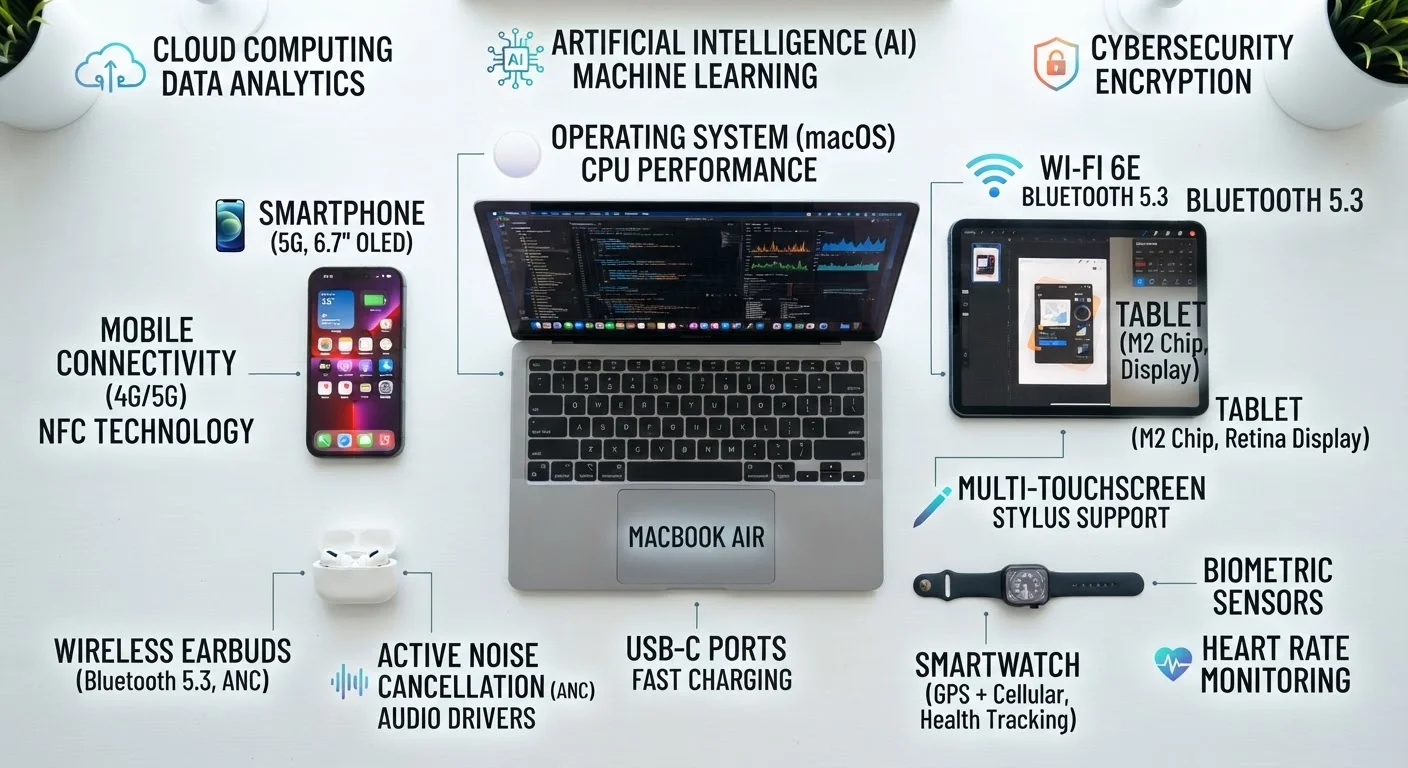
- OS (Operating System): The foundational software layer managing hardware resources and providing the environment in which apps run. Examples include Android, iOS, Windows, and macOS.
- ROM vs. RAM: ROM (Read-Only Memory, now more commonly called internal storage or flash storage) is where your files and apps live permanently. RAM (Random Access Memory) is short-term working memory the processor uses for active tasks - more RAM allows more apps to stay open simultaneously.
- UFS (Universal Flash Storage): A high-speed internal storage standard used in smartphones. UFS 3.1 and UFS 4.0 are significantly faster than older eMMC storage, reducing app load times and file transfer durations.
- Bloatware: Pre-installed apps that come with a device, placed there by manufacturers or carriers. They consume storage and sometimes run in the background, affecting performance.
- Latency: See glossary. In storage contexts, latency refers to the delay between requesting data and receiving it - NVMe SSDs have far lower latency than traditional hard drives.
- Frame Rate (fps): Frames per second - the number of individual images displayed each second in video or games. Higher frame rates produce smoother motion. Note that frame rate is produced by the GPU, while refresh rate is a property of the display hardware.
- Upscaling: Software or hardware processing that increases the apparent resolution of lower-resolution content to better fill a higher-resolution screen. Quality varies by implementation.
Understanding these terms together gives you a clearer lens for evaluating what device specifications actually mean in use, rather than as isolated numbers. For a structured introduction to reading spec sheets as a whole, Everything First-Time Device Shoppers Should Know Before Reading a Spec Sheet provides a grounded starting point.