

Key Takeaways
- A deliberately smaller wardrobe can reduce decision fatigue and simplify daily routines.
- Buying less requires more thoughtful upfront choices about fit, versatility, and quality.
- Gaps in a small wardrobe become more noticeable and harder to ignore than in a large one.
- Clothing care habits matter more when each item carries more weight in your rotation.
- The approach works best when built around your actual lifestyle, not an idealized one.
Fewer decisions reduce daily mental load
When every item in your wardrobe works with most others, getting dressed becomes a faster, lower-stakes process. Decision fatigue is a real cognitive phenomenon, and simplifying the morning routine is a tangible benefit.
You actually wear what you own
A smaller, curated wardrobe closes the gap between what you own and what you reach for. Pieces stop sitting dormant and start earning their place through regular use.
Higher-quality items become financially viable
Buying fewer pieces allows you to spend more per item without increasing overall clothing expenditure. A better-constructed garment worn 80 times delivers more value than a cheaper one worn 8 times.
Clearer personal style emerges over time
Constraint is a useful creative tool. When you cannot rely on volume, you learn faster what silhouettes, fabrics, and colors genuinely work for you - and which you gravitate toward for reasons other than actual preference.
Reduced environmental footprint
Garment production is resource-intensive. Owning and wearing pieces longer - rather than cycling through trends - reduces the frequency of disposal and the demand for new production.
Gaps become immediately visible and disruptive
In a large wardrobe, a missing item type goes unnoticed for months. In a small one, a single piece going out of commission for cleaning or repair can create a real outfit problem with limited workarounds.
Upfront curation requires significant time and effort
Editing a wardrobe honestly - keeping only what fits, works together, and suits your actual lifestyle - is genuinely difficult and time-consuming, particularly if strong sentimental or financial attachment to items is involved.
Less flexibility for varied occasions
A tightly edited wardrobe built for everyday life may leave you underprepared for less frequent events - a formal occasion, an outdoor trip, an unexpected dress code. Anticipating these gaps requires deliberate planning.
Individual item wear increases significantly
Fewer items in rotation means each piece is laundered, handled, and worn more often. Without sound care habits, items may show wear sooner than they would in a larger rotation.
Seasonal transitions require more thought
Managing a small wardrobe across seasons - without doubling in size twice a year - demands a more deliberate strategy around layering, fabric weight, and year-round versatility.
Our Verdict
Owning less clothing and wearing more of what you own is a fundamentally sound approach to building personal style - but it demands honest self-assessment and patience. The clarity and practicality it delivers are real, as are the planning requirements it imposes. It is not a universal prescription, but a discipline that rewards those willing to engage with it seriously.
Ideal for anyone feeling overwhelmed by their current wardrobe, looking to develop a more intentional relationship with clothing, or seeking to reduce the mental overhead of getting dressed each day.
What It Actually Means to Own Less
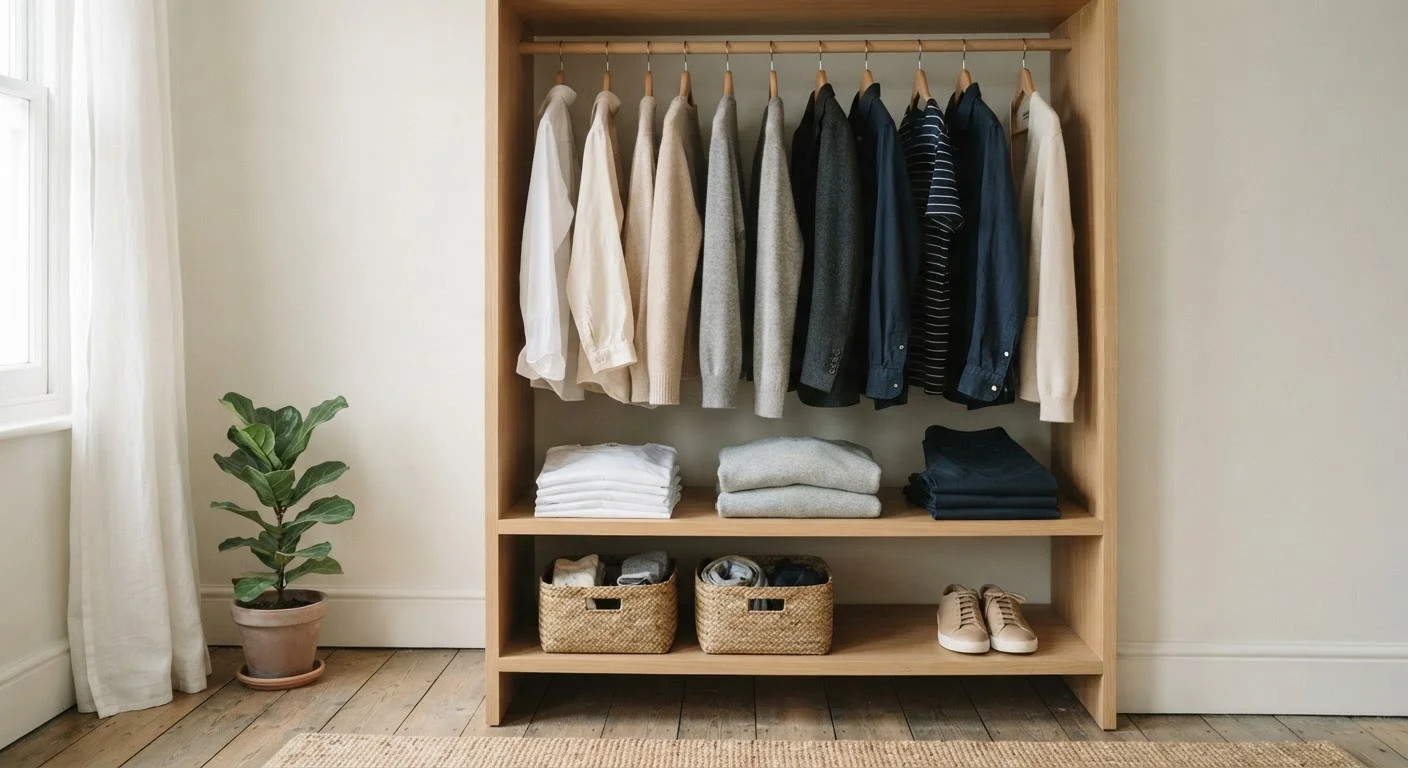
The idea of owning fewer clothes is often framed as a lifestyle statement, but at its core it is a practical strategy: keep only what you actually wear, in pieces that work together. This is not about reaching a specific item count. It is about closing the gap between what hangs in your closet and what appears on your body.
Most people own far more than they use. A wardrobe with 80 items where 20 get worn regularly is, functionally, a 20-item wardrobe with 60 pieces of visual noise. Reducing that noise is the starting point. For a deeper look at the mechanics behind this approach, the capsule wardrobe framework offers a useful structural model.
Fewer decisions reduce daily mental load
When every item in your wardrobe works with most others, getting dressed becomes a faster, lower-stakes process. Decision fatigue is a real cognitive phenomenon, and simplifying the morning routine is a tangible benefit.
You actually wear what you own
A smaller, curated wardrobe closes the gap between what you own and what you reach for. Pieces stop sitting dormant and start earning their place through regular use.
Higher-quality items become financially viable
Buying fewer pieces allows you to spend more per item without increasing overall clothing expenditure. A better-constructed garment worn 80 times delivers more value than a cheaper one worn 8 times.
Clearer personal style emerges over time
Constraint is a useful creative tool. When you cannot rely on volume, you learn faster what silhouettes, fabrics, and colors genuinely work for you - and which you gravitate toward for reasons other than actual preference.
Reduced environmental footprint
Garment production is resource-intensive. Owning and wearing pieces longer - rather than cycling through trends - reduces the frequency of disposal and the demand for new production.
The Real Costs of Owning Less
A smaller wardrobe removes certain problems while introducing others. The tradeoffs are worth understanding before committing to the approach.
Gaps become immediately visible and disruptive
In a large wardrobe, a missing item type goes unnoticed for months. In a small one, a single piece going out of commission for cleaning or repair can create a real outfit problem with limited workarounds.
Upfront curation requires significant time and effort
Editing a wardrobe honestly - keeping only what fits, works together, and suits your actual lifestyle - is genuinely difficult and time-consuming, particularly if strong sentimental or financial attachment to items is involved.
Less flexibility for varied occasions
A tightly edited wardrobe built for everyday life may leave you underprepared for less frequent events - a formal occasion, an outdoor trip, an unexpected dress code. Anticipating these gaps requires deliberate planning.
Individual item wear increases significantly
Fewer items in rotation means each piece is laundered, handled, and worn more often. Without sound care habits, items may show wear sooner than they would in a larger rotation.
Seasonal transitions require more thought
Managing a small wardrobe across seasons - without doubling in size twice a year - demands a more deliberate strategy around layering, fabric weight, and year-round versatility.
Versatility also depends heavily on fit and color strategy. Pieces that don't work together - regardless of individual quality - undermine the whole system. Neutral colors earn their place precisely because they function as connective tissue between other items. Similarly, fit matters more than size - a well-fitting piece works harder than a poorly fitting one regardless of how versatile it's supposed to be.
Making a Small Wardrobe Actually Work
The practical success of a smaller wardrobe depends less on how many items you own and more on how well those items reflect your real life. A common failure mode is building a wardrobe around an aspirational lifestyle rather than an actual one - filling a small closet with pieces suited for occasions that rarely occur.
~20%
Clothes worn regularly from a typical wardrobe
Clothing industry observers and wardrobe researchers have long noted the rough pattern that most people regularly wear only a small fraction of what they own, though exact figures vary by individual.
3-4x
Cost-per-wear reduction from higher use
A garment's cost-per-wear drops significantly the more often it is worn - a useful framework for evaluating whether a more expensive piece represents better long-term value.
Care habits also become more consequential. When a single item appears in rotation every few days, how you wash, dry, and store it directly affects how long it lasts. Practical clothing care habits are worth reviewing before you commit to fewer, higher-use pieces.
If you are starting from scratch rather than editing an existing wardrobe, building a starter wardrobe from the ground up walks through how to approach initial selections with versatility and longevity in mind. And if impulsive or trend-driven buying has shaped your current wardrobe, it is worth reading about how shopping habits can overshadow personal style - understanding the pattern is the first step to changing it.
This Approach Looks Different for Everyone
A small wardrobe for someone with a highly variable lifestyle - frequent travel, mixed dress codes, active outdoor pursuits - will necessarily look different from one built around a single consistent context. The goal is not a particular item count but a high ratio of worn-to-owned. There is no single correct version of this approach, and applying someone else's exact formula to your own life is one of the most common reasons the strategy fails.