

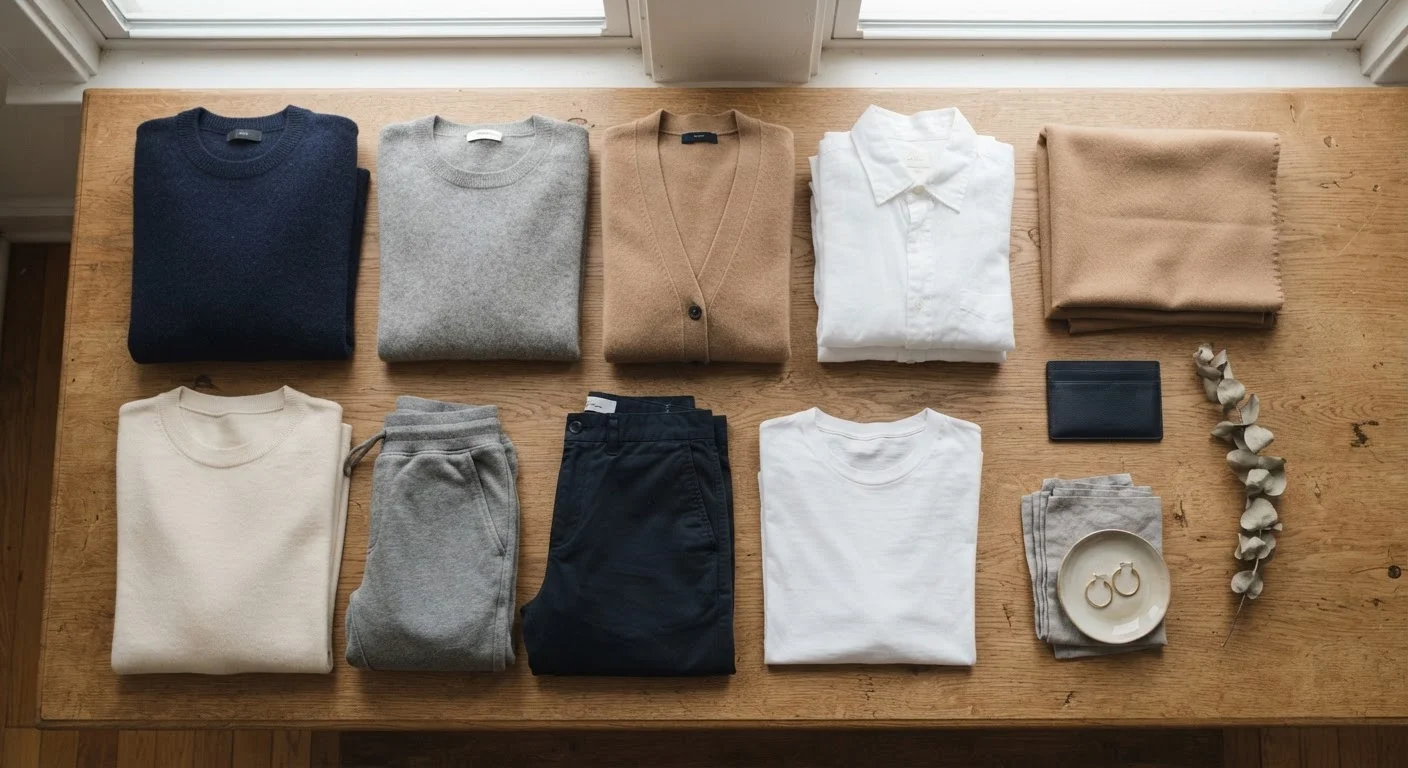
Key Takeaways
- Neutral colors - white, grey, navy, camel, black - act as connective tissue between wardrobe pieces.
- Near-neutrals like navy and camel offer more visual interest than true neutrals while retaining versatility.
- A neutral foundation reduces daily decision fatigue and lowers the barrier to building outfits.
- Neutrals work because they don't compete with one another, allowing texture and fit to carry visual weight.
- A wardrobe anchored in neutrals can accommodate accent pieces without requiring an entirely new color system.
Neutral Colors in a Wardrobe
Neutral colors are a core group of hues - including white, black, grey, navy, beige, camel, and cream - that pair readily with virtually any other color or pattern. Unlike accent colors, neutrals don't compete for visual attention; instead, they create cohesion across an outfit. They function as the connective tissue of a wardrobe, making it easier to combine pieces and expand outfit options without buying more.
In color theory, true neutrals (black, white, grey) are achromatic - they lack hue saturation. Wardrobe neutrals like navy and camel are considered near-neutrals: low-saturation colors that behave like neutrals in practical styling contexts.
Why Neutrals Deserve More Credit Than They Get
The word "neutral" gets misread as "safe" or "unimaginative," but in practical wardrobe-building terms, neutral colors do something active and deliberate: they create the conditions for other pieces to work together. A navy trouser doesn't just exist on its own - it connects a white shirt to a camel blazer. That connective function is exactly what makes neutrals strategic rather than passive.
This is particularly relevant when thinking about a capsule wardrobe - a curated collection of versatile pieces designed to maximize outfit options while minimizing volume. Neutrals are the backbone of that approach. Without them, individual pieces risk becoming wardrobe orphans: well-made items that simply don't connect to anything else you own.
Neutrals Are Not One-Size-Fits-All
The specific neutrals that work best can vary by skin tone, climate, and lifestyle. Warm-toned individuals may find ivory and camel more flattering than stark white or cool grey. Those in warmer climates may reach for linen beiges over heavy charcoal wools. Treat the concept of 'neutral foundation' as a framework, not a fixed prescription - the specific colors within it should reflect your actual context.
The Difference Between True Neutrals and Near-Neutrals
Not every neutral behaves the same way. True neutrals - black, white, and grey - are achromatic, meaning they carry no hue. They pair with virtually everything because there's no color conflict to manage. Near-neutrals like navy, camel, olive, and burgundy carry a distinct hue but are low enough in saturation that they function like neutrals in practice. They're often considered the more interesting choice because they add warmth, depth, or richness without creating the visual tension that more saturated colors might.
Navy, for instance, reads as a neutral across many professional and casual contexts. Camel performs similarly - it adds warmth to a grey or white outfit without asserting itself as an accent color. Understanding this spectrum helps when coordinating colors across an outfit without formal training in color theory.
~30%
Clothing worn regularly in the average wardrobe
Research from wardrobe audit studies frequently finds that most people regularly wear only a fraction of what they own, often citing difficulty combining pieces as a key barrier.
5-7
Core neutral tones that cover most wardrobe needs
Style educators and wardrobe consultants commonly identify a set of five to seven neutrals - black, white, grey, navy, camel, cream, and sometimes olive - as sufficient to anchor a functional, coordinated wardrobe.
How Neutrals Function Within a Real Wardrobe
The practical value of neutrals becomes clearest when you track how individual pieces interact. A grey crewneck sweater might pair with navy chinos, dark denim, khaki trousers, or black joggers - without any deliberate effort. That's a single item producing multiple outfit combinations across different tones. Compare that to a cobalt blue sweater, which pairs well but requires more intentional coordination to avoid clashing.
This cross-compatibility is why style fundamentals consistently recommend building a wardrobe foundation in neutral tones before adding accent pieces. The foundation items do the heavy lifting; accent pieces layer on top without needing to double as connectors.
Start With One Neutral at a Time
If you're transitioning toward a more neutral-anchored wardrobe, resist the urge to overhaul everything at once. Identify one gap - perhaps outerwear or trousers - and replace the next purchase in that category with a neutral. Over time, the cumulative effect on outfit flexibility will become evident without requiring a full wardrobe reset.
For anyone building a wardrobe from the ground up, prioritizing neutral foundations first often produces the fastest return in terms of outfit flexibility. Each neutral item added increases the utility of every other neutral already in the closet.
The Role Neutrals Play in Reducing Decision Fatigue
There's a functional, cognitive benefit to a neutral-anchored wardrobe that often goes unmentioned: fewer decisions in the morning. When most items share a common color logic, the mental work of building an outfit decreases significantly. Pieces don't need to be auditioned for compatibility - they already belong to a coherent system.
This doesn't mean eliminating variety. Texture, silhouette, and fit all carry significant visual weight in a neutral palette. A chunky wool knit and a fine-gauge merino in the same grey carry completely different visual registers. Mixing these elements within a neutral palette is what keeps the approach from reading as monotonous.
The broader argument for owning fewer, more versatile pieces is explored in detail in the case for buying less and wearing more - and neutrals are central to that logic. Items that work with everything you own are, by definition, worth more to your wardrobe than items that require specific partners to function.