

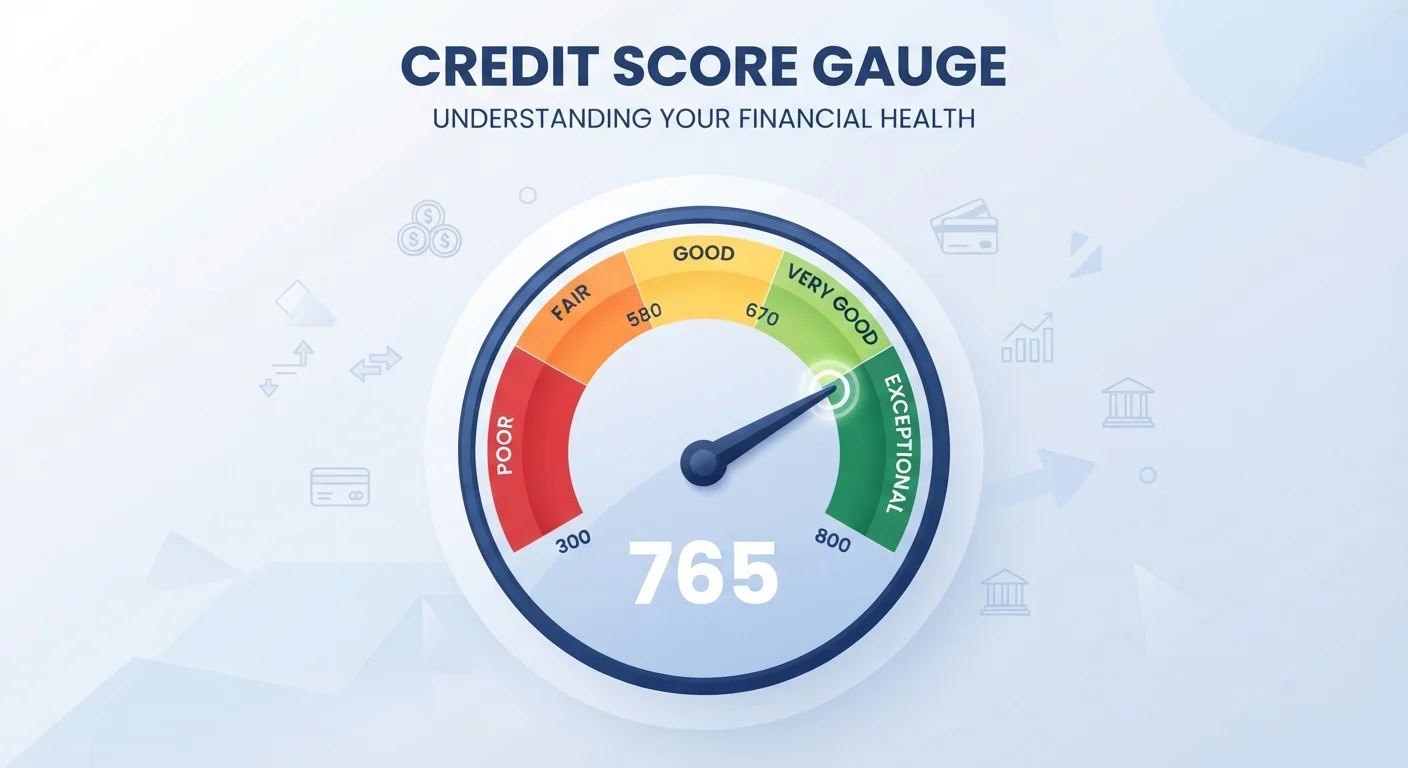
The Credit Score Scale at a Glance
Credit scores in the United States most commonly run from 300 to 850. That 550-point span is divided into tiers that lenders use as a quick signal of repayment risk. Understanding where you fall - and what that tier communicates - is the foundation of smarter borrowing decisions.
Two scoring models dominate the market: FICO and VantageScore. Both use the 300-850 range, but their tier labels and cutoff points differ slightly. The table below reflects broadly accepted ranges that apply to standard FICO models, which most major lenders still use for credit decisions. For a deeper look at how these two models diverge, see FICO Score vs. VantageScore: Two Models, One Credit File.
| Score Range | FICO Tier | General Interpretation |
|---|---|---|
| 800-850 | Exceptional | Strongest approval odds; most favorable terms available |
| 740-799 | Very Good | Near-top terms; minimal friction with most lenders |
| 670-739 | Good | Near or above average; competitive rates generally accessible |
| 580-669 | Fair | Approval possible but with higher rates or stricter terms |
| 300-579 | Poor | Significant difficulty qualifying; secured or alternative products often required |
This article is for general educational purposes only and does not constitute personalized financial advice. Consult a licensed financial professional for guidance specific to your situation.
What Each Tier Signals to Lenders
Lenders don't just see a number - they see a risk category. Here's what each tier typically communicates:
Exceptional (800-850)
Borrowers in this range have a long record of on-time payments, low credit utilization, and minimal recent inquiries. Lenders view them as very low risk. While this tier generally unlocks the most favorable interest rates and terms available, it doesn't guarantee any specific offer - lenders consider income, debt load, and other factors too.
Very Good (740-799)
This tier reflects consistent, responsible credit behavior. Most borrowers here qualify for competitive rates and encounter little resistance from mainstream lenders. The gap between this tier and Exceptional is often smaller than consumers expect.
Good (670-739)
Scores in this range are at or above the national average. Lenders generally view these borrowers as acceptable risk, though interest rates may be modestly higher than those offered to Very Good or Exceptional borrowers.
Fair (580-669)
This tier often reflects past credit challenges - late payments, high utilization, or limited history. Approval is possible but may come with higher rates, lower credit limits, or requirements such as a co-signer. Credit-building tools like secured cards and credit-builder loans can help borrowers move upward from this range.
Poor (300-579)
Borrowers here face the most restricted access to credit. Traditional unsecured loans and credit cards are difficult to obtain. Rebuilding typically requires addressing the underlying issues on the credit report - a process detailed in Reading Your Credit Report for the First Time.
Credit Score
A three-digit number, typically ranging from 300 to 850, that summarizes a borrower's creditworthiness based on information in their credit report. Higher scores indicate lower perceived risk to lenders.
FICO Score
A credit scoring model developed by Fair Isaac Corporation and widely used by lenders. It weighs payment history, amounts owed, length of credit history, new credit, and credit mix.
VantageScore
A credit scoring model created collaboratively by the three major credit bureaus (Equifax, Experian, and TransUnion). It uses the same 300-850 scale as FICO but applies different weightings to credit factors.
Credit Utilization
The ratio of a borrower's revolving credit balances to their total available revolving credit limits. Lower utilization generally has a positive effect on credit scores.
Credit Tier
A labeled band within the credit score range (such as Fair, Good, or Exceptional) used by lenders and scoring models to categorize borrower risk levels.
Debt-to-Income Ratio
A measure comparing a borrower's total monthly debt payments to their gross monthly income. Lenders use this alongside credit scores to assess repayment capacity.
Why the Exact Cutoffs Aren't Rigid
Credit score tiers are guideposts, not hard gates. Individual lenders set their own internal thresholds, which can differ meaningfully from published ranges. A mortgage lender may require a minimum score of 620 for a conventional loan, while an auto lender may approve borrowers at 580 with adjusted terms. Some lenders in the subprime market serve borrowers well below 580, though typically at significantly higher cost.
Lender Thresholds Vary by Product
Published credit score tiers are industry conventions, not universal rules. Each lender sets its own minimum score requirements, and those thresholds differ by loan type - a personal loan, auto loan, and mortgage may each carry different cutoffs at the same institution. Always verify requirements directly with the lender before applying.
Score alone also rarely tells the whole story. Lenders weigh income, existing debt obligations, employment history, and the specific product being applied for. A 700 score paired with a high debt-to-income ratio may fare worse than a 680 score with a clean financial picture.
Understanding the factors that produce your score is equally important. Payment history, credit utilization, account age, credit mix, and new inquiries each carry different weight - and knowing which levers to pull makes improving your score more strategic. For a broader look at what scores do and don't reflect, see What Your Credit Score Actually Measures - and What It Doesn't.