

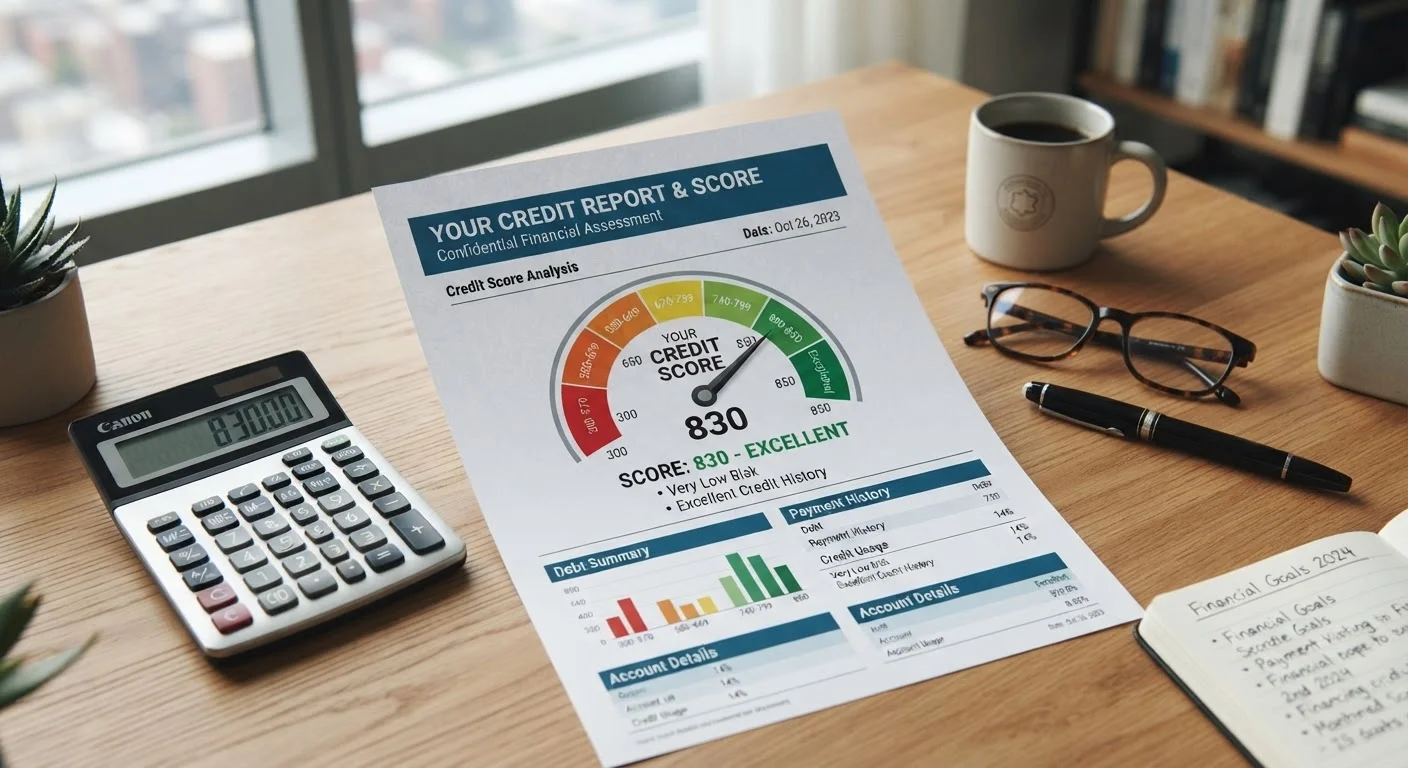
| Payment History Weight | ≈35% of FICO score (myFICO.com, FICO score factor breakdown) |
| Credit Utilization Weight | ≈30% of FICO score (myFICO.com, FICO score factor breakdown) |
| Length of Credit History Weight | ≈15% of FICO score (myFICO.com, FICO score factor breakdown) |
| Credit Mix Weight | ≈10% of FICO score (myFICO.com, FICO score factor breakdown) |
| New Inquiries Weight | ≈10% of FICO score (myFICO.com, FICO score factor breakdown) |
| Late Payment Reporting Window | Up to 7 years on credit file (Fair Credit Reporting Act (FCRA)) |
| Recommended Utilization Threshold | Below 30% (lower is better) (General industry guidance; no single published standard) |
| Rate-Shopping Inquiry Window | 14-45 days (model dependent) (FICO and VantageScore published documentation) |
How Credit Scores Are Built
Your credit score is not a single judgment call - it's a calculated output based on five distinct categories of information pulled from your credit file. Each category carries a different weight, meaning some decisions you make have a far larger impact on your score than others. Understanding how those weights break down is the first step toward managing your credit more deliberately.
The most widely used scoring model, FICO, assigns approximate percentage weights to each factor. VantageScore uses similar categories but applies slightly different weightings. For a side-by-side comparison of both models, see FICO Score vs. VantageScore. This article focuses on the five universal factors and what each one actually measures.
| Payment History Weight | ≈35% of FICO score (myFICO.com, FICO score factor breakdown) |
| Credit Utilization Weight | ≈30% of FICO score (myFICO.com, FICO score factor breakdown) |
| Length of Credit History Weight | ≈15% of FICO score (myFICO.com, FICO score factor breakdown) |
| Credit Mix Weight | ≈10% of FICO score (myFICO.com, FICO score factor breakdown) |
| New Inquiries Weight | ≈10% of FICO score (myFICO.com, FICO score factor breakdown) |
| Late Payment Reporting Window | Up to 7 years on credit file (Fair Credit Reporting Act (FCRA)) |
| Recommended Utilization Threshold | Below 30% (lower is better) (General industry guidance; no single published standard) |
| Rate-Shopping Inquiry Window | 14-45 days (model dependent) (FICO and VantageScore published documentation) |
The Five Factors Explained
1. Payment History (≈35%)
The single largest factor is whether you pay your bills on time. Even one missed payment - particularly one reported 30 or more days late - can meaningfully lower your score. The impact of a late payment diminishes over time but can remain on your report for up to seven years. Consistent, on-time payments are the most reliable way to build and protect your score.
2. Credit Utilization (≈30%)
Utilization measures how much of your available revolving credit you're currently using. If your total credit card limits add up to $10,000 and your balances total $3,000, your utilization is 30%. Scoring models generally reward keeping this ratio below 30%, and lower is typically better. Importantly, utilization is recalculated every scoring cycle, so paying down balances can improve your score relatively quickly. Why utilization trips up even careful borrowers covers the common pitfalls in detail.
3. Length of Credit History (≈15%)
Scoring models favor longer credit histories because they provide more data about your borrowing behavior. This factor considers the age of your oldest account, your newest account, and the average age of all accounts. Closing an old card you no longer use can shorten your average account age and increase your utilization ratio simultaneously - two unintended consequences worth weighing before you cancel.
4. Credit Mix (≈10%)
Having experience with different types of credit - revolving accounts like credit cards and installment loans like auto or student loans - can modestly benefit your score. Lenders view borrowers who have managed multiple credit types responsibly as lower risk. That said, this factor carries less weight than the first two, so opening new accounts solely to diversify your mix is rarely worth the short-term cost.
5. New Credit Inquiries (≈10%)
Each time you apply for credit, a hard inquiry is recorded on your file. A single inquiry typically has a small, temporary effect. However, several applications in a short period can signal financial stress to lenders. Rate-shopping for mortgages or auto loans is generally treated as a single inquiry if applications occur within a 14-45 day window, depending on the scoring model.
Hard Inquiry
A record created on your credit file when a lender or creditor checks your credit as part of an application decision. Hard inquiries can temporarily lower your score by a small amount.
Credit Utilization Ratio
The percentage of your total available revolving credit that you are currently using. It is calculated by dividing total balances by total credit limits across all revolving accounts.
Revolving Credit
A type of credit account - such as a credit card or home equity line - that allows repeated borrowing up to a set limit, with balances that can vary from month to month.
Installment Loan
A loan repaid in fixed, scheduled payments over a set term. Auto loans, mortgages, student loans, and personal loans are common examples.
Credit Mix
The variety of credit account types appearing in your credit file, including revolving accounts and installment loans. A diverse mix can modestly benefit your credit score.
Average Account Age
The mean age of all open credit accounts on your credit report. Scoring models use this, along with the age of your oldest and newest accounts, to assess your credit history length.
Putting It All Together
Because payment history and utilization together account for roughly 65% of a FICO score, those two areas deserve the most attention. Automating payments eliminates the risk of forgetting a due date, and paying card balances in full each month keeps utilization low. Progress on these two fronts alone can produce meaningful score improvement over time.
The remaining 35% - credit age, mix, and new inquiries - matters, but is less immediately actionable. The most practical rule: avoid unnecessary account closures and new credit applications unless you have a clear purpose for them.
For a broader view of what your score does and doesn't capture about your financial life, see What Your Credit Score Actually Measures. And if you want to verify that the data driving your score is accurate, Reading Your Credit Report for the First Time walks through how to interpret each section of your report.
Your Score Can Change Every Month
Credit scores are recalculated each time a lender requests them, using the data in your credit file at that moment. Because balances and account statuses update regularly, your score is not static - it can shift up or down from one month to the next. This also means that paying down balances or resolving errors can show up in your score sooner than many people expect.
This article is for general informational purposes only and does not constitute personalized financial or credit advice. Consult a licensed financial professional for guidance tailored to your situation.