

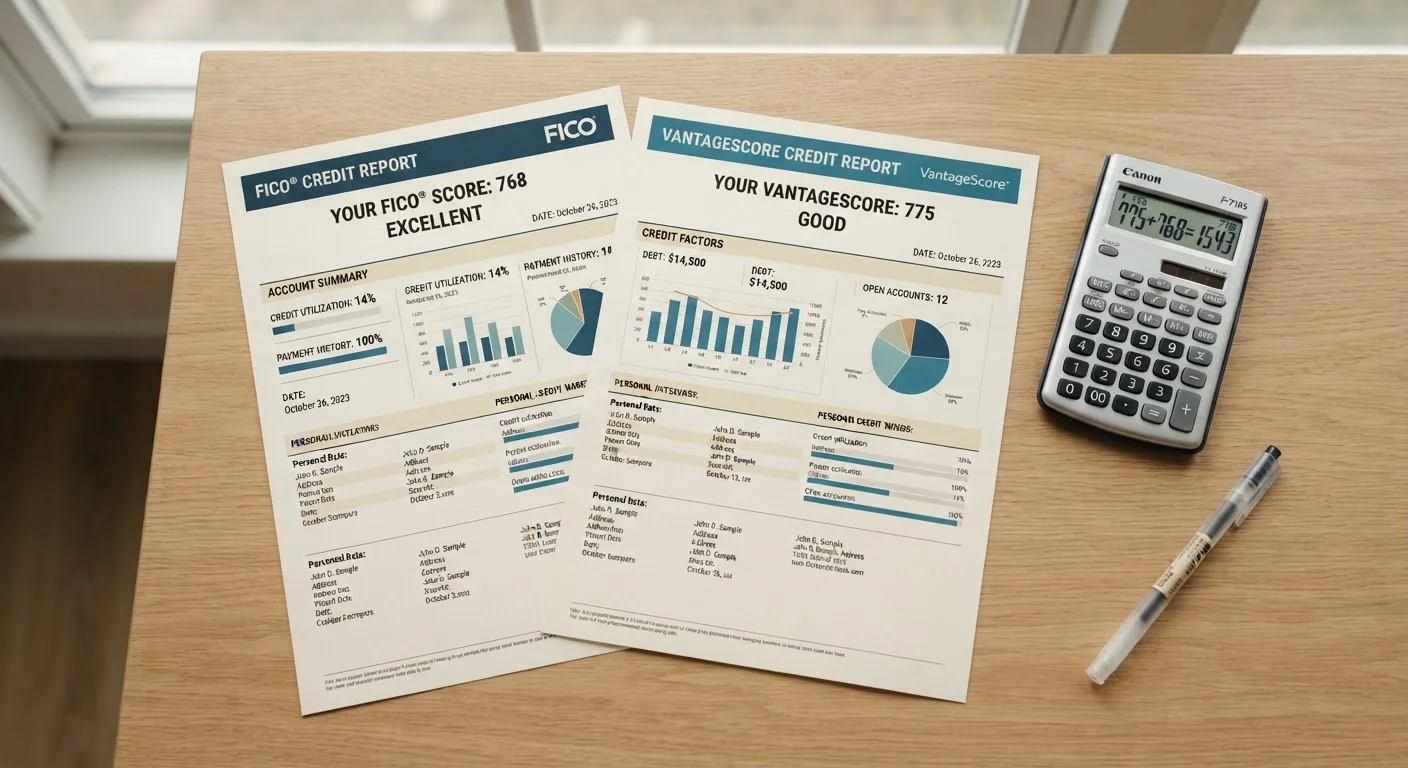
Key Takeaways
- FICO and VantageScore both use a 300-850 range but weigh credit factors differently.
- FICO requires at least six months of credit history; VantageScore can score files with as little as one month.
- Most mortgage and auto lenders rely on FICO, while free credit monitoring services commonly use VantageScore.
- Your scores across both models may differ by several points - this is normal and expected.
- Responsible credit habits - on-time payments and low utilization - improve both scores simultaneously.
- Neither score alone determines loan approval; lenders also consider income, debt-to-income ratio, and other factors.
Option A
FICO Score
The long-established standard used by the vast majority of lenders.
Best for: Anyone applying for a mortgage, auto loan, or credit card where lender-specific scoring requirements apply.
Option B
VantageScore
The newer, increasingly accessible model built for broader credit inclusion.
Best for: Consumers monitoring their credit health through free tools, or those with limited credit history who benefit from alternative data.
If you're preparing to apply for a mortgage or auto loan
FICO Score
Most mortgage lenders are required to use FICO scores, and auto lenders overwhelmingly pull FICO as well. Knowing your FICO score before applying gives you the most relevant benchmark.
If you want to monitor your credit for free on a regular basis
VantageScore
Many free credit monitoring platforms - including those offered by banks and personal finance apps - display VantageScore. It's a consistent, accessible way to track trends over time.
If you have a thin credit file or are new to credit
VantageScore
VantageScore's lower history threshold means it can generate a score for files FICO cannot yet evaluate, giving newer borrowers earlier visibility into their standing.
If you're focused on rebuilding after past credit problems
FICO Score
Since most creditors underwriting significant lending decisions use FICO, tracking your FICO recovery progress ensures you're watching the number that will matter most when you apply.
Two Models, One Purpose
When a lender checks your credit, they're asking a fundamental question: how likely is this person to repay what they borrow? Credit scoring models convert your credit history into a three-digit number designed to answer that question quickly. FICO and VantageScore are the two dominant models, and while they share the same 300-850 scale, they were built by different organizations using different methodologies.
FICO - created by Fair Isaac Corporation - has been in use since 1989 and remains the score most lenders pull when making significant credit decisions. VantageScore was developed jointly by the three major credit bureaus (Equifax, Experian, and TransUnion) and launched in 2006, partly to offer an alternative that could score a broader population. Understanding what a credit score actually measures is essential context before comparing how these two models operate.
How the Two Models Weigh Your Credit Factors
Both models analyze the same underlying data - your payment history, amounts owed, length of credit history, new credit inquiries, and credit mix - but they assign different weights to each factor and handle edge cases differently.
| Criterion | FICO Score | VantageScore |
|---|---|---|
| Developer | Fair Isaac Corporation | Equifax, Experian & TransUnion |
| First introduced | 1989 | 2006 |
| Score range | 300-850 | 300-850 |
| Minimum credit history required | 6 months of activity | As little as 1 month |
| Heaviest-weighted factor | Payment history (~35%) | Payment history (~40%) |
| Where commonly seen | Mortgage & auto lenders | Free monitoring apps & bureaus |
| Versions in active use | Multiple (FICO 8, 9, 10, etc.) | VantageScore 3.0 and 4.0 |
One of the most meaningful differences involves minimum scoring requirements. FICO requires at least one account that is six months old and has been reported to a bureau within the past six months. VantageScore can generate a score with as little as one month of history and one account reported within the past two years. This makes VantageScore more useful for consumers with thin credit files. For more on how utilization - one of the most volatile scoring factors - functions within both models, see our guide on why credit utilization trips up even careful borrowers.
Where Each Score Appears in Real Life
The score you see when you log into a free credit monitoring app is almost always a VantageScore. Many bank apps, personal finance platforms, and bureau websites display VantageScore because the bureaus that own it make it widely available. That visibility is genuinely useful for tracking trends - but it's not necessarily the score a lender will use.
90%+
Top lenders using FICO scores
According to FICO's own published figures, more than 90% of top U.S. lenders use FICO scores in their credit decisioning processes.
2,600+
Financial institutions using VantageScore
VantageScore has reported that over 2,600 financial institutions and other users incorporate VantageScore into various credit decisions and monitoring products.
Mortgage lenders in the United States are currently required to use specific FICO score versions under guidelines from government-sponsored enterprises like Fannie Mae and Freddie Mac. Auto lenders and credit card issuers similarly lean on FICO, though some are beginning to incorporate VantageScore into their decisioning. Knowing which score a lender uses before you apply helps you monitor the right number. {{link:/personal-finance/credit-and-banking/credit-score-ranges-decoded-from-poor-to-exceptional|Credit score ranges decoded from poor to exceptional|Credit score ranges decoded} explains how those tiers translate into lender perceptions under both models.
This article is for general informational and educational purposes only and does not constitute personalized financial or credit advice. Consult a licensed financial professional for guidance specific to your situation.
Building Credit That Works Across Both Models
Because both models draw on the same credit file, the habits that strengthen one score generally strengthen the other. Paying every bill on time, keeping revolving balances well below credit limits, avoiding unnecessary new credit applications, and maintaining a mix of account types all contribute positively to both FICO and VantageScore calculations.
Score Differences Are Normal - Not a Problem
It's common for your FICO score and VantageScore to differ by anywhere from a few points to 30 or more. This doesn't mean one is wrong. Each model applies its own formula to the same underlying data, and different FICO versions (FICO 8 vs. FICO 9, for example) can also produce different results. Rather than worrying about discrepancies, focus on the behaviors that improve both scores consistently over time.
For consumers starting from scratch or recovering from past difficulties, tools like secured cards, credit-builder loans, and authorized user arrangements can help establish or rebuild the file that both models read. Our comparison of secured cards, credit-builder loans, and authorized user status walks through how each approach works and what trade-offs to consider.
The key practical insight: don't fixate on small point differences between your FICO and VantageScore readings. A gap of 10-30 points between the two is common and expected given the different algorithms. Focus instead on the directional trend - are your scores moving up over time? - and on understanding which score your next lender is most likely to pull.