

Key Takeaways
- A credit score measures repayment behavior, not wealth, income, or overall financial health.
- Payment history and credit utilization together account for roughly 65% of a FICO score.
- Your score does not reflect your savings, net worth, employment history, or spending habits.
- Different scoring models may produce different numbers from the same credit file.
- Errors on your credit report can lower your score - reviewing it regularly is worthwhile.
Credit Score
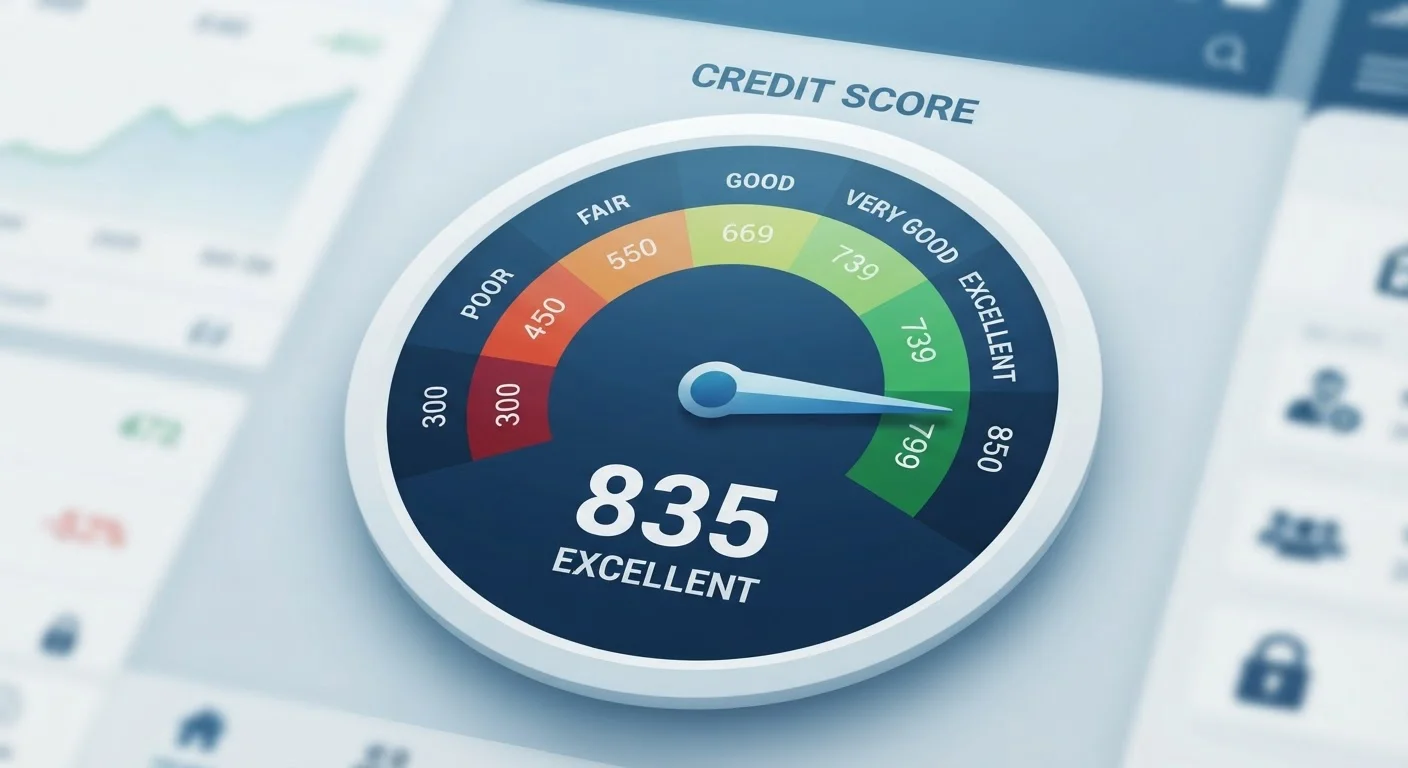
A credit score is a three-digit number, typically ranging from 300 to 850, that summarizes how reliably you've managed borrowed money based on your credit history. Lenders use it to quickly assess the likelihood that you'll repay a new debt on time. The higher the score, the lower the perceived risk you represent to a lender.
Most scores are generated by statistical models - most commonly FICO or VantageScore - that analyze data from your credit report at one of the three major bureaus: Equifax, Experian, or TransUnion.
The Five Inputs Behind the Number
A credit score isn't a mystery - it's a formula. Under the widely used FICO model, five factors drive the calculation, and they're not weighted equally. Understanding what goes in helps you understand what the output actually means.
Payment history carries the most weight, accounting for approximately 35% of a FICO score. It answers a simple question: have you paid your bills on time? Even one missed payment can leave a mark that lingers for years. Credit utilization - the share of your available revolving credit you're currently using - follows at around 30%. Together, these two factors account for nearly two-thirds of your score. See how each factor is weighted for a deeper breakdown of all five inputs.
The remaining weight is split among the length of your credit history (15%), your mix of credit types such as cards, loans, and mortgages (10%), and recent applications for new credit (10%). Each factor tells a piece of a story about how you handle financial obligations.
35%
Weight of payment history in FICO score
According to FICO, payment history is the single largest factor in the standard FICO score calculation.
~200M
Americans with a scoreable credit file
The Consumer Financial Protection Bureau estimates roughly 200 million Americans have a credit file at one of the major bureaus.
300-850
Range of most standard credit scores
Both FICO and VantageScore use this range, with higher scores indicating lower credit risk to lenders.
What a Credit Score Genuinely Does Not Reflect
This is where most misunderstandings take root. A credit score is not a measure of financial wellness - it's a measure of credit behavior. Several things that feel financially relevant are entirely absent from the calculation.
- Income and wealth: A surgeon with a history of maxing out credit cards and missing payments can score lower than a teacher who has managed a single card responsibly for a decade.
- Savings and investments: Your 401(k) balance, emergency fund, or brokerage account are invisible to scoring models.
- Spending habits: How much you spend on groceries, subscriptions, or dining out doesn't appear in your credit file.
- Employment status: Whether you're employed, self-employed, or between jobs has no direct effect on your score.
This distinction matters because a good credit score doesn't automatically mean someone is in strong financial shape - and a temporarily lower score doesn't mean someone is irresponsible with money. Credit score ranges decoded can help you understand what lenders actually infer from each tier.
Your Score Can Vary by Bureau
Because not all creditors report to every bureau, your score may differ depending on which bureau a lender pulls. A difference of 10-20 points between bureaus is common and doesn't indicate an error. If you see a large discrepancy, it's worth pulling your full report from each bureau to compare the underlying data.
How Lenders Actually Use the Score
Lenders use your score as a risk filter - a quick signal about the probability of default, not a complete picture of you as a borrower. A mortgage lender, for example, will use your score to determine whether you qualify and at what interest rate. A higher score typically unlocks lower rates, which compounds into meaningful savings over a loan's lifetime.
But lenders almost never rely on the score alone. They also examine your full credit report, debt-to-income ratio, employment verification, and the purpose of the loan. Your score opens or closes the door; everything else fills in the context. For a closer look at what's actually in that report, see reading your credit report for the first time.
It's also worth noting that different scoring models exist. A lender pulling a mortgage-specific FICO score may see a different number than the one a credit card issuer uses. FICO vs. VantageScore explains how the two dominant models diverge and when each is applied.
Common Behaviors That Move the Number
Because the score is formula-driven, it responds predictably to specific behaviors. Paying every bill on time, keeping revolving balances well below credit limits, and avoiding a flurry of new credit applications are the most reliable ways to build and protect a score over time.
Credit utilization is especially reactive. Carrying a high balance one month can pull your score down quickly - and paying it down can bring it back up just as fast. Why credit utilization trips up even careful borrowers explains the mechanics behind this and the common mistakes people make.
One practical habit worth developing: review your credit report at least once a year. Errors - such as accounts that aren't yours or payments incorrectly marked late - can suppress your score without your knowledge. You're entitled to a free report from each of the three major bureaus annually through AnnualCreditReport.com.
Dispute Errors Before Applying for Credit
If you spot an inaccuracy on your credit report - such as a payment marked late that you paid on time - file a dispute with the relevant bureau before applying for a major loan. Correcting an error can take 30-45 days, and resolving it in advance avoids having an avoidable ding affect your rate or approval odds.
This article is for general informational and educational purposes only and does not constitute personalized financial or legal advice. Consult a qualified financial professional for guidance specific to your situation.