

Key Takeaways
- Fatal crash rates at night are significantly higher than during daylight, even with less traffic on the road.
- Human vision degrades substantially in low light, affecting depth perception, peripheral awareness, and reaction time.
- Properly aimed headlights, clean windshields, and adjusted speed are foundational night-driving habits.
- Fatigue compounds night-vision limitations - recognizing drowsiness early is a critical safety step.
- Small vehicle maintenance tasks, like replacing dim bulbs, can meaningfully expand your sight distance after dark.
Why Night Driving Is Disproportionately Dangerous
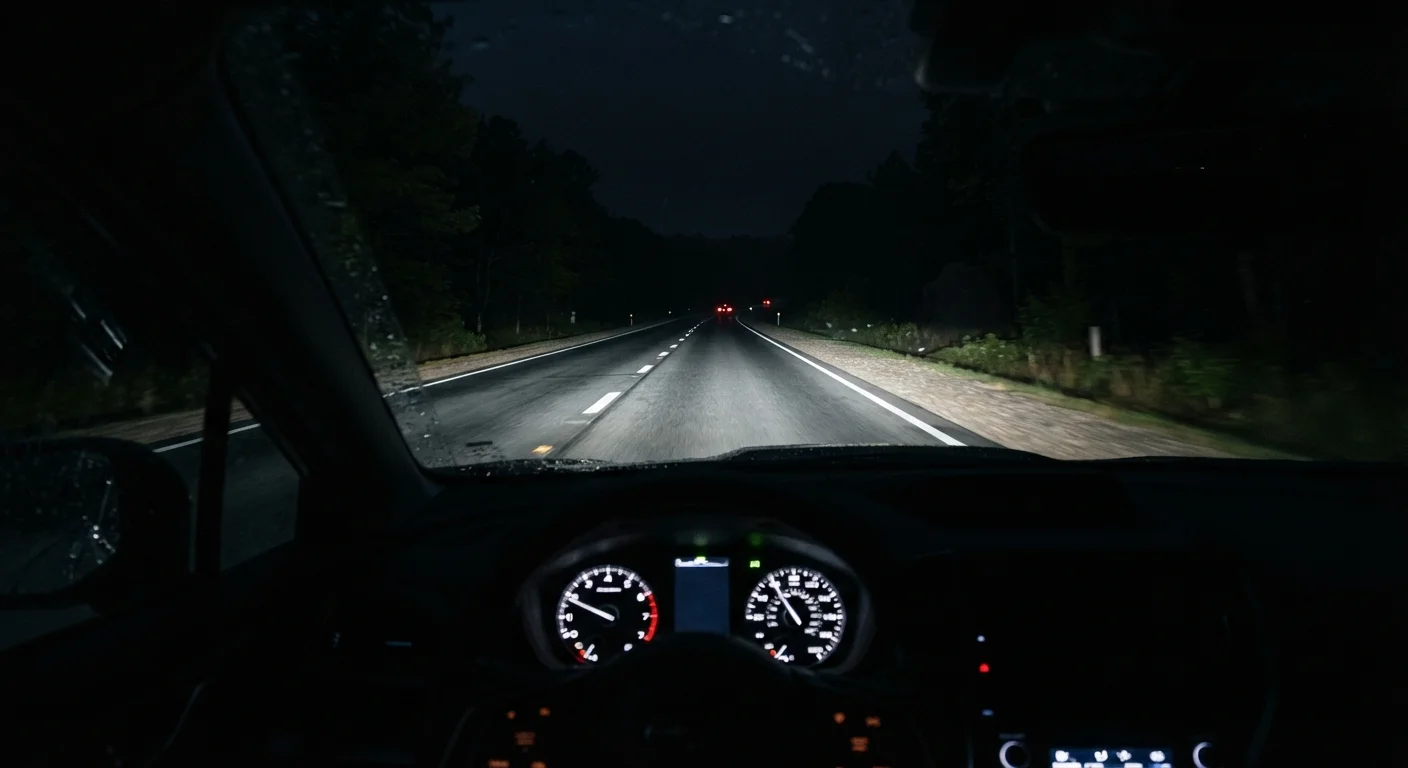
Most drivers know that driving at night feels different - but the degree of added risk is often underestimated. According to the National Safety Council, roughly half of all traffic fatalities occur at night, despite nighttime accounting for a much smaller share of total miles driven. The math points to a clear conclusion: darkness amplifies risk in ways that go well beyond simply not seeing as far ahead.
The core problem is biological. The human eye is optimized for daylight. In low-light conditions, the eye shifts from cone-based (color, fine detail) to rod-based (motion, peripheral) vision. Depth perception weakens, color contrast collapses, and peripheral awareness narrows. Older drivers are particularly affected - a 50-year-old may need roughly twice as much light to see clearly as a 30-year-old, due to natural changes in the eye's lens and pupil responsiveness.
Add to this the hazard profile of nighttime roads - higher rates of impaired driving, more fatigued drivers, unlit pedestrians and cyclists - and the picture becomes clear. Understanding the specific mechanics of night-vision limitation is the starting point for building habits that address them.
~50%
of traffic fatalities occur at night
According to the National Safety Council, roughly half of all traffic deaths happen in darkness despite nighttime representing a minority of total driving miles.
2×
more light needed by older drivers
Vision researchers have noted that by around age 50, drivers may require approximately twice as much ambient light to see as clearly as they could at age 30, due to changes in lens and pupil function.
Vehicle Maintenance That Directly Affects Night Visibility
Before adjusting any driving habits, it's worth examining the vehicle itself. Many drivers operate with headlights, mirrors, or windshields that meaningfully degrade their nighttime vision without realizing it. These are routine maintenance considerations that pay off specifically after dark.
Check and replace aging or dim headlight bulbs before they fail completely.
Headlight output degrades gradually over time, so drivers often don't notice the reduction until it's significant. A bulb operating at 70% output can meaningfully shrink the cone of light ahead - reducing your reaction window at speed.
Verify that headlights are aimed correctly - not too high, not too low.
Misaimed headlights either blind oncoming drivers or illuminate the road surface too close to the vehicle to be useful. Either condition reduces safety. Alignment can shift over time from minor impacts or suspension changes.
Clean the inside and outside of the windshield thoroughly before night driving.
Interior windshield film - a common buildup from outgassing plastics and dust - scatters oncoming light and creates glare halos that are nearly invisible during the day but seriously degrade night vision.
Reposition mirrors to minimize blind spots and reduce interior glare.
Rearview mirrors set to reflect headlights directly into the driver's eyes create temporary glare recovery periods. Using the anti-glare (night) setting on the mirror, or repositioning side mirrors correctly, reduces this hazard. Most drivers have mirrors positioned suboptimally - see why your mirrors may be set up wrong.
Driving Habits That Reduce After-Dark Risk
Even a perfectly maintained vehicle cannot compensate for habits that ignore nighttime conditions. The following practices draw on the same principles covered in defensive driving fundamentals - anticipation, positioning, and managing your margins.
Speed management is central to all of this. At night, your headlights typically illuminate about 160-250 feet ahead, depending on the type. At 60 mph, stopping distance can exceed 300 feet. That gap - sometimes called "overdriving your headlights" - means you may not have enough space to stop for something you can only just see. Slowing down closes that gap. For a deeper look at how speed and stopping distance interact, see the physics behind braking.
Fatigue, Glare, and the Compounding Hazards of Night
Two hazards specific to nighttime driving deserve focused attention: glare and fatigue. Both are common, frequently underestimated, and interact with each other in ways that compound risk.
Glare from oncoming headlights - especially modern high-intensity LEDs - can temporarily overwhelm night-adapted eyes. The recovery period, called dark adaptation, can take several seconds. During that time, your effective vision is severely limited. The standard technique is to avert your gaze slightly to the right edge of the road rather than looking directly into oncoming lights.
Fatigue is the other major compounding factor. The body's circadian rhythm naturally promotes drowsiness in the late-night hours, meaning many drivers are fighting their own biology after midnight. Fatigue slows reaction time, narrows attention, and - critically - impairs the driver's ability to recognize their own impairment. See how fatigue impairs driving for a detailed breakdown of the warning signs.
Plan Around Your Fatigue Window
The body's circadian rhythm creates a natural dip in alertness between roughly midnight and 6 a.m. If a long night drive is unavoidable, plan rest stops before you feel tired - not after. Waiting until drowsiness is obvious means impairment has already set in. If you find yourself yawning repeatedly, drifting in your lane, or missing turns, pull over safely rather than pushing through.
Distraction also worsens at night when the visual environment is already degraded. Bright dashboard screens, interior lighting, and infotainment systems create contrast that forces the eye to readjust repeatedly. Dimming interior displays after dark is a simple adjustment with a meaningful payoff. See overlooked attention drains for more on how non-phone distractions affect driver performance.
Building After-Dark Awareness as a Consistent Practice
Night driving safety isn't about a single technique - it's about building a set of habits that activate consistently whenever conditions change. The drivers who manage after-dark risk most effectively are those who treat it the way they treat adverse weather: as a distinct operating environment requiring deliberate adjustments, not just the same daytime approach with the headlights on.
That means confirming your vehicle is ready (lights, mirrors, windshield), adjusting your speed to match your actual sight distance, managing fatigue before it becomes dangerous, and reducing sources of interior glare and distraction. For context on how nighttime risk compares across different road types, highway versus surface street risk profiles offers useful framing.
None of these habits require special equipment or advanced training. They require accurate awareness of what darkness actually does to your vision - and the discipline to respond to that reality every time you drive after sunset.
This article is for general informational and educational purposes only. It does not constitute professional safety, medical, or legal advice. Always exercise personal judgment and consult qualified professionals when needed.