

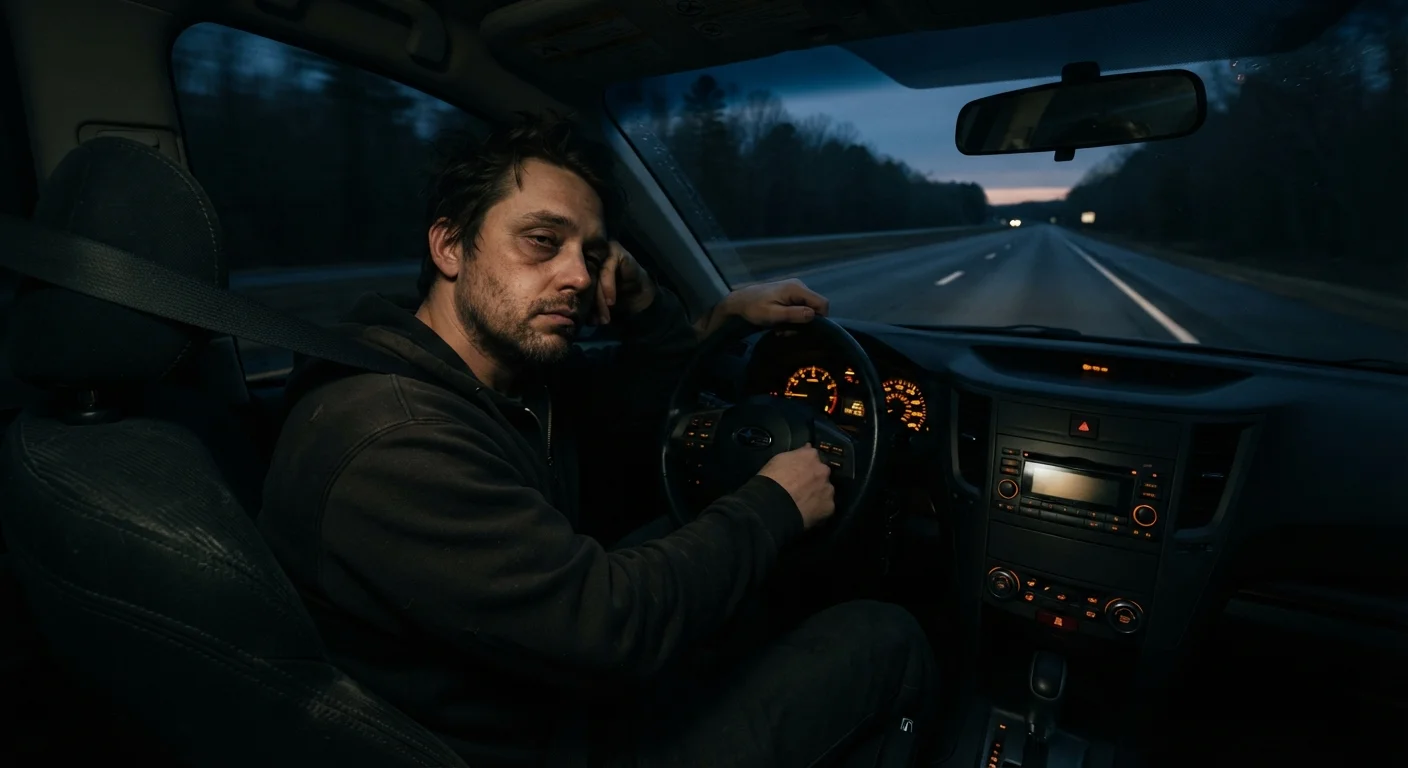
Key Takeaways
- Fatigue impairs reaction time, lane-keeping, and judgment in ways similar to alcohol intoxication.
- Drivers commonly underestimate their own impairment because fatigue also diminishes self-awareness.
- Microsleep episodes - lasting just 1-5 seconds - can occur without the driver realizing it.
- Certain groups, including shift workers and long-haul drivers, face significantly elevated risk.
- Caffeine and opening windows are not reliable substitutes for actual sleep.
- Pulling over and resting is the only safe response when drowsiness becomes noticeable.
Drowsy Driving
Drowsy driving refers to operating a vehicle while significantly fatigued or sleep-deprived. It degrades the mental and physical abilities needed to drive safely - including reaction time, decision-making, and sustained attention. Unlike alcohol impairment, fatigue-related impairment often goes unrecognized by the driver themselves.
Research has shown that being awake for 18 consecutive hours can produce impairment comparable to a blood alcohol concentration of 0.05%, and 24 hours of wakefulness can approach the effect of a 0.10% BAC - above the legal limit in all U.S. states.
Why Fatigue Is More Than Just Feeling Tired
Most drivers associate impairment with alcohol or drugs. Fatigue rarely gets the same mental weight - yet it disrupts the same core functions that safe driving depends on. When the brain is sleep-deprived, it doesn't simply slow down; it begins to malfunction in ways that are difficult to detect from the inside.
Sustained attention - the ability to monitor the road continuously over time - degrades first. Next comes reaction speed: a tired driver may still see a hazard but take a fraction of a second longer to respond. On a highway at 65 mph, that fraction translates to additional car lengths of travel before any corrective action begins. Lane-tracking, hazard anticipation, and multi-step decision-making all follow the same downward curve as fatigue deepens.
Defensive driving relies on precisely these capacities - the ability to scan ahead, interpret risk, and respond before a situation becomes a collision. Fatigue systematically undermines every one of them.
~100,000
Police-reported drowsy driving crashes annually (U.S.)
The National Highway Traffic Safety Administration has estimated approximately 100,000 police-reported crashes per year are linked to drowsy driving, though the true number is believed to be higher due to underreporting.
1-5 sec
Duration of a microsleep episode
At 65 mph, even a one-second microsleep means a vehicle travels roughly 95 feet with no active driver control - approximately the length of a standard tractor-trailer.
18 hrs
Wakefulness equivalent to 0.05% BAC
Research published in sleep science literature has found that 18 hours of continuous wakefulness can produce cognitive and motor impairment comparable to a blood alcohol concentration of 0.05%.
The Self-Awareness Problem: Why Drivers Don't Notice
One of the most well-documented findings in fatigue research is that impaired drivers tend to rate their own performance far higher than it actually is. This is not denial - it's a physiological consequence of sleep deprivation itself. The same brain regions responsible for self-monitoring and judgment are among the first to be compromised.
This creates a feedback loop: a fatigued driver feels "fine enough" to continue because the very tools needed to assess their condition are no longer working accurately. Studies using driving simulators have found that subjects dramatically underestimated their performance decline even as their error rates climbed sharply.
Microsleep makes this worse. These brief, involuntary lapses in consciousness last between one and five seconds - enough time for a vehicle traveling at highway speeds to cover the length of a football field. The driver experiences no continuous memory gap, which means they often have no awareness the episode occurred at all.
Circadian Timing Matters Independently of Sleep
The body's internal clock creates predictable windows of reduced alertness: roughly midnight to 6 a.m. and again between 2 p.m. and 4 p.m. Crash risk rises during these windows even for drivers who are not significantly sleep-deprived. Planning long drives to avoid these periods is a practical, evidence-supported precaution.
Who Faces the Highest Risk
While fatigue can affect any driver, certain populations carry statistically elevated risk. Shift workers - particularly those rotating between day and night schedules - face chronic disruption to their circadian rhythms, reducing both sleep quality and total sleep time. Commercial truck and bus drivers, despite federal hours-of-service regulations, remain a group of concern due to the long durations and irregular schedules involved.
People with untreated obstructive sleep apnea (a condition in which breathing repeatedly stops during sleep) often accumulate significant sleep debt without realizing it, since the disruptions occur during sleep rather than being consciously experienced. Young drivers, particularly young men between 16 and 25, are overrepresented in drowsy-driving crash data - a pattern researchers link to both irregular sleep schedules and a tendency to underestimate risk.
Fatigue compounds other driving challenges as well. Night driving already reduces visibility and increases cognitive load; add fatigue into that environment and the risk multiplies. Similarly, adverse weather conditions that demand higher alertness become far more dangerous for a fatigued driver who lacks the attentional reserve to adapt.
Recognizing the Signs - and Responding Correctly
Because self-assessment is unreliable when fatigued, it helps to treat specific observable behaviors as objective signals rather than feelings to push through. These include: repeated yawning or eye rubbing, difficulty maintaining consistent speed, drifting across lane markings, missing turns or exits already planned, and - most critically - having no memory of the last several miles driven.
That last sign, sometimes called "highway hypnosis," is not a harmless daydream. It indicates that the brain was not fully processing the driving environment in real time.
When to Pull Over - No Exceptions
If you notice yourself yawning repeatedly, drifting in your lane, or unable to recall recent miles driven, pull off at the nearest safe location. A 20-minute nap in a parked vehicle - away from traffic - is one of the most effective short-term countermeasures available. Set an alarm and do not drive again until you feel genuinely alert, or until a rested driver can take the wheel.
Common countermeasures like turning up the radio, rolling down the window, or consuming caffeine are at best temporary. Caffeine can reduce the subjective sensation of sleepiness for a limited period, but it does not restore the cognitive performance that sleep deprivation has already degraded. The only effective countermeasure is actual rest - either a short nap of 20 minutes in a safe location or handing the wheel to a rested driver.
Fatigue intersects with other attention drains that also quietly reduce driver awareness. Understanding the full landscape of impairment - not just the most visible causes - is part of building a genuinely safer approach to every trip.
This article is for general informational and educational purposes only. It does not constitute medical or legal advice. Drivers with concerns about sleep disorders or chronic fatigue should consult a qualified healthcare professional.