

Key Takeaways
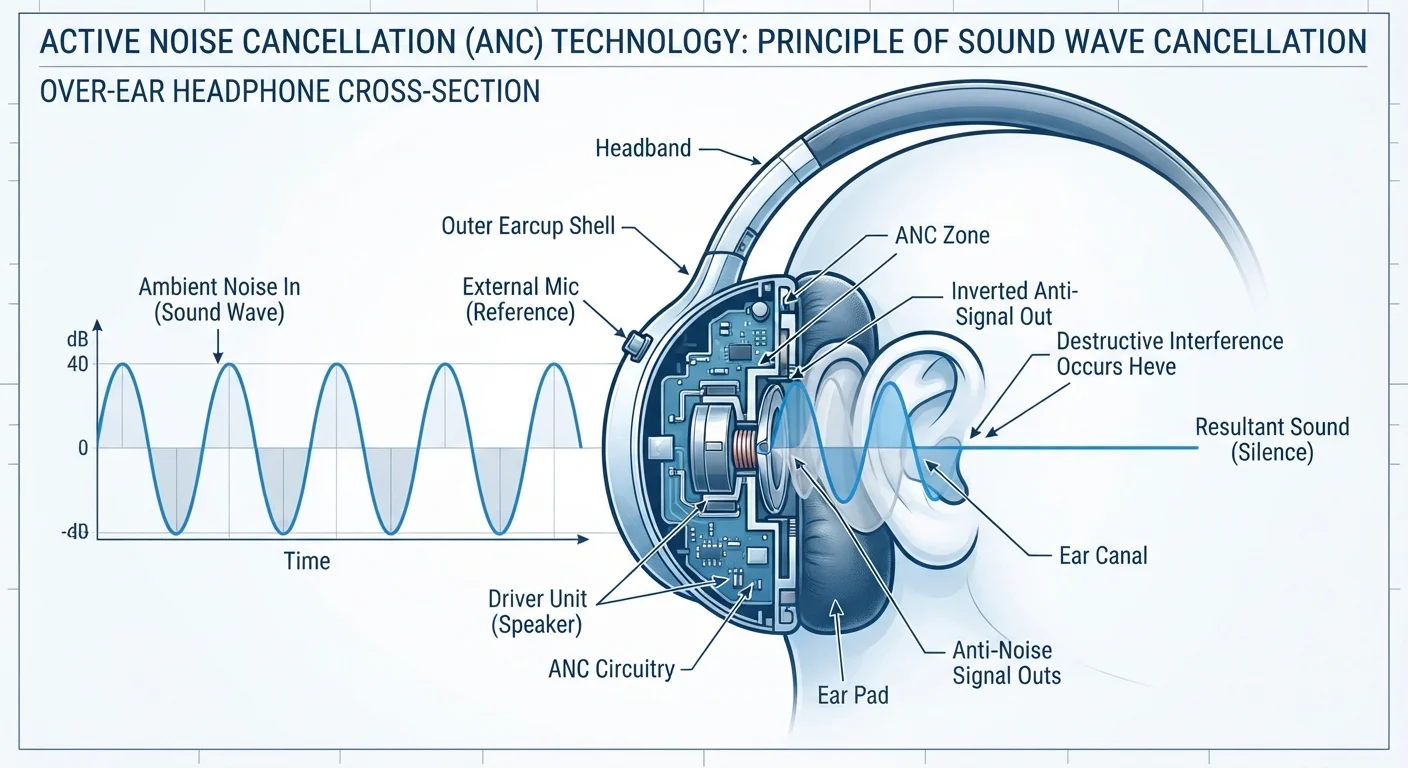
- ANC uses microphones to listen to ambient noise and generates an inverted sound wave to cancel it out.
- The physics principle behind ANC is called destructive interference - two identical waves 180° out of phase cancel each other.
- ANC is most effective on low-frequency, steady sounds like engine drone, less so on sudden or high-pitched noise.
- Passive isolation from ear cup padding works alongside ANC for broader noise reduction.
- An internal processor must complete the sense-generate-emit cycle faster than the noise reaches your eardrum.
Active Noise Cancellation (ANC)
Active noise cancellation is a technology built into headphones and earbuds that uses tiny microphones and a processor to detect unwanted ambient sound, then generates an opposing sound wave to neutralize it before it reaches your ears. The result is a significant reduction in low-frequency background noise - think airplane engines, HVAC hum, or train rumble. It works in real time, continuously sampling the environment and adjusting the counter-signal.
The opposing signal is produced 180° out of phase with the incoming noise, a phenomenon called destructive interference in wave physics. The cancellation is most effective on predictable, steady-state sounds below roughly 1 kHz.
Sound Waves and the Principle of Destructive Interference
Sound is a pressure wave - alternating compressions and rarefactions moving through air. When two sound waves occupy the same space, they combine. If their peaks align, they reinforce each other and get louder; this is constructive interference. If one wave's peak lines up exactly with the other's trough, they cancel out; this is destructive interference.
Active noise cancellation is a practical application of destructive interference. The headphones generate a second sound wave that is a precise mirror image - the same amplitude, the same frequency, but flipped 180 degrees in phase. When this "anti-noise" meets the incoming ambient sound wave inside the ear cup, the two signals neutralize each other, and the noise effectively disappears.
The elegance of the concept masks a demanding engineering challenge: the entire sense-and-respond cycle must complete in less time than it takes the original sound wave to travel from the ear cup wall to your eardrum - a window measured in fractions of a millisecond.
How the Hardware Actually Works
Every pair of ANC headphones contains at least one small microphone dedicated solely to sampling the environment - not picking up your voice, but listening to the noise around you. That microphone's signal feeds into a dedicated digital signal processor (DSP), a chip designed to analyze the incoming waveform and calculate its inverse almost instantaneously.
The DSP then sends that inverted signal to the headphone's driver - the same speaker element that plays your music - where it is emitted alongside your audio. The combined output reaching your eardrum has the ambient noise stripped away.
Hybrid ANC Gives the Broadest Coverage
When evaluating ANC headphones, look for devices that describe a hybrid or dual-microphone system. Feedforward-only designs react quickly but can miss residual noise, while feedback-only designs correct errors but have less lead time. A hybrid arrangement offers the widest cancellation band across real-world listening environments.
There are two primary microphone placements, each with trade-offs:
- Feedforward ANC: The microphone sits on the outside of the ear cup, sampling noise before it enters. This gives the processor slightly more time to react, but the microphone is also more exposed to wind and handling noise.
- Feedback ANC: The microphone is positioned inside the ear cup, close to the ear. It can detect and correct any residual noise that slipped through, acting as a quality-check loop.
- Hybrid ANC: Uses both placements simultaneously, combining the reaction speed of feedforward with the correction ability of feedback for the most thorough cancellation.
For a closer look at how microphone technology enables real-time audio processing, see how smart speakers process ambient sound using similar far-field microphone principles.
What ANC Can and Cannot Cancel
The physics of ANC impose clear limits. Low-frequency, steady-state sounds - aircraft cabin drone, HVAC systems, highway road noise - are ideal targets. Their waveforms repeat predictably, making them straightforward to model and invert. The processor essentially learns the pattern and stays ahead of it.
High-frequency sounds and sudden transients (a dog barking, a door slamming) are far harder to cancel. Their waveforms change too rapidly for even a fast DSP to track and invert before they reach your eardrum. This is why ANC does not create true silence - it attenuates specific types of noise selectively.
~20 dB
Typical noise reduction from effective ANC
Engineering analyses of commercial ANC headphones generally cite 15-25 dB of low-frequency attenuation when ANC is functioning optimally in controlled conditions.
< 1 kHz
Frequency range where ANC is most effective
ANC systems are most capable below approximately 1,000 Hz; performance typically declines for higher-frequency sounds due to processing latency constraints.
Physical construction fills the gap where electronics fall short. The foam padding and closed-back design of most ANC headphones provides passive isolation - a physical barrier that absorbs mid- and high-frequency sound before it even enters the ear cup. ANC and passive isolation work as complementary layers, each covering what the other misses. For a deeper comparison of how these two approaches differ in practice, see our explainer on active vs. passive noise isolation.
There is also the question of audio signal delivery. Whether your headphones connect via Bluetooth or a cable affects the signal path and latency in ways that interact with ANC performance - a topic explored in our overview of wired vs. wireless headphone trade-offs.