
Noise-Cancelling Technology: Active vs. Passive Isolation in Headphones and Earbuds

Key Takeaways
- Active noise cancellation (ANC) uses microphones and signal processing to electronically cancel incoming sound.
- Passive isolation relies on physical materials - foam, silicone, or ear cup padding - to block sound.
- ANC is most effective against low-frequency, continuous sounds like engine rumble or HVAC noise.
- Passive isolation handles mid and high frequencies more reliably without requiring battery power.
- Many modern headphones combine both methods to cover a broader range of ambient noise.
- Each approach involves trade-offs in cost, comfort, audio fidelity, and battery dependency.
Noise-Cancelling Technology
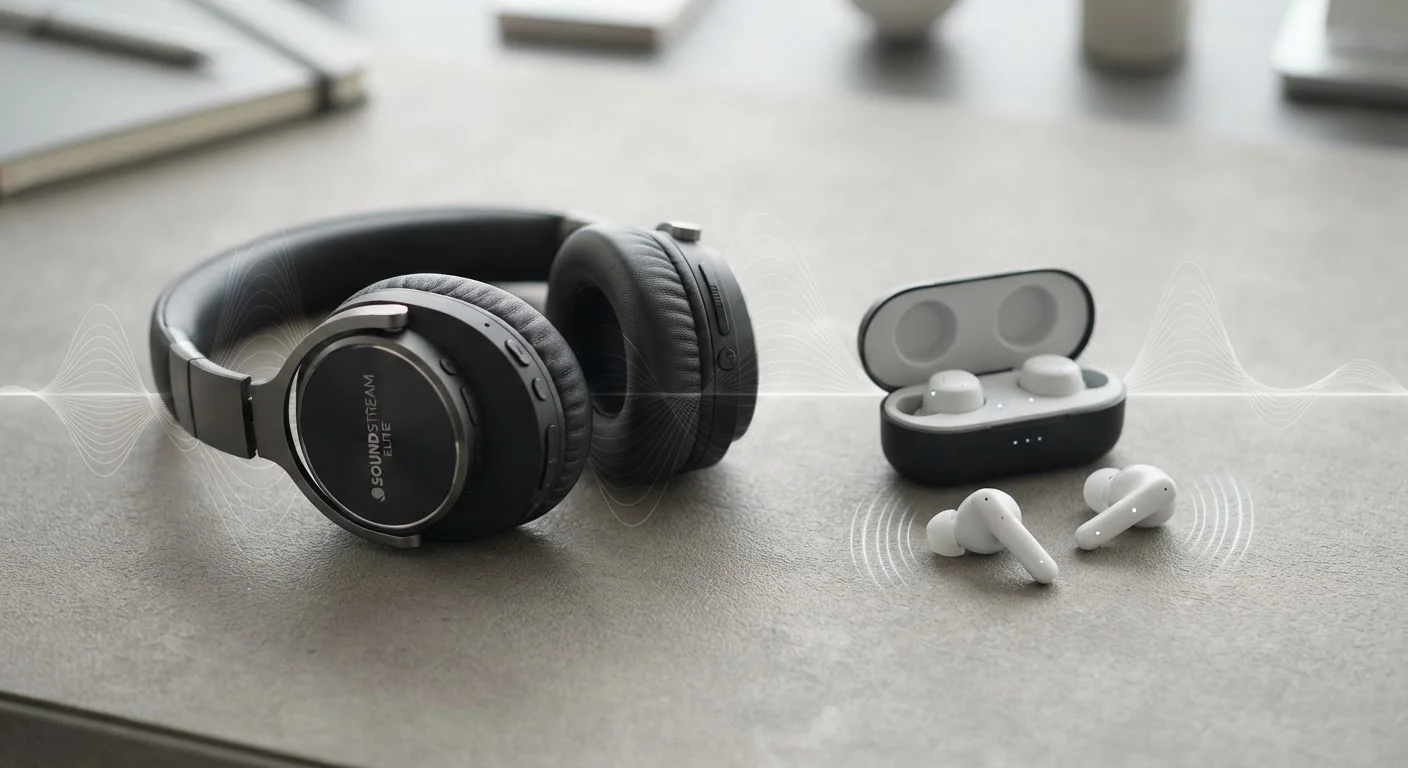
Noise-cancelling technology refers to methods headphones and earbuds use to reduce unwanted ambient sound reaching your ears. There are two fundamentally different approaches: active noise cancellation (ANC), which uses electronics to generate opposing sound waves, and passive isolation, which physically blocks sound using materials and fit. Most listeners encounter both, often combined in a single device.
ANC targets low-frequency, steady-state noise most effectively; passive isolation performs better across mid and high frequencies where physical barriers are most efficient.
How Active Noise Cancellation Works
Active noise cancellation (ANC) is an electronic process, not a physical one. Tiny microphones - typically mounted on the outside of the ear cup or earbud - continuously sample the ambient sound around you. A dedicated processor analyzes that incoming audio in real time and generates a sound wave that is the mathematical inverse, or "anti-phase" copy, of the detected noise. When the original sound wave and the anti-phase wave meet at your ear, they cancel each other out through a principle called destructive interference.
This process happens in milliseconds, repeatedly and continuously. The system must detect noise, compute the inverse, and deliver the cancellation signal before the original sound reaches your eardrum - a tight timing window that requires purpose-built hardware.
ANC excels at handling low-frequency, steady sounds: the rumble of airplane engines, train carriages, or air conditioning systems. These predictable, cyclical waves are easiest for the processor to model and cancel. Higher-frequency, unpredictable sounds - like a sudden voice or a door slamming - are harder to cancel in time, which is why ANC alone rarely eliminates all ambient noise. For a deeper look at the physics involved, see how ANC uses inverted sound waves.
“Noise cancellation is not a single technology - it is a system design problem. Every implementation involves compromises between latency, power consumption, and the frequency range you can realistically target.”
— Audio Engineering Perspective, Widely held view among acoustic engineers working on consumer headphone design
How Passive Isolation Works
Passive isolation has no electronics at all. It works by placing a physical barrier between the outside world and your ear canal. The effectiveness depends on the materials used, the geometry of the design, and how well the headphone seals against your head or inside your ear.
In over-ear (circumaural) headphones, thick memory foam or viscoelastic ear cushions wrap around the entire ear, absorbing and reflecting sound before it enters. On-ear designs press cushions directly against the outer ear. In-ear earbuds use silicone or foam tips that conform to the shape of the ear canal, creating a physical plug.
Passive isolation is most effective at mid and high frequencies - voices, traffic noise, ambient office chatter - where shorter wavelengths are stopped more easily by physical mass. Low frequencies, with their longer wavelengths and higher energy, tend to pass through most materials more readily, which is where passive designs fall short compared to ANC.
~25-35 dB
Typical passive isolation range for well-fitted in-ear tips
Measured attenuation figures for foam and silicone ear tips across standard test frequencies, commonly cited in acoustic engineering literature.
~20-40 dB
ANC attenuation range at optimal low frequencies
Figures represent manufacturer-reported or independently tested peak cancellation performance in the 50-500 Hz range where ANC is most effective.
~125 Hz
Frequency where passive isolation begins to drop off significantly
Below this threshold, physical barriers become progressively less effective at blocking sound, illustrating why low-frequency noise is harder to stop passively.
Practical Trade-Offs: Which Approach Suits Which Situation?
Understanding the trade-offs helps you evaluate headphone specifications more critically, rather than treating "noise-cancelling" as a single feature.
Battery and Power Dependency
ANC requires continuous power. If a battery dies mid-flight, the cancellation stops - and on some designs, audio playback stops too. Passive isolation is always on and requires nothing beyond the physical device.
Comfort and Fit
Passive isolation depends on a good seal, which means fit is critical. Ill-fitting ear tips or loose ear cups reduce isolation significantly. Some listeners find deep in-ear seals uncomfortable over time. ANC can compensate for a less-than-perfect fit by electronically canceling what the physical seal misses.
Audio Transparency
Many ANC headphones include a transparency mode (sometimes called ambient mode), which uses the external microphones to pipe in selected environmental sound. This is useful for hearing announcements or conversations without removing the headphones. Purely passive designs offer no equivalent feature.
Combined Approaches
Most premium headphones today layer both methods: the ear cup or tip provides passive isolation as a baseline, while ANC handles residual low-frequency bleed. This hybrid strategy covers a wider noise spectrum than either method alone. For context on how connectivity choices interact with audio performance, see wired vs. wireless headphone trade-offs.
Test Fit Before Judging Isolation
Passive isolation performance depends almost entirely on seal quality. If in-ear tips feel loose or over-ear cups don't fully surround your ear shape, measured attenuation drops substantially. Try different tip sizes or ear cup styles before concluding a device has weak isolation - often, fit is the variable, not the material.
Reading the Specs: What the Numbers Actually Mean
Headphone marketing uses noise reduction figures - often expressed in decibels (dB) - but these can be misleading without context. A spec like "up to 30 dB noise reduction" typically reflects peak performance at the frequencies where the design is most effective, not average performance across the full audible range.
When comparing passive isolation figures, look for attenuation ratings measured across multiple frequencies (often 125 Hz, 500 Hz, 1 kHz, and above). For ANC, manufacturers sometimes publish frequency response curves for the cancellation system - a more complete picture than a single peak dB number.
Neither number fully captures real-world performance, which depends on fit, ear anatomy, and the specific noise environment. Standardized testing under controlled conditions gives the most reliable comparison basis, though such data isn't always publicly available for consumer products.