

Key Takeaways
- Wired headphones deliver audio through an analog or digital electrical signal with no compression or encoding step.
- Wireless headphones use Bluetooth codecs to compress and transmit audio, introducing a small but measurable latency.
- Most listeners cannot distinguish codec-induced quality differences in everyday listening conditions.
- Wireless headphones add battery dependency, radio interference risk, and codec matching complexity.
- Wired connections remain the standard for professional audio, video production, and latency-sensitive tasks.
- Neither type is objectively superior - the right choice depends on use case and listening environment.
Option A
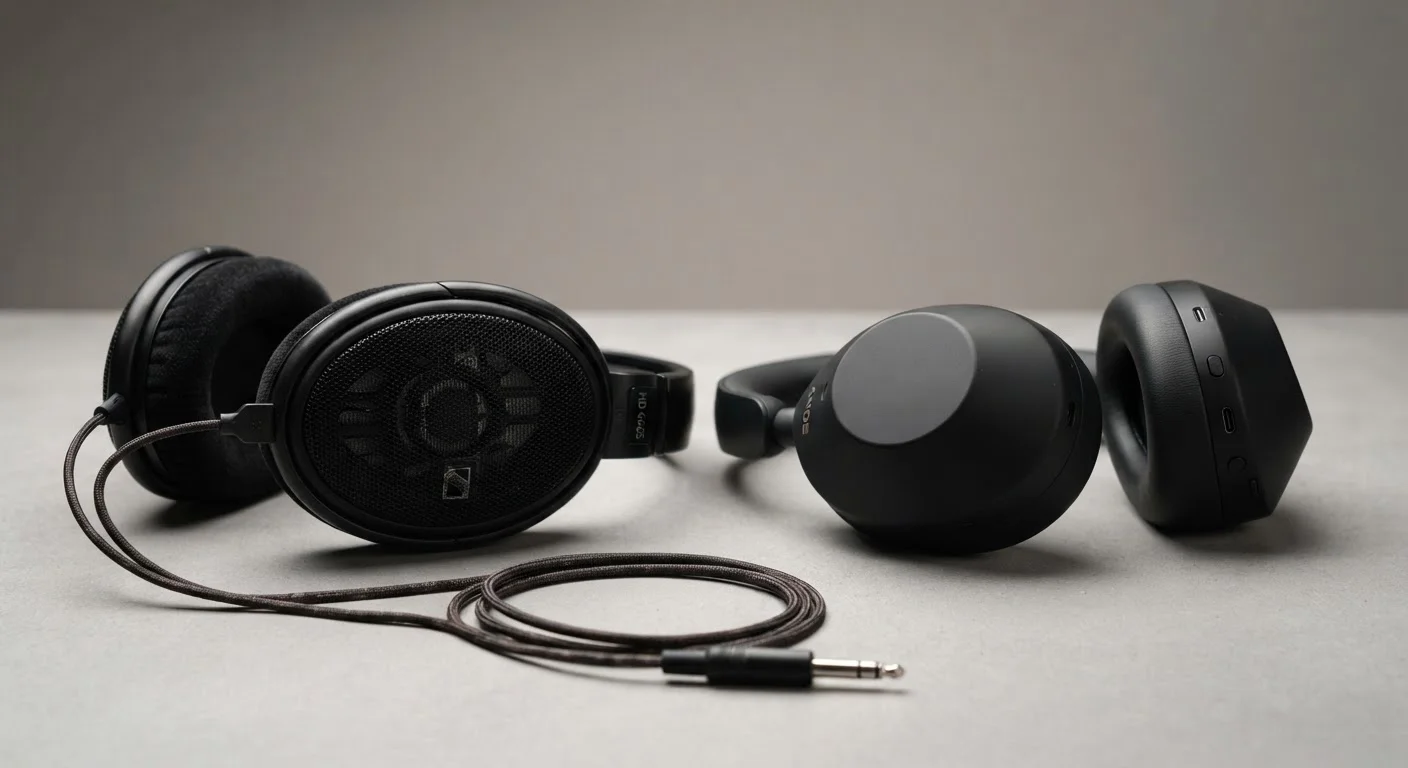
Wired Headphones
The direct, uncompressed signal path.
Best for: Listeners prioritizing audio fidelity, zero-latency playback, and freedom from battery management.
Option B
Wireless Headphones
The cable-free, convenient everyday companion.
Best for: Commuters, gym-goers, and anyone who values freedom of movement over absolute signal purity.
If you edit video, record audio, or need perfectly synced sound
Wired Headphones
Even low Bluetooth latency can cause audible sync issues in production work. A wired connection eliminates this variable entirely.
If you commute, exercise, or move frequently while listening
Wireless Headphones
Cable-free freedom is a genuine ergonomic advantage, and modern codecs deliver quality that satisfies most listeners in motion.
If audio fidelity is your primary criterion
Wired Headphones
Wired signal paths avoid lossy compression and are not subject to interference, making them the standard in critical listening environments.
If you use multiple devices and switch sources frequently
Wireless Headphones
Multipoint Bluetooth pairing allows seamless switching between devices - a workflow advantage wired connections cannot replicate without adapters.
How Each Type Moves Audio from Source to Ear
The fundamental difference between wired and wireless headphones is the signal path - the journey audio takes from a device to your ear. Understanding this path explains most of the practical trade-offs.
Wired headphones receive an electrical audio signal directly through a cable, typically via a 3.5mm analog jack or a digital USB-C connection. In the analog case, a digital-to-analog converter (DAC) inside the source device converts the digital audio file into a continuous electrical signal, which travels down the cable and vibrates the headphone driver. The process is direct and involves no additional encoding.
Wireless headphones introduce several extra steps. The source device encodes the digital audio using a Bluetooth codec - a compression algorithm - and transmits it as a radio signal. The headphones receive this signal, decode it, convert it to analog through an onboard DAC and amplifier, and then drive the speaker. This chain adds complexity at each stage. For a broader look at how wired and wireless trade-offs play out across peripherals, see how wired and wireless peripherals compare.
| Criterion | Wired Headphones | Wireless Headphones |
|---|---|---|
| Signal path | Direct electrical (analog or digital) | Encoded Bluetooth radio transmission |
| Latency | Effectively zero | 40-200ms depending on codec |
| Audio compression | None (source quality preserved) | Codec-dependent; varies by pairing |
| Battery required | No | Yes; runtime varies by model |
| Interference risk | None | Possible in congested 2.4GHz environments |
| Mobility | Limited by cable length | Typically up to 10m (33ft) range |
| Typical use case | Studio, desktop, critical listening | Commuting, exercise, casual listening |
Latency, Codecs, and What They Mean in Practice
Latency - the delay between audio being sent and heard - is one of the most consequential technical differences. Wired connections operate at effectively zero perceptible latency. Bluetooth introduces delays that vary by codec.
Standard Bluetooth audio (SBC codec) can produce latency of 100-200 milliseconds. Higher-quality codecs like aptX Low Latency, AAC, and LDAC reduce this, typically to 40-80ms range, though exact figures depend on implementation. For music-only listening, this delay is largely unnoticeable. For watching video or gaming, even modest latency creates a visible lip-sync mismatch.
Codecs also affect audio quality. SBC applies heavier compression; LDAC (developed by Sony) supports higher bitrates that approach lossless quality under good conditions. However, codec performance degrades with distance, interference, and congestion. The source device and headphones must also support the same codec - if they don't match, both devices fall back to a common lower-quality option.
~20ms
Threshold of perceptible audio-video sync error
Audio engineers generally cite 20ms as the point at which listeners begin to detect lip-sync mismatch, though sensitivity varies by individual.
990 kbps
Maximum bitrate of LDAC codec
Sony's LDAC specification supports up to 990 kbps, which is significantly higher than SBC's typical ceiling of around 320 kbps.
2.4 GHz
Bluetooth operating frequency band
Bluetooth shares the 2.4GHz ISM band with Wi-Fi and other consumer devices, making interference a potential issue in dense environments.
This dynamic parallels the wired-versus-wireless debate in networking. Wi-Fi vs. Ethernet comparisons reveal a similar pattern: wireless introduces overhead that a direct connection avoids, even when the wireless performance is practically adequate for most tasks.
Battery, Interference, and Reliability
Wireless headphones carry onboard batteries, which adds meaningful practical considerations. Battery capacity affects listening duration, and charging habits affect long-term cell health. A wired pair has no battery to deplete or degrade - they work as long as the cable and driver remain intact.
Radio interference is another variable wired headphones avoid entirely. Bluetooth operates in the 2.4GHz band, shared with Wi-Fi, microwaves, and other devices. Dense wireless environments - crowded offices, transit hubs - can cause brief dropouts or degraded audio. Most modern Bluetooth implementations handle this well, but the risk exists where wired connections face no such variable.
For users who also use headphones with active noise cancellation, wireless models must power both the ANC circuitry and the Bluetooth radio simultaneously, which accelerates battery draw. How ANC and passive isolation work explains the underlying physics and the trade-offs involved in each approach.
When Source Quality Sets the Ceiling
The audio quality of any headphone - wired or wireless - is limited by the quality of the source file or stream. Lossless audio delivered via a high-bitrate codec like LDAC can sound very similar to the same file played over a wire, provided signal conditions are good. Conversely, a highly compressed streaming file will limit perceived quality regardless of how good the connection is. The connection type is only one variable in the overall chain.