

Key Takeaways
- Smart speakers use multiple microphones arranged in an array, not just a single mic.
- Beamforming focuses audio pickup in a specific direction, filtering out room noise.
- A dedicated low-power chip listens continuously for the wake word without sending audio to the cloud.
- Only after the wake word is detected does the device transmit your command for processing.
- Echo cancellation prevents the speaker from hearing its own audio output as voice input.
Far-Field Voice Recognition
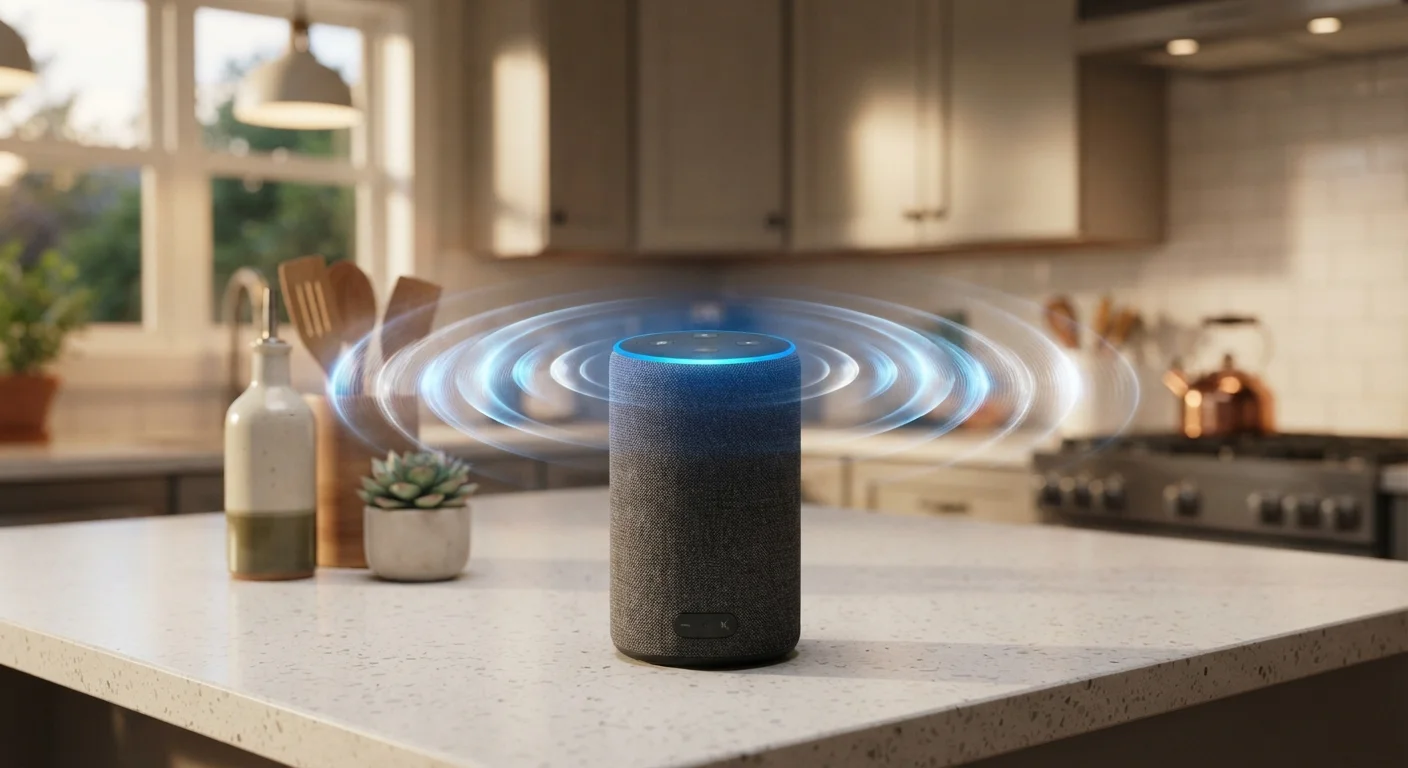
Far-field voice recognition is the technology that allows a smart speaker to detect and understand spoken commands from several feet away - even in a noisy room. It combines specialized microphone arrays, noise-filtering algorithms, and always-on wake-word detection to pick your voice out of ambient sound. The result is a device that responds accurately without requiring you to speak directly into it.
Far-field recognition typically uses a beamforming microphone array - multiple microphones working in concert - to triangulate the direction of sound and suppress signals arriving from other directions.
The Microphone Array: Why One Mic Isn't Enough
A single microphone can capture sound, but it cannot tell you where that sound is coming from. Smart speakers solve this by using a microphone array - a set of microphones positioned at precise, calculated distances from one another, typically arranged in a ring or line around the device's housing.
Sound travels at roughly 1,125 feet per second through air. When you speak from across the room, your voice reaches each microphone at a slightly different moment - differences measured in microseconds. A processor compares these arrival-time differences across all microphones and uses the pattern to calculate the direction of the sound source. This technique is called beamforming: the device mathematically amplifies audio arriving from your direction while attenuating everything else.
The practical effect is that your voice is isolated even when other noise sources - a TV, appliances, conversations - fill the room. For a deeper look at how microphones can also subtract unwanted sound, see how noise-cancelling headphones work, which uses a related principle of phase inversion.
7
Microphones in high-end smart speakers
Some devices use up to seven microphones in a circular array to maximize directional accuracy and noise rejection.
~1,125 fps
Speed of sound through air
Microsecond timing differences as sound crosses the microphone array are what enable precise beamforming.
1-2 sec
Typical cloud response latency
From wake-word confirmation to spoken response, most smart speakers complete the full cloud round-trip in under two seconds under normal network conditions.
Always Listening, Not Always Transmitting
The phrase "always listening" often raises privacy concerns, but the engineering reality is more nuanced. Smart speakers run two separate processing pipelines simultaneously. The first is a very small, low-power chip - sometimes called a digital signal processor (DSP) or dedicated wake-word engine - that does nothing but monitor for the specific phonetic pattern of the wake word (such as "Hey, "). This chip operates entirely on-device and consumes minimal battery or power.
This local chip does not record, store, or transmit audio. It simply compares incoming sound patterns against a stored phonetic model. Only when it detects a match does it "wake up" the main processor and begin capturing the command that follows - which is then sent to cloud servers for natural language interpretation and a response.
Use the Hardware Mute for Privacy Confidence
Most smart speakers include a physical mute button that disconnects the microphones from the device's circuitry entirely - independent of software. When privacy matters most, a hardware mute provides a more reliable guarantee than a software setting alone, because it removes the microphone signal at the hardware level before any processing can occur.
The wake-word model itself is trained on thousands of voice samples to recognize the target phrase across different accents, volumes, and speaking speeds, while minimizing false activations from acoustically similar words.
Acoustic Echo Cancellation: Hearing Over Its Own Voice
One engineering challenge unique to smart speakers - as opposed to headphone microphones or phone handsets - is that the device is both a speaker and a listener simultaneously. Without countermeasures, the microphones would pick up the audio the speaker itself is producing, creating a feedback loop and making it nearly impossible to isolate your voice.
The solution is acoustic echo cancellation (AEC). The device maintains a real-time digital model of the audio signal it is sending to its own speaker. It then subtracts that reference signal from what the microphones capture, leaving only sounds that did not originate from the device - ideally, your voice.
AEC is computationally demanding, especially when the speaker is playing music loudly or the room has hard, reflective surfaces that create reverb. Higher-end devices invest in more sophisticated AEC algorithms and more microphones specifically to maintain performance in acoustically challenging environments.
What Happens After It Hears You
Once a wake word is confirmed and your command captured, the audio is compressed and transmitted over your Wi-Fi connection to cloud-based servers. There, a natural language processing (NLP) engine transcribes the speech to text, identifies the intent of the request, and formulates a response - all typically within one to two seconds.
Some smart speakers now perform limited command interpretation entirely on-device, without a cloud round-trip. This is called on-device processing, and it handles simple, predictable requests - setting a timer, adjusting volume, answering a basic question - without a network dependency. Commands requiring broad knowledge retrieval still route to the cloud.
The combination of microphone arrays, beamforming, wake-word DSPs, echo cancellation, and cloud NLP is what makes it feel effortless - but each layer represents substantial engineering working in coordination.
On-Device Processing Is Expanding
As dedicated AI chips become smaller and more power-efficient, the balance between on-device and cloud processing is shifting. Manufacturers are moving more routine tasks - timers, alarms, smart home control - entirely onto the device. This reduces latency and means the speaker can respond to some commands even when your internet connection is disrupted.