

Key Takeaways
- Body-shape categories are a simplification - most people don't fit neatly into one type.
- The most useful dressing principle is fit: how a garment sits on your actual measurements matters most.
- Some proportion-based guidelines have genuine merit; others were designed around a narrow beauty ideal.
- Personal comfort and confidence are valid style goals alongside visual proportion.
Where Body-Shape Advice Comes From
The body-shape framework - sorting figures into categories like "hourglass," "pear," "apple," or "rectangle" - has appeared in fashion media for decades. Its appeal is obvious: it promises a shortcut. Instead of navigating every possible combination of cut, fabric, and proportion, it offers a pre-filtered guide.
The framework emerged largely from mid-twentieth century fashion writing, shaped by ideals of the era that equated one silhouette (the hourglass) with the aspirational standard. Advice built on those assumptions instructed readers to dress toward a specific shape rather than to dress for their actual one. That distinction matters, and it's where a lot of the criticism of these systems is well-founded.
Understanding the origins helps separate what's genuinely useful from what's inherited convention. Some proportion principles do hold up - but not because certain body types need correcting.
Common Myths - and What's Actually True
The myth-and-fact pairs below address the most persistent claims in body-shape dressing advice. Some are worth keeping; others deserve to be retired.
Myth
Everyone fits into one of the standard body-shape categories, so the rules are universal.
Fact
Human bodies exist on a continuum. The categorical system is a simplification, and most people have proportions that straddle multiple "types."
The four or five classic categories were designed as approximations, not anatomical classifications. Shoulder width, torso length, hip placement, and waist definition all vary independently - meaning the same label can describe people with meaningfully different proportions. Treating the category as a fixed identity leads to advice that may not apply to your actual measurements.
Myth
Certain body shapes need to be "balanced" or "corrected" through clothing choices.
Fact
No body shape requires correction. Proportion techniques are tools for achieving a chosen visual effect - not fixes for a perceived flaw.
The language of "balancing" or "minimizing" particular features carries an embedded judgment: that a specific silhouette is the goal. This framing has real costs - it frames bodies as problems to be solved rather than starting points for personal expression. Proportion techniques are neutral tools. Whether you use them to shift visual weight, create contrast, or emphasize a particular area should be a deliberate aesthetic choice, not an obligation.
Myth
Horizontal stripes always make you look wider.
Fact
The effect of horizontal stripes depends on stripe width, contrast, placement, and the garment's overall cut - not a universal rule.
Research on optical illusions in fashion (sometimes called the Helmholtz illusion, after early work on visual perception) has produced mixed results when applied to real garments on real bodies. Narrow stripes on a form-fitting garment behave differently than wide, high-contrast stripes on a loose silhouette. Fabric drape, color value, and the surrounding outfit all modify the effect. Blanket avoidance of horizontal stripes isn't supported by a consistent body of evidence.
Myth
Wearing all one color is universally slimming.
Fact
Monochromatic dressing can create a long, unbroken line - but the effect varies based on fabric, sheen, and fit, not color alone.
A single-color outfit in a matte, structured fabric worn at the correct fit does tend to read as streamlined. But the same logic doesn't apply automatically to shiny or clingy fabrics in the same color, which can highlight texture variation across the body. The underlying principle - minimizing contrast breaks the silhouette into fewer visual segments - is sound, but the execution matters as much as the color choice itself.
Myth
Rules that work for one body type are automatically wrong for another.
Fact
Many techniques - like a defined waist, a well-placed hem length, or a quality fabric - are broadly flattering regardless of body type.
The binary framing ("this works for pears, not apples") often overstates the exclusivity of styling principles. A wrap silhouette, for example, creates a defined waist across a wide range of proportions because of how it's constructed - not because it's specifically designed for one category. Evaluating techniques by what they actually do, rather than which body type they're "for," is a more flexible and accurate approach.
What Proportion Principles Actually Offer
Stripped of the idea that any body needs visual "correction," proportion-based dressing does have practical value. The principle that breaking the eye line at a specific point - say, a mid-thigh hem on a coat - can create a particular visual effect is simply an observation about how humans perceive line and shape. Used deliberately, it's a tool, not a mandate.
Where the framework earns genuine credibility is in fit. A garment that fits across the shoulders, sits cleanly at the waist, and doesn't pull at the hips will almost always read better than one that doesn't - regardless of body type. For a deeper look at why the number on the tag so often misleads, see why fit outweighs size.
5+
Distinct body-shape classification systems in common use
Fashion references variously use four, five, or more categories - a sign that the system reflects convention, not a single agreed standard.
~60%
Clothing returns attributed to fit issues
Industry estimates consistently point to poor fit as the leading driver of returns in apparel, underscoring why fit assessment matters more than category rules.
The more durable framing is this: proportion guidelines tell you what a garment tends to do visually. Whether that effect suits your goal on a given day is entirely your call.
Building a Wardrobe That Works on Its Own Terms
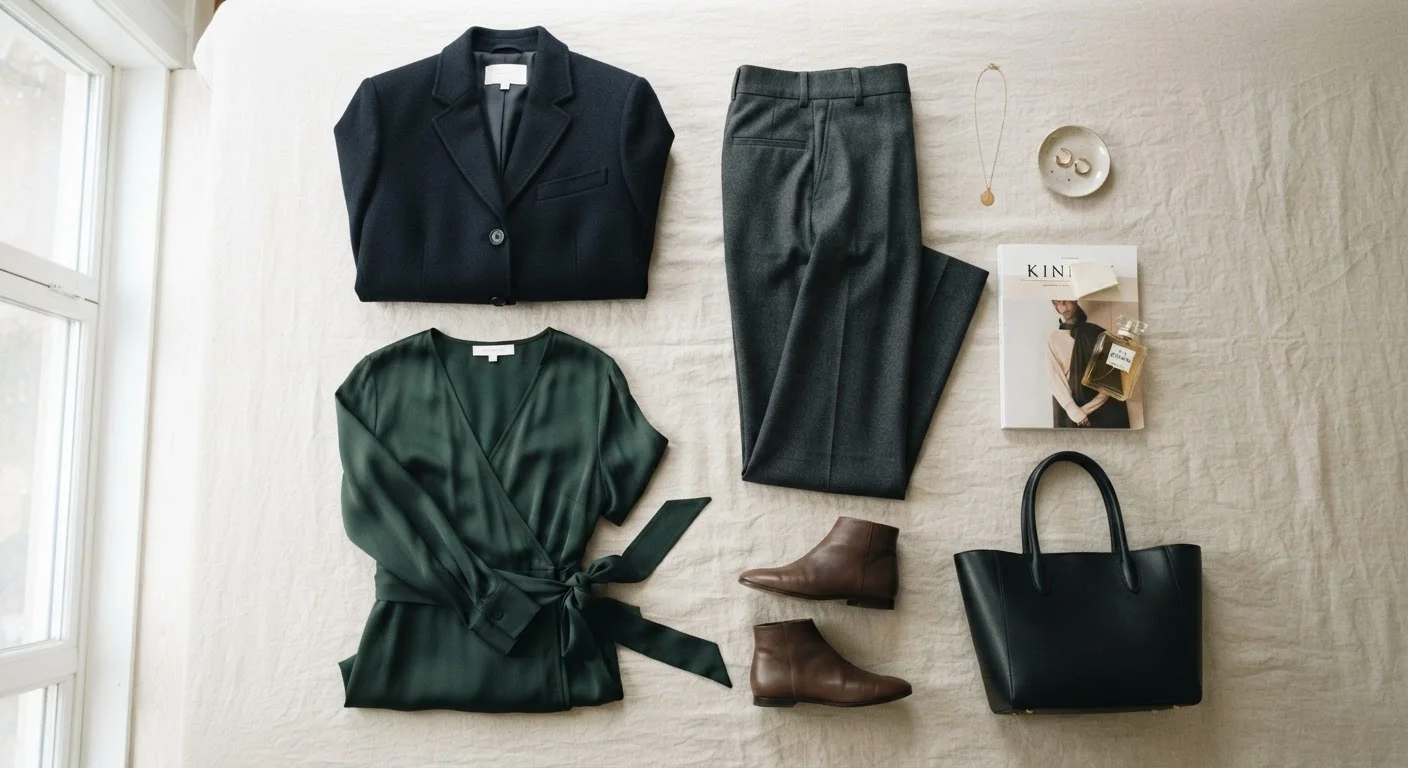
A practical alternative to rigid body-shape rules is focusing on the clothing items that consistently perform well and can be adapted to different occasions and aesthetics. Versatile foundations - a well-cut trouser, a structured layer, a dress with a defined waist - work across a wide range of body types precisely because they're built on sound tailoring principles rather than trend logic. Wardrobe foundations covers the specific pieces worth prioritizing.
It's also worth examining how shopping habits can quietly override personal style intentions. Impulse purchases driven by trend cycles or promotional framing often result in pieces that don't integrate with what you already own. Recognizing those patterns is a useful first step toward a more intentional approach.
Dressing Advice Shouldn't Undermine Confidence
If body-shape guidance leaves you feeling like your body is a problem to manage, that's a sign the framework isn't serving you. Style systems are tools - they should expand your options, not restrict them. No editorial or fashion rule carries authority over your own comfort and sense of self. Consult a personal stylist if you'd like individualized guidance tailored to your specific goals and proportions.
Finally, color coordination is its own layer of dressing strategy - one that interacts with, but is separate from, proportion and fit. Color coordination without a design degree offers practical guidance on building combinations that hold up in practice.