
Actual Cash Value vs. Replacement Cost: The Claim Payout Difference That Surprises Policyholders

Key Takeaways
- Actual Cash Value pays what your item was worth at the time of loss, after depreciation is applied.
- Replacement Cost Value pays what it costs to buy or rebuild the equivalent item at today's prices.
- The gap between the two can amount to thousands of dollars on a single claim.
- Both methods apply to home and auto insurance, but the default varies by policy type and insurer.
- Higher premiums for RCV coverage may be offset by significantly larger claim payouts.
- Always verify your valuation method in the declarations page before you need to file a claim.
Option A
Actual Cash Value (ACV)
The depreciation-adjusted payout method.
Best for: Policyholders seeking lower premiums who can absorb some out-of-pocket cost after a loss.
Option B
Replacement Cost Value (RCV)
The full rebuild-or-replace payout method.
Best for: Homeowners and drivers who want to restore what they lost without a significant gap in coverage.
If you want the lowest possible premium and can cover some costs out of pocket
Actual Cash Value (ACV)
ACV policies carry lower premiums, making them suitable if you have savings to bridge any gap between the payout and replacement cost.
If you want to fully restore your home or belongings without a significant shortfall
Replacement Cost Value (RCV)
RCV eliminates the depreciation gap, so the insurer covers the actual cost to repair or replace at current market prices.
If you own older vehicles with significant depreciation already applied
Actual Cash Value (ACV)
For older cars, the market value may already be low enough that the premium savings from ACV outweigh the payout difference.
If you own a newer home or recently purchased high-value personal property
Replacement Cost Value (RCV)
New construction and high-value items depreciate quickly, and rebuilding costs often exceed market value - RCV closes that gap.
What Each Valuation Method Actually Means
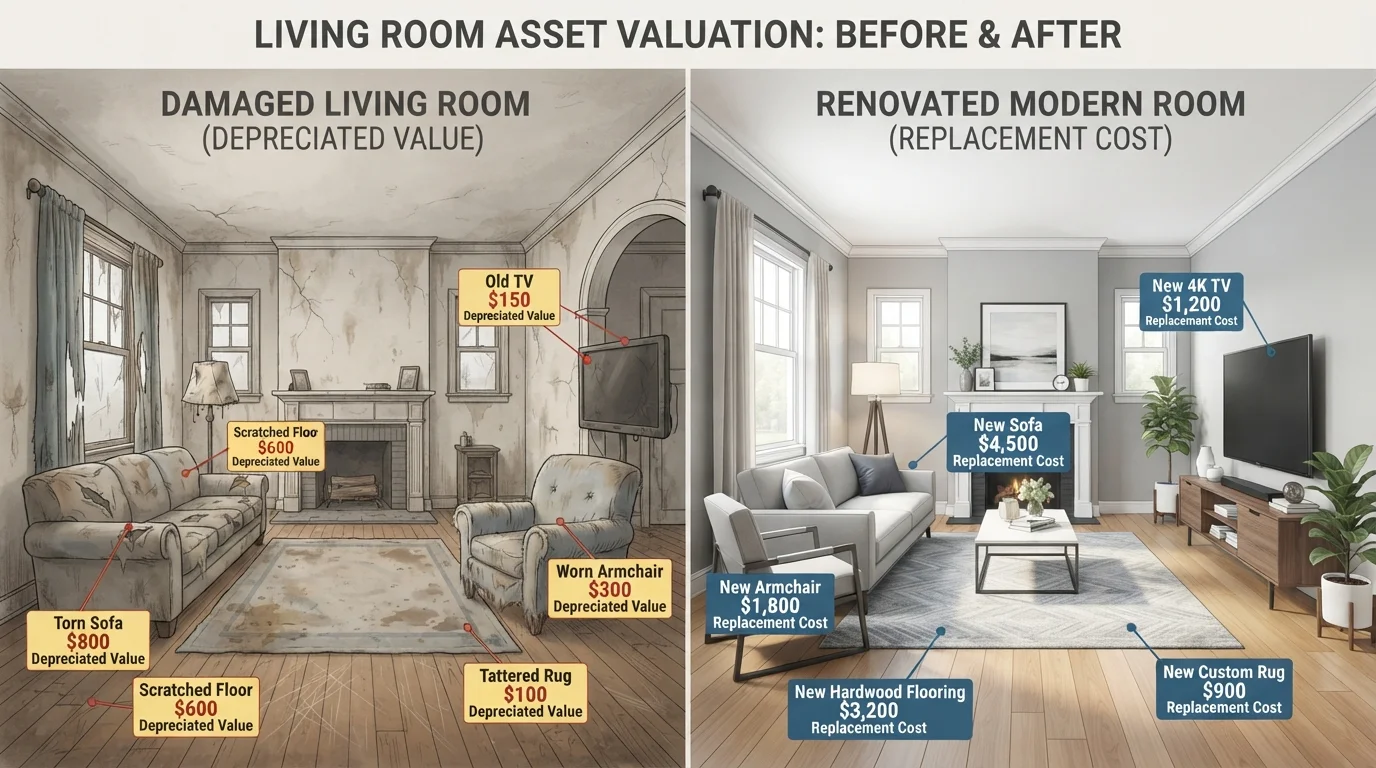
Actual Cash Value (ACV) is calculated by taking the replacement cost of an item and subtracting depreciation - the reduction in value due to age, wear, and obsolescence. If your five-year-old television is destroyed in a fire, the insurer estimates what that same TV would cost new today, then deducts the depreciation accumulated over five years. The result is often considerably less than what you would need to buy a comparable replacement.
Replacement Cost Value (RCV) works differently. The insurer pays what it actually costs to repair the damage or purchase a comparable new item - without factoring in depreciation. That same destroyed TV would be valued at today's retail price for an equivalent model, not its worn-down market value.
The distinction sounds technical, but it produces real, measurable dollar differences at claim time. Understanding which method governs your policy is one of the most practical steps you can take before a loss occurs. Check your declarations page - the summary document at the front of your policy - for the specific language used.
Where to Find Your Valuation Method
Your policy's valuation method is typically stated on the declarations page - the summary sheet at the beginning of your policy documents - and in the coverage definitions section. Look for language such as "actual cash value," "replacement cost," or "depreciation." If the wording is unclear, ask your agent or insurer to confirm in writing which method applies to each coverage component (dwelling, personal property, auto) before a claim occurs.
How the Gap Shows Up in Practice
Consider a homeowner whose roof sustains storm damage. If the roof is 10 years old and the insurer applies a depreciation rate of 5% per year, the ACV payment would reflect 50% depreciation - meaning the insurer pays roughly half the replacement cost. On a $20,000 roof, that gap is $10,000 the policyholder must cover out of pocket.
The same logic applies to personal property. Appliances, electronics, furniture, and clothing all depreciate at varying rates. An ACV policy on personal property can leave policyholders significantly short when replacing an entire household's worth of contents after a major loss.
| Criterion | Actual Cash Value (ACV) | Replacement Cost Value (RCV) |
|---|---|---|
| How payout is calculated | Replacement cost minus depreciation | Current cost to replace or rebuild |
| Depreciation deducted | Yes - reduces payout significantly | No - full replacement cost covered |
| Typical premium cost | Lower | Higher |
| Out-of-pocket risk after a claim | Higher - policyholder covers the gap | Lower - insurer covers full replacement |
| Common in auto insurance | Yes - standard for collision and comprehensive | Rare - requires add-on products |
| Common in homeowners insurance | Often default for personal property | Often available for dwelling coverage |
| Best suited for | Older assets, budget-conscious policyholders | Newer assets, full-recovery priority |
In auto insurance, ACV is the standard for comprehensive and collision coverage. If your car is declared a total loss, the insurer pays the vehicle's fair market value at the time of the loss - not what you paid for it or what it costs to buy a comparable new model. For context on how vehicle depreciation compounds over time, see our guide to vehicle depreciation.
Coverage Decisions: Weighing Premium Cost Against Payout Risk
RCV coverage typically costs more in annual premiums than ACV coverage, and for good reason - insurers are accepting greater financial exposure. Whether that added cost is worthwhile depends on the age and value of what you're insuring, your financial capacity to bridge a payout gap, and how long you plan to hold the policy.
For auto policies, some insurers offer new car replacement or gap insurance as add-ons that function similarly to RCV by covering the difference between ACV and the loan or purchase price. These are distinct products with their own terms. Collision and comprehensive coverages both default to ACV in most standard policies, so understanding their payout mechanics matters before a claim arises.
For homeowners, dwelling coverage and personal property coverage often carry different valuation methods within the same policy. Your structure may be insured at replacement cost while your belongings default to ACV - or vice versa. Reviewing both separately is important. See our article on dwelling versus personal property coverage for a closer look at how those two components interact.
If you are preparing to file a claim and want to understand how valuation affects the process, our claims walkthrough covers documentation strategies and adjuster communication in detail.
This article is for general informational purposes only and does not constitute personalized insurance, financial, or legal advice. Coverage terms, exclusions, and payout calculations vary by insurer and policy. Always review your actual policy documents and consult a licensed insurance professional for guidance specific to your situation.