

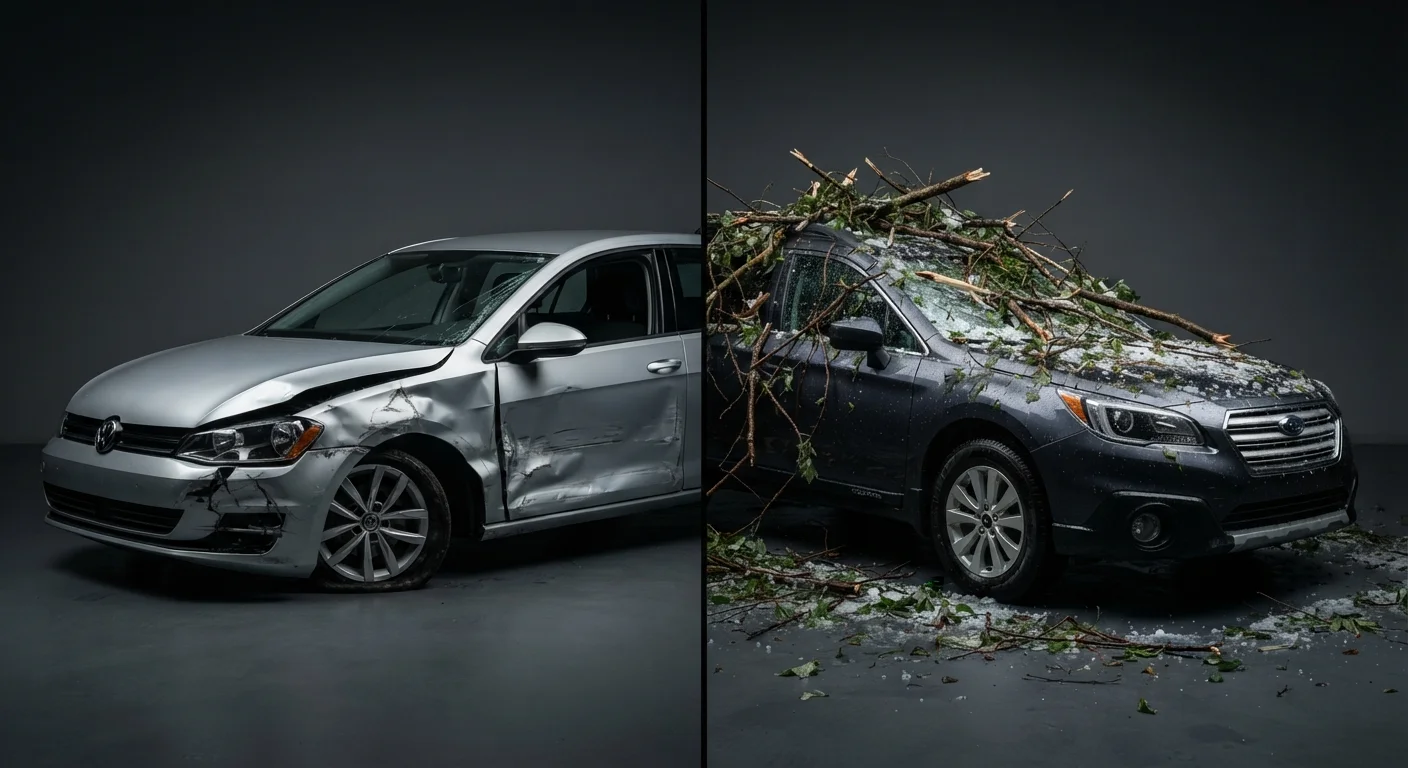
Key Takeaways
- Collision coverage applies when your vehicle impacts another car or object; comprehensive covers nearly everything else.
- Neither coverage pays for damage to another person's vehicle or property - that falls under liability coverage.
- Lenders financing or leasing a vehicle typically require both collision and comprehensive coverage.
- Both coverages are subject to a deductible you choose, which directly affects your premium.
- Whether you need one or both depends on your vehicle's value, how you use it, and your financial situation.
Option A
Collision Coverage
The coverage that steps in when your car strikes something.
Best for: Drivers who want protection when their vehicle is damaged in an accident involving another car or a stationary object.
Option B
Comprehensive Coverage
The coverage for losses that happen without a collision.
Best for: Drivers seeking protection from theft, weather events, falling objects, fire, and other non-collision perils.
If you have an auto loan or lease
Both Collision and Comprehensive
Most lenders require both coverages for financed or leased vehicles. Dropping either could put you in breach of your loan or lease agreement.
If your car has a high market value
Both Collision and Comprehensive
A higher-value vehicle means a larger potential loss. Carrying both coverages limits your out-of-pocket exposure significantly.
If your car's value is low relative to your combined deductible and premiums
Consider dropping one or both
When annual premiums plus your deductible approach or exceed what the insurer would pay for a total loss, self-insuring may be more economical.
If you live in an area with high theft, hail, or flood risk
Comprehensive Coverage
Environmental and theft-related risks can cause substantial vehicle damage. Comprehensive coverage addresses these perils directly.
If you frequently drive in heavy traffic or on congested roads
Collision Coverage
Higher driving frequency in dense traffic raises the statistical likelihood of an impact event, making collision coverage particularly relevant.
What Each Coverage Is Actually Doing
Collision coverage pays to repair or replace your vehicle when it is damaged as a result of an impact - whether with another vehicle, a guardrail, a fence, a pothole, or any other object. The cause is a physical collision involving your car.
Comprehensive coverage (sometimes called "other than collision" in policy language) applies to a wide range of non-collision losses: theft, vandalism, fire, flood, hail, wind damage, falling trees or debris, hitting an animal, and similar events beyond your control at the wheel.
Both coverages pay for damage to your own vehicle. They do not cover injuries or damage you cause to others - that is the role of liability coverage, which you can explore in more detail in our article on what liability coverage actually protects you from.
It is also worth noting that both coverages are subject to a deductible - the amount you pay out of pocket before the insurer covers the rest. Common deductible amounts range from $250 to $1,500. A higher deductible lowers your premium but increases your share of any claim payout. For a deeper look at how insurers calculate what they actually pay you, see our piece on actual cash value vs. replacement cost.
Head-to-Head: How the Two Coverages Compare
The table below illustrates the key differences across common comparison points. Keep in mind that specific policy terms, exclusions, and limits vary by insurer and state - always review your actual policy documents.
| Criterion | Collision | Comprehensive |
|---|---|---|
| Triggering event | Impact with object or vehicle | Theft, weather, fire, animals, vandalism |
| Covers your vehicle | Yes | Yes |
| Covers other vehicles | No | No |
| Deductible applies | Yes | Yes |
| Required by lenders | Typically yes | Typically yes |
| Deer strike covered | No | Yes |
| Hail damage covered | No | Yes |
| At-fault accident covered | Yes | No |
| Vehicle theft covered | No | Yes |
One of the most common points of confusion: if a deer runs into your car, that is typically a comprehensive claim, not a collision claim. The determining factor is whether you struck something or whether something happened to your vehicle from an external, non-collision source.
When Lenders Remove the Choice From Your Hands
If you are financing or leasing your vehicle, the decision about whether to carry collision and comprehensive coverage may not be entirely yours. Most lenders and leasing companies require both as a condition of the loan or lease agreement. This protects their financial interest in the vehicle.
If you drop required coverage and your lender discovers it, they may purchase what is known as force-placed insurance on your behalf - typically at a significantly higher cost and with narrower protections than a policy you would choose yourself.
What Force-Placed Insurance Means for You
Force-placed (or lender-placed) insurance is purchased by a lender on a borrower's behalf when required coverage lapses. It protects the lender's interest in the vehicle, not necessarily yours. Premiums are typically rolled into your loan payments, often at rates higher than what you could obtain independently. If you receive a notice about force-placed insurance, contacting your own insurer promptly is advisable.
Once a vehicle is fully paid off, you regain full control over which optional coverages to carry. That is typically the point at which drivers reassess whether collision, comprehensive, or both still make financial sense given the vehicle's current value.
For a broader look at how your auto coverage interacts with other policies, our overview of car insurance coverage types every US driver should understand provides helpful context.
Making the Decision for Your Situation
Neither coverage is universally necessary once a vehicle is owned outright. The right approach depends on several factors:
- Vehicle value: A general rule of thumb is to compare the vehicle's current market value against the annual cost of the coverage plus your deductible. If the math is close, self-insuring may make sense - though that means absorbing the full loss yourself if something happens.
- Your financial cushion: Can you comfortably replace or repair the vehicle out of pocket? If not, maintaining coverage reduces your financial risk.
- Where you live and how you drive: High-crime areas increase the relevance of comprehensive; heavy commuters in dense traffic may lean toward collision.
- Your risk tolerance: Some drivers prefer the peace of mind that comes with broader coverage regardless of the actuarial math.
These are general educational considerations, not personalized financial advice. For guidance tailored to your specific circumstances, consult a licensed insurance agent who can review your full coverage picture. You may also want to consider how your auto policy fits alongside homeowners coverage - our article on bundling auto and home insurance explains what combining policies changes and what it does not.
This article is for general informational and educational purposes only and does not constitute personalized insurance, financial, or legal advice. Coverage terms, exclusions, and availability vary by insurer and state. Always read your actual policy documents and consult a licensed insurance professional before making coverage decisions.