

| AAFCO's Role | Sets model nutrient standards; does not directly test or approve individual products |
| Species Covered | Dogs and cats (separate nutrient profiles for each) |
| Recognized Life Stages | Growth, reproduction, adult maintenance, all life stages |
| Substantiation Methods | Formulation (nutrient calculation) or feeding trials |
| "Complementary" Label | Means the food is NOT complete and balanced on its own |
| Enforcement Authority | Individual U.S. state feed control officials |
What Is AAFCO and Why Does It Matter?
The Association of American Feed Control Officials (AAFCO) is a non-governmental advisory body that establishes model regulations and nutrient profiles for pet food sold in the United States. AAFCO itself does not test or approve pet foods - that responsibility falls to individual state feed control officials - but its nutritional standards form the baseline that most U.S. states incorporate into law.
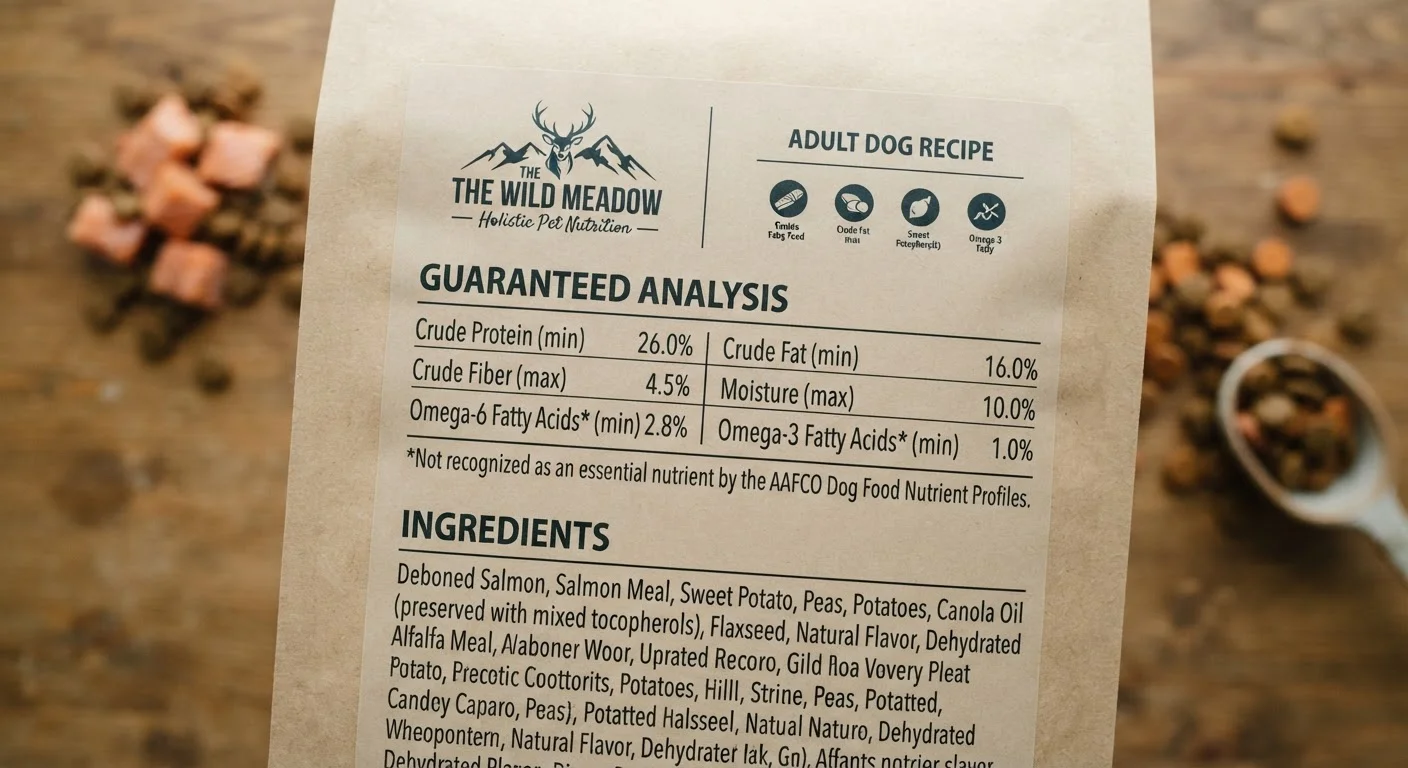
When you see an AAFCO nutritional adequacy statement on a bag or can of pet food, you're seeing a manufacturer's claim that the product meets those established nutrient profiles - for a specific species, life stage, and in some cases, breed size. Understanding what that statement does and does not guarantee is essential for any owner trying to feed their pet well. For a broader look at how labels communicate nutrition, see decoding pet food labels.
| AAFCO's Role | Sets model nutrient standards; does not directly test or approve individual products |
| Species Covered | Dogs and cats (separate nutrient profiles for each) |
| Recognized Life Stages | Growth, reproduction, adult maintenance, all life stages |
| Substantiation Methods | Formulation (nutrient calculation) or feeding trials |
| "Complementary" Label | Means the food is NOT complete and balanced on its own |
| Enforcement Authority | Individual U.S. state feed control officials |
The Two Types of AAFCO Adequacy Claims
AAFCO recognizes two methods by which a manufacturer can substantiate a nutritional adequacy statement:
- Formulation method (nutrient profile): The manufacturer calculates that the recipe's ingredient mix meets AAFCO's published minimum (and maximum, where applicable) nutrient levels on paper. No animals are fed the food as part of this process. It is the most common method.
- Feeding trial method: The food is fed to a group of dogs or cats under AAFCO protocols for a defined period. Animals are monitored for weight, coat condition, and select blood markers. Foods substantiated this way carry language such as "Animal feeding tests using AAFCO procedures substantiate that provides complete and balanced nutrition."
A formulation-based claim does not confirm that nutrients are bioavailable - meaning actually absorbed and used by the animal's body. A feeding trial offers stronger real-world evidence but covers only the parameters AAFCO measures, not every aspect of long-term health. Neither method is a blanket guarantee of optimal nutrition.
AAFCO Nutritional Adequacy Statement
A label claim, regulated by individual U.S. states, indicating a pet food meets AAFCO's established nutrient profiles for a specified species and life stage. It may be supported by calculation or by an actual feeding trial.
Nutrient Profile
AAFCO's published tables of minimum (and some maximum) nutrient levels required for a food to be considered complete and balanced for dogs or cats at a given life stage.
Feeding Trial
A structured test in which a pet food is fed to a group of animals under AAFCO protocols for a set period. It provides real-world substantiation that the food supports health, within the limits of the protocol's scope and duration.
Bioavailability
The degree to which a nutrient in food is actually absorbed and used by the animal's body. A food can meet a nutrient level on paper without that nutrient being efficiently absorbed.
Complementary or Supplemental Food
A pet food product that does not carry an AAFCO nutritional adequacy statement and is not intended to be fed as a sole diet. Examples include broths, toppers, and some wet food pouches.
All Life Stages
An AAFCO-recognized designation meaning a food meets the most demanding nutrient standards (those for growth and reproduction), making it technically suitable for animals of any age or reproductive status.
Reading Life Stage Language on the Label
AAFCO adequacy statements always specify which life stage or population the food is designed for. The recognized categories are:
- Growth: Formulated for puppies or kittens, which have higher needs for protein, calcium, phosphorus, and certain vitamins.
- Reproduction: Designed for pregnant or lactating females.
- Adult maintenance: Meets nutrient minimums for healthy adult animals but may be insufficient for younger or reproducing animals.
- All life stages: Must meet the more demanding growth and reproduction standards, making it suitable across the board - though it may deliver more of some nutrients than an adult-only animal needs.
- Complementary or supplemental: Does not carry a nutritional adequacy statement; the food is not intended as a sole diet. Treat toppers, broths, and some wet foods fall here.
Feeding a food labeled only for adult maintenance to a growing puppy or kitten is a common - and potentially harmful - mistake. Always match the life stage on the label to your pet's actual life stage. If you're comparing diet formats, wet food, dry food, and raw diet trade-offs covers how adequacy claims apply across formats.
Large-Breed Puppies: A Special Case
Foods labeled "all life stages" must meet growth nutrient minimums, but some may not restrict calcium and phosphorus to the levels recommended for large- and giant-breed puppies. Excess calcium during rapid growth has been associated with developmental orthopedic conditions in large breeds. Look specifically for "including growth of large-breed dogs" on the label if you have a large-breed puppy, and discuss diet selection with your veterinarian.
What AAFCO Statements Don't Tell You
An AAFCO statement confirms minimum nutritional adequacy - it is not a quality rating, a digestibility score, or a measure of ingredient sourcing. Key limitations to keep in mind:
- Ingredient quality is not assessed. Two foods can both carry the same AAFCO claim while using ingredients of very different quality or digestibility. For guidance on reading ingredient lists, see what's actually in your pet's food.
- Long-term health outcomes are not studied. AAFCO feeding trials run for a relatively short duration and measure a limited set of markers. Chronic conditions linked to diet may not surface in that window.
- Raw and home-prepared diets often lack statements. If a diet has no AAFCO statement, it should be formulated with input from a board-certified veterinary nutritionist. Learn more about the evidence around raw feeding for pets.
- Individual variation matters. A food meeting population-level standards may not suit a pet with specific health conditions, sensitivities, or unusual metabolic needs.
For a structured way to assess overall diet quality beyond the AAFCO statement, evaluating pet food for nutritional soundness provides a practical checklist. Always consult your veterinarian if you have concerns about your individual pet's nutritional needs.
This article is for general informational purposes only and does not constitute veterinary or nutritional advice. Consult a licensed veterinarian or board-certified veterinary nutritionist for guidance specific to your pet.