

Key Takeaways
- Lithium-ion batteries work by moving ions between two electrodes, not by storing static charge.
- Capacity fades over time because repeated cycling causes physical and chemical changes inside the cell.
- Heat is the single biggest accelerant of battery degradation - more so than charge frequency.
- Keeping a battery between 20% and 80% charge generally slows capacity loss over time.
- Battery specs like mAh describe stored charge, not real-world runtime, which varies by device.
Lithium-Ion Battery
A lithium-ion (Li-ion) battery stores and releases electrical energy through the controlled movement of lithium ions between two electrodes - the anode and the cathode - through a liquid or gel electrolyte. When you charge a device, ions migrate in one direction; when you use it, they flow back, generating current. This back-and-forth cycle is what makes the battery rechargeable.
The electrolyte is ionically conductive but electronically insulating, which forces electrons to travel through the external circuit - the device's components - rather than shorting out internally.
How a Lithium-Ion Battery Actually Works
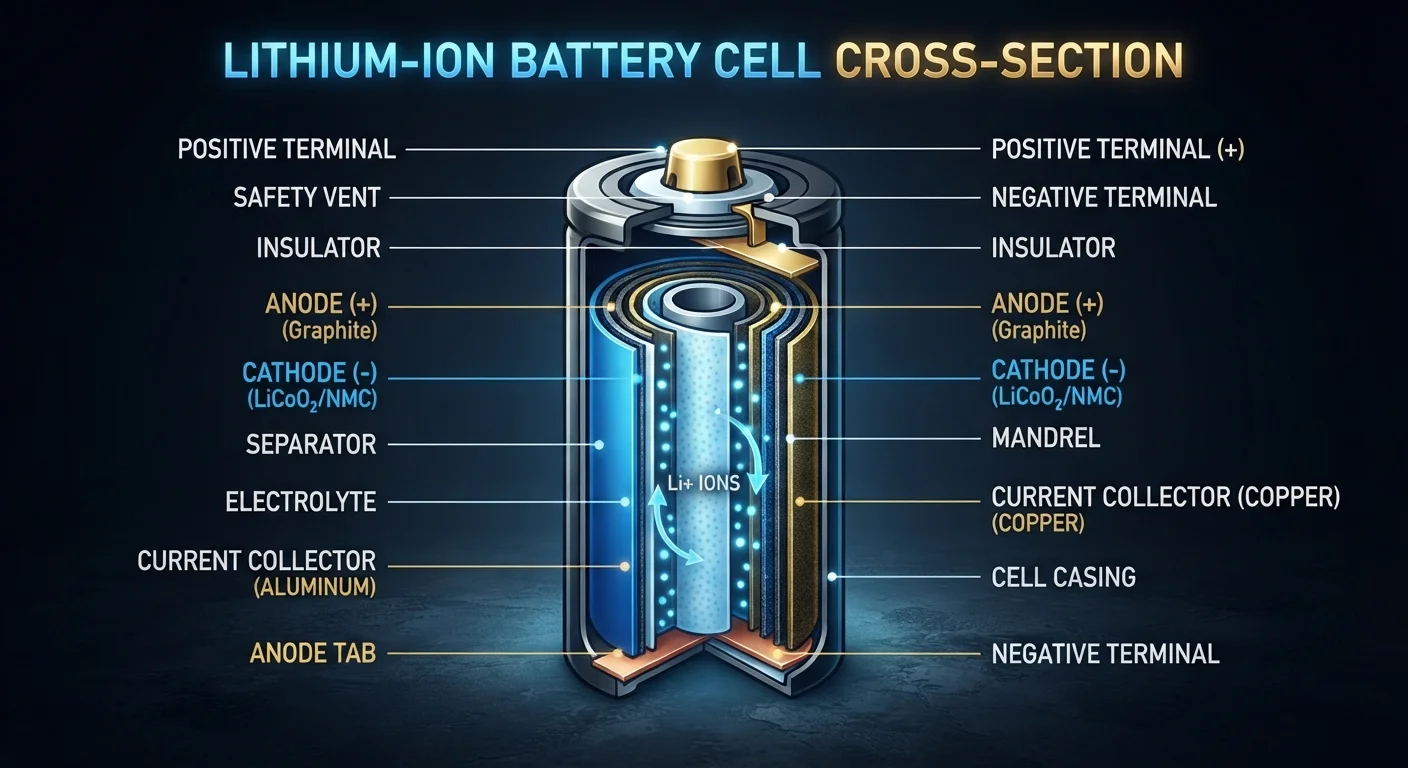
Strip away the metal casing and you'll find a surprisingly elegant system. A lithium-ion cell contains three key components working together: an anode (typically graphite), a cathode (commonly a lithium metal oxide compound like lithium cobalt oxide or lithium iron phosphate), and an electrolyte - a solution that conducts lithium ions between them.
During charging, an external power source pushes electrons through a circuit while simultaneously driving lithium ions out of the cathode, through the electrolyte, and into the anode for storage. When you use the device, the process reverses: ions travel back to the cathode, and electrons flow through your device's components, powering them. That electron flow is the electrical current your device runs on.
A thin, porous layer called a separator sits between the anode and cathode. It physically prevents contact between the two electrodes - which would cause a short circuit - while still allowing ions to pass through. If this separator is damaged by heat or physical puncture, the result can be rapid, uncontrolled discharge: a hazard known as thermal runaway.
“The lithium-ion battery is an extremely elegant technology - but elegance doesn't mean simplicity. The interplay between the electrodes, electrolyte, and separator involves dozens of competing chemical processes happening simultaneously.”
— Yet-Ming Chiang, Materials scientist and battery researcher, Massachusetts Institute of Technology
Why Batteries Degrade - and What Speeds It Up
No battery lasts forever, and understanding why requires looking at what changes inside the cell over time. The core problem is that lithium-ion chemistry is never perfectly reversible. Each cycle leaves behind small amounts of irreversible chemical byproducts and causes minor physical expansion and contraction in the electrode materials.
Over hundreds of cycles, a few specific processes accumulate:
- Lithium plating: At high charge rates or low temperatures, lithium can deposit as metallic clusters on the anode rather than intercalating cleanly into graphite. These deposits reduce available capacity and can eventually pierce the separator.
- SEI layer growth: A thin film called the solid electrolyte interphase (SEI) forms naturally on the anode's surface. It's actually protective in the early stages, but it continues growing over time, consuming lithium and increasing internal resistance.
- Cathode cracking: Repeated expansion and contraction of cathode particles causes microscopic fractures, reducing the surface area available for ion exchange.
Heat accelerates all of these processes significantly. A battery operating at 40°C (104°F) consistently will degrade meaningfully faster than the same cell kept at room temperature. This is why device performance in hot climates - or habits like charging in a hot car - tends to shorten battery lifespan noticeably. The connection between battery decline and overall device slowdowns is more direct than many users realize.
~500
Typical full charge cycles before 80% capacity
Most lithium-ion consumer battery specifications rate cells for approximately 300-500 full cycles before capacity drops to 80% of original, though this varies by chemistry and usage conditions.
2×
Faster degradation rate at elevated temperatures
Electrochemical research broadly supports that battery aging reactions roughly double in rate for every 10°C increase in operating temperature, following Arrhenius kinetics.
20-80%
Charge range that minimizes electrode stress
Battery engineers and device manufacturers commonly recommend keeping charge levels in this range to reduce mechanical strain on electrode materials over long-term use.
Practical Habits That Actually Help
Battery chemistry imposes real limits, but user behavior can meaningfully extend how long a battery holds its capacity. The most evidence-supported guidance centers on temperature management and charge level habits.
Simple Habits That Slow Battery Aging
Avoid exposing your device to prolonged heat - this is more damaging than charge frequency alone. Where your device offers a charge-limit setting (common on newer smartphones and laptops), enabling it to cap charging at around 80% can meaningfully extend long-term capacity. Remove protective cases that trap heat during intensive charging sessions.
Keeping charge levels between roughly 20% and 80% reduces the mechanical stress placed on electrode materials at the extremes of their capacity. A fully charged or fully depleted cell holds its electrodes under more strain than one at mid-range. Many modern smartphones now include optional charge-limiting features precisely for this reason.
Fast charging is convenient but applies more heat and electrical stress per unit time than standard charging. Using slower charging speeds when you're not in a hurry - including wireless charging at moderate wattages - can be gentler on the cell. For a balanced look at how wireless charging actually compares, see common wireless charging misconceptions.
Screen brightness and display technology also play a role in how hard a battery works. OLED and LCD panels draw power differently, and understanding that relationship helps explain why battery runtime varies so much across devices with similar mAh ratings. For a deeper look at what those capacity numbers actually mean, battery specs like mAh and Wh are frequently misunderstood.
Finally, it's worth noting that lithium-ion cells in consumer electronics behave quite differently from the lead-acid batteries in vehicles - which operate on different chemistry and fail in distinct ways. Car battery failure signs are a separate subject entirely.