

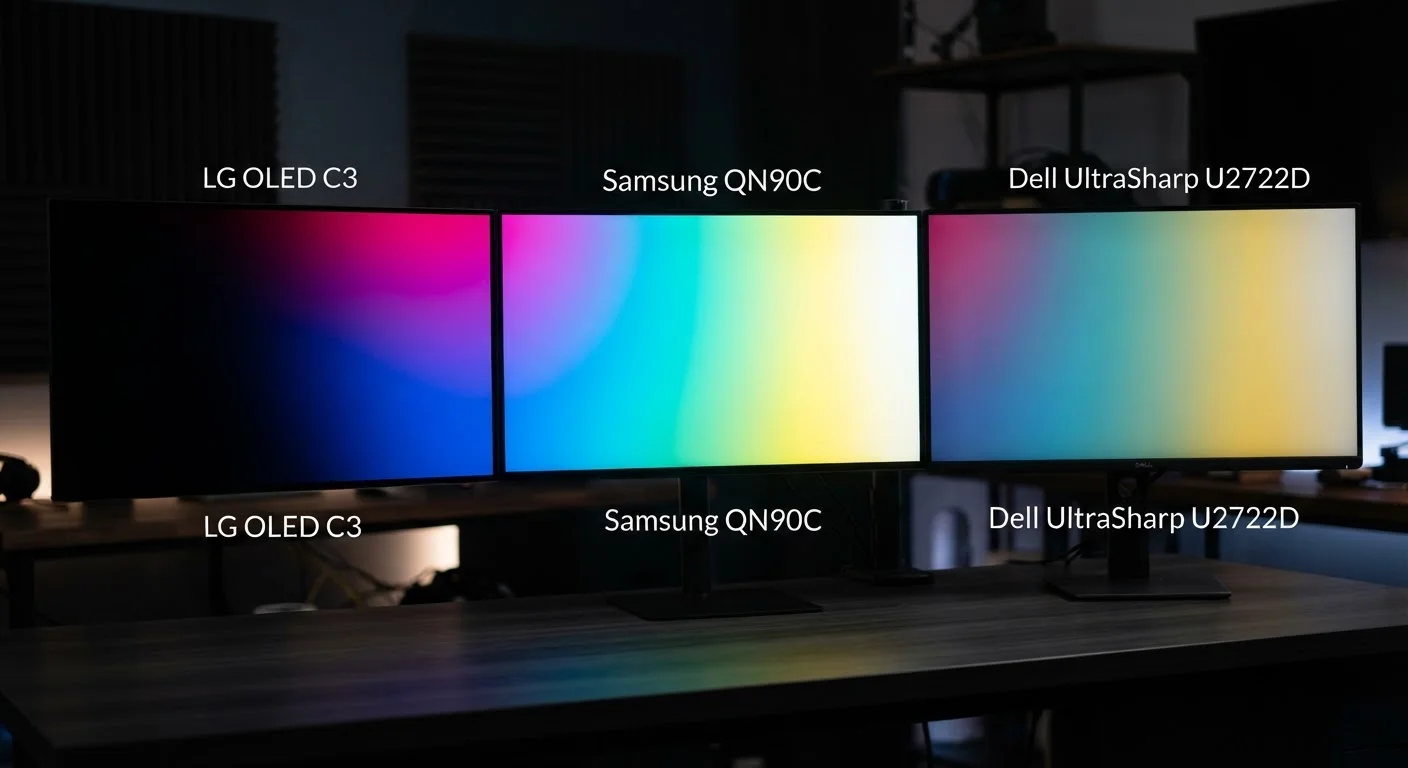
Key Takeaways
- OLED pixels emit their own light, allowing true black and infinite contrast ratios.
- LCD panels require a backlight, which limits how dark a dark scene can actually appear.
- QLED uses quantum dot technology to improve brightness and color volume over standard LCD.
- Each panel type involves trade-offs in brightness, longevity, viewing angle, and price.
- Your viewing environment - bright room vs. dark room - matters as much as the panel spec.
Display Panel Technology
Display panel technology refers to the underlying method a screen uses to produce light and color. OLED, QLED, and LCD are the three dominant types found in modern TVs and monitors. Each works differently at a hardware level, which directly affects how images look under various lighting conditions and viewing angles.
OLED uses per-pixel electroluminescence; LCD relies on a backlight filtered through liquid crystals; QLED is an LCD variant that replaces the traditional color filter with quantum dot material to expand color gamut and brightness.
How Each Technology Produces Light
To understand what separates these panel types, it helps to start at the source: how each screen actually makes light.
LCD (Liquid Crystal Display) works by shining a backlight - typically LED-based - through a layer of liquid crystals that act as shutters. Those crystals can block or allow light through, and a color filter layer adds hue. The key limitation: the backlight is always on, so even "black" areas of an image are actually illuminated from behind, just less so.
OLED (Organic Light-Emitting Diode) eliminates the backlight entirely. Each pixel contains an organic compound that emits its own light when current passes through it. When a pixel needs to show black, it simply turns off. This gives OLED screens a theoretically infinite contrast ratio and makes dark scenes look genuinely dark rather than gray.
QLED (Quantum Light-Emitting Diode) is not a completely separate technology - it is an enhanced form of LCD. A layer of quantum dots (nanoscale semiconductor particles) is placed between the backlight and the liquid crystal panel. These dots convert backlight energy into more precise wavelengths of light, yielding richer colors and higher brightness potential than conventional LCD.
For a deeper look at how OLED and LCD differ at the component level, see how OLED and LCD panels produce light and color differently.
∞:1
Theoretical contrast ratio of OLED panels
Because individual OLED pixels can turn fully off, the measured contrast ratio is effectively infinite in controlled test conditions.
2-10 nm
Typical quantum dot particle size in QLED displays
Quantum dot particle size determines the wavelength of light emitted; this nanoscale precision is what allows QLED to achieve a wider color gamut than conventional LCD backlights.
1,000+ nits
Peak brightness common in QLED displays
High-end QLED panels frequently reach or exceed 1,000 nits peak brightness, making them well-suited to high-ambient-light viewing environments.
What This Means in Actual Viewing Conditions
Hardware differences translate directly into the experience you have watching TV or working at a monitor.
Contrast and Black Levels
OLED holds a clear advantage here. Because pixels switch off individually, dark scenes in films or games appear with a depth that backlit displays cannot fully replicate. LCD and QLED panels use local dimming - dividing the backlight into zones that can be dimmed independently - but this is an approximation, not true per-pixel control.
Brightness
QLED and premium LCD panels can sustain higher peak brightness levels than most OLED displays, which matters in rooms with significant ambient light. A very bright screen in a sunny living room is easier to watch than one overwhelmed by glare. OLED panels have grown brighter over successive product generations, but high-brightness LCD/QLED remains competitive in this specific metric.
Color Accuracy and Viewing Angles
OLED tends to deliver consistent color and contrast across wide viewing angles, which matters when multiple people are watching from different seats. Some LCD variants - particularly those using VA (Vertical Alignment) panels - can shift color noticeably at off-center angles. QLED can deliver excellent color volume, particularly at higher brightness levels.
Calibrate Before You Judge
Factory display settings are often tuned for showroom brightness rather than home viewing accuracy. Adjusting the picture mode to a calibrated or 'filmmaker' preset - available on many modern screens - gives you a more realistic baseline for comparing what each panel type actually delivers in your space.
Longevity Considerations
OLED screens can experience image retention or burn-in when static elements - like a news ticker or game HUD - are displayed at high brightness for extended periods. Modern OLED panels include pixel-refresh routines and automatic dimming features that reduce this risk substantially. LCD and QLED panels do not share this specific vulnerability, though backlights do degrade over time.
Matching Panel Type to Your Setup
No single panel technology is universally superior. The right choice depends on your environment and primary use.
- Dark rooms for film and TV: OLED's black levels and contrast deliver a cinematic experience that aligns closely with how content creators intend dark scenes to look.
- Bright rooms or mixed-use spaces: QLED or high-brightness LCD panels maintain legibility and vivid color even with ambient light competition.
- Gaming: Both OLED and high-end QLED panels now support fast refresh rates that reduce motion blur. Refresh rate interacts with panel type when evaluating motion clarity, so consider both together.
- Long reading or work sessions: Eye comfort depends more on brightness settings and blue-light filtering than panel type. For a comparison involving e-readers and reading-focused screens, see how E-ink and LCD approach reading differently.
Marketing Labels Can Blur Technical Distinctions
Display branding terms evolve faster than the underlying technologies. Some manufacturers use proprietary names that reference quantum dots, OLED, or mini-LED combinations without clearly distinguishing which component is being described. When evaluating any screen, the panel type (OLED vs. LCD) and backlight method (full-array local dimming, edge-lit, quantum dot) are the two most informative technical categories to identify separately.
Understanding panel technology is part of reading any display specification accurately - much like learning to parse a structured label in another context. The terminology exists to communicate real engineering differences, not marketing distinction. Knowing what each term refers to lets you assess whether a particular display characteristic matters for your actual use case.