

Key Takeaways
- Hair porosity describes how well strands absorb and retain moisture - not how dry hair looks.
- Low porosity resists moisture uptake; high porosity absorbs quickly but loses moisture just as fast.
- Porosity is influenced by genetics, heat styling, chemical treatments, and environmental exposure.
- Matching your product weights and ingredients to your porosity level leads to more predictable results.
- No single porosity type is superior - each responds best to different care strategies.
Hair Porosity
Hair porosity refers to how readily your hair's outer layer - the cuticle - opens to absorb moisture and how well it seals that moisture in afterward. It exists on a spectrum from low to high, and it's one of the most practical factors determining how your hair responds to products and treatments. Unlike hair type or curl pattern, porosity is about structure, not appearance.
Porosity is governed by the state of the cuticle, the overlapping scale-like cells on the hair shaft. Tightly closed scales indicate low porosity; raised or missing scales indicate high porosity, often linked to chemical or heat damage.
The Cuticle: Why Structure Drives Everything
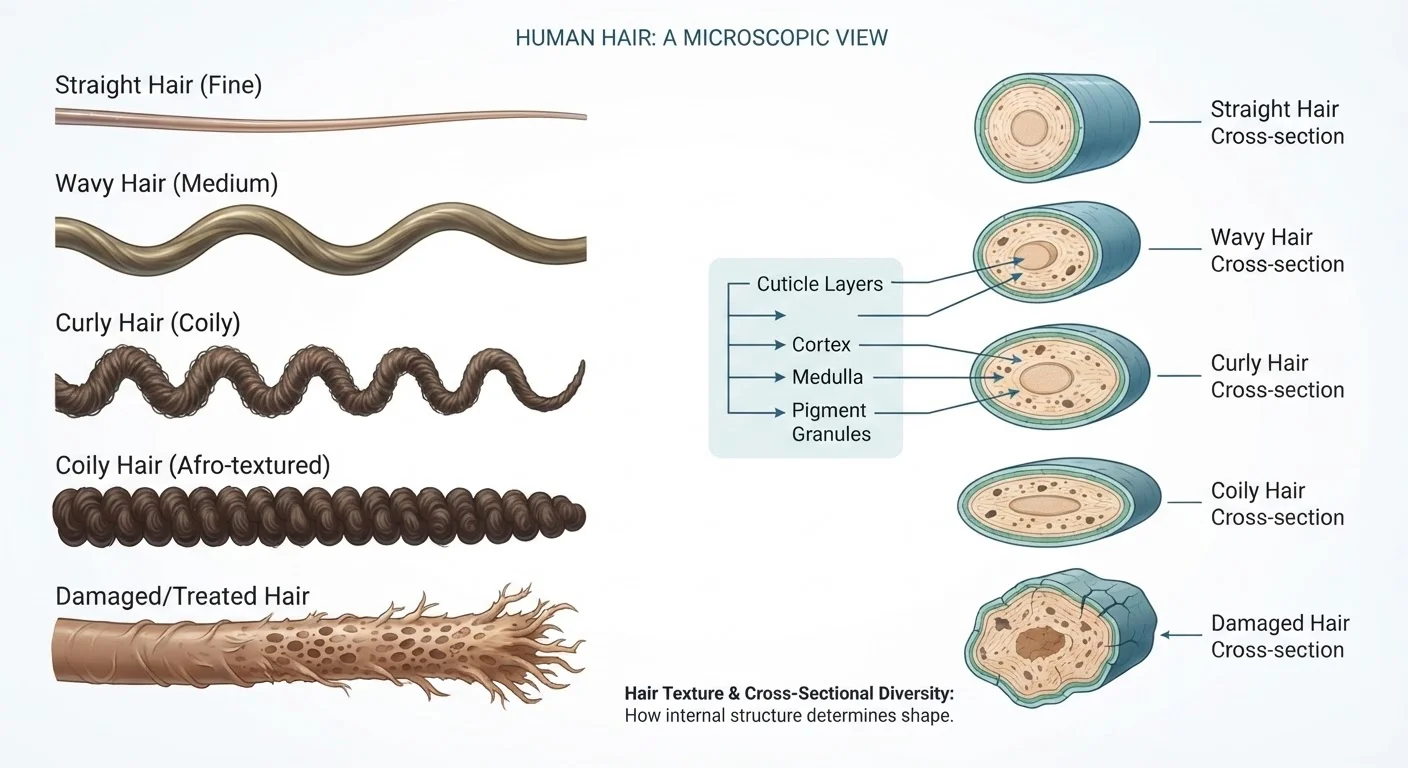
Every hair strand is wrapped in a cuticle - a series of overlapping, scale-like cells that act as the strand's first line of defense. In ideal conditions, these scales lie flat, protecting the inner cortex and keeping moisture locked in. The degree to which they open, and how readily they close again, is what we mean by porosity.
Think of cuticle scales like roof shingles. Tightly overlapping shingles shed water efficiently; lifted or damaged shingles let water in and out unpredictably. That analogy captures why two people can use the identical product and get completely different results - their cuticle structure is simply reading the formula differently.
For a deeper look at what compromises that structure in the first place, see our guide to hair damage and its causes.
3 layers
Structural layers of a single hair strand
The cuticle, cortex, and medulla make up the hair shaft; porosity is determined by the outermost cuticle layer's condition.
~6-7
Ideal scalp and hair surface pH range
Research in dermatology journals notes that an acidic pH environment supports a flatter, more closed cuticle - relevant to product and rinse choices.
Low, Medium, and High Porosity - What Each Actually Means
Low porosity hair has a tightly closed cuticle. Water tends to bead or roll off initially, and the hair can take noticeably longer to become fully saturated. Once moisture does get in, though, it tends to stay - which is a genuine advantage. The trade-off is that products, particularly heavier creams and oils, can accumulate on the surface rather than penetrate, leaving hair feeling coated or limp.
Medium (or normal) porosity is often described as the most flexible state. The cuticle opens and closes with relative ease, accepting moisture and holding it reasonably well. This is the baseline many hair care formulations are implicitly designed around.
High porosity hair has a cuticle that is raised, compromised, or structurally incomplete. Moisture absorbs quickly - sometimes too quickly - but escapes just as fast. Hair can feel perpetually thirsty, frizzy in humidity, and prone to breakage. High porosity can be a natural characteristic of certain hair types, though it is frequently a signal of accumulated damage from heat or chemical processing.
Adjusting Your Routine by Porosity Level
Understanding your porosity is useful only when it translates into practical decisions. Here is how to approach each end of the spectrum.
For Low Porosity Hair
The main challenge is getting moisture in. Applying conditioner to warm, damp hair - or using a gentle heat cap during deep conditioning - can help the cuticle accept product more readily. Stick to lighter, water-based leave-ins and avoid layering heavy butters and oils that tend to sit rather than absorb. Clarifying regularly helps remove the buildup that low porosity hair accumulates more easily than other types.
For High Porosity Hair
The goal shifts to sealing: getting moisture in is easy, keeping it in is the work. Protein-based treatments can temporarily fill gaps in the cuticle, reducing how quickly moisture escapes. Layering a butter or oil over a water-based moisturizer - following the well-established LOC or LCO methods - creates a barrier that slows moisture loss. Cold or cool water rinses after conditioning can also help encourage the cuticle to lie flatter.
When evaluating product labels for ingredients that match your porosity needs, our breakdown of common hair product ingredients offers useful context without the marketing noise.
Try the Behavioral Test Before Buying Products
Rather than relying solely on at-home float tests, observe how your hair behaves after washing: how long it takes to wet fully, how quickly it dries, and whether products absorb or sit on the surface. These real-use observations give a more reliable porosity signal than any single informal test and can guide smarter product choices without unnecessary trial and error.
Porosity in Context: One Factor Among Several
Porosity is genuinely useful, but it doesn't operate in isolation. Hair density, strand diameter, curl pattern, and scalp health all interact with porosity in ways that make a purely porosity-focused approach incomplete. Someone with fine, low-porosity strands and someone with coarse, low-porosity strands will not respond identically to the same products, even if their porosity category matches.
It's also worth noting that porosity can vary across different sections of the same head - especially if some areas have seen more heat exposure or chemical processing than others. Treating your hair as a single, uniform category can lead to routine choices that work for some areas and not others.
For a fuller picture of how hair characteristics interact, our plain-language reference on hair texture and type is a practical companion to this guide.
Porosity Tests Have Limits
The widely shared float test (placing a strand in water and watching whether it sinks or floats) is a rough proxy at best. Product residue, strand cleanliness, and the presence of natural oils can all skew results. Hair professionals generally consider behavioral observation - how hair absorbs and retains moisture during regular washing and styling - a more practical and reliable indicator of true porosity.