

| Number of primary curl categories | 4 (Types 1-4) |
| Subcategory letters per type | a, b, c |
| Strand diameter classifications | Fine, medium, coarse |
| Does curl type determine porosity? | No - they are independent properties |
| Type with highest shrinkage potential | Type 4 (especially 4c) |
| What typing systems do NOT assess | Porosity, elasticity, scalp health, damage level |
What Hair Typing Systems Actually Measure
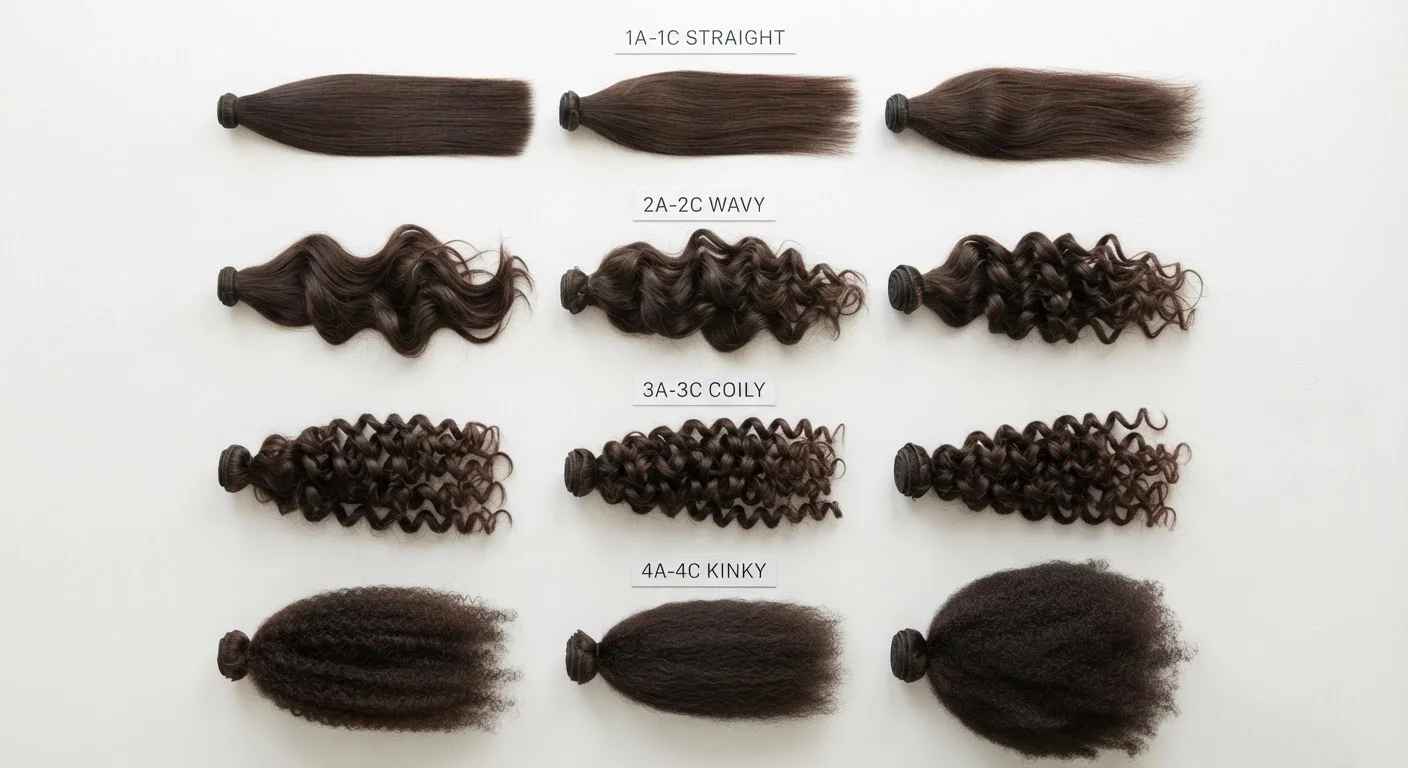
Hair typing systems attempt to categorize strands by observable physical characteristics - primarily curl pattern, strand diameter (often called texture), and sometimes density. The most widely referenced framework in the US assigns numbers 1 through 4 to curl shape categories (straight through coily), with letter subdivisions (a, b, c) indicating variation within each group.
It's worth clarifying what these systems do not measure: porosity, elasticity, scalp condition, or overall hair health. Knowing you have 3b curls, for instance, tells you about the shape of your strands - it says nothing about how well those strands absorb moisture or how resilient they are to styling stress. For a fuller picture, understanding hair porosity is a complementary and often more actionable reference.
| Number of primary curl categories | 4 (Types 1-4) |
| Subcategory letters per type | a, b, c |
| Strand diameter classifications | Fine, medium, coarse |
| Does curl type determine porosity? | No - they are independent properties |
| Type with highest shrinkage potential | Type 4 (especially 4c) |
| What typing systems do NOT assess | Porosity, elasticity, scalp health, damage level |
The Core Categories Explained
Here's a plain-language breakdown of the four primary curl pattern categories:
- Type 1 (Straight): Strands lie flat with no natural curl or wave. Subcategories reflect shine level and thickness, from fine and pin-straight (1a) to coarser, with slight body (1c).
- Type 2 (Wavy): A loose S-shape that becomes more defined from 2a (subtle beach wave) to 2c (pronounced waves that can border on ringlet formation). Waviness originates at or near the root.
- Type 3 (Curly): Defined ringlets or spirals. Type 3a curls are loose and large-diameter; 3c curls are tight corkscrew spirals. Shrinkage - the difference between stretched and natural length - becomes more noticeable here.
- Type 4 (Coily/Kinky): Tightly coiled or zigzag patterns with the highest degree of shrinkage. Type 4c, at the far end, may have no visible curl clumping and is particularly prone to dryness due to the difficulty natural sebum has traveling down highly coiled strands.
Understanding the structural differences between these types connects directly to how different hair structures respond to damage - tighter curl patterns have more points of vulnerability along each strand.
Curl Pattern
The natural shape a hair strand forms from root to tip - ranging from straight to coily. Determined primarily by the cross-sectional shape of the hair follicle.
Strand Diameter
The physical thickness of a single hair strand, typically classified as fine, medium, or coarse. Affects how hair absorbs products and responds to heat styling.
Hair Density
The number of individual hair strands per square inch of scalp. High density and thick strand diameter are different properties that are often confused.
Shrinkage
The difference between a hair strand's stretched length and its natural, unstyled length. More pronounced in coily and kinky hair types due to tight curl formation.
Porosity
A measure of how readily the hair's cuticle layer opens to absorb and retain moisture. Ranges from low to high and is not determined by curl type alone.
Sebum
The natural oil produced by sebaceous glands in the scalp. In straight hair it travels easily down the shaft; in tightly coiled hair, distribution is more limited, contributing to dryness.
Strand Diameter and Density: The Missing Variables
Curl pattern alone is an incomplete guide to building a care routine. Two equally important properties often overlooked by basic typing systems are strand diameter and hair density.
Strand diameter - whether individual hairs are fine, medium, or coarse - affects how quickly hair absorbs products, how much weight it can hold before losing shape, and how it responds to heat. Fine strands are more easily overwhelmed by heavy formulas; coarse strands may need richer conditioning agents to maintain flexibility.
Density refers to how many strands grow per square inch of scalp - not to be confused with strand thickness. Someone can have fine-diameter strands at very high density, creating the appearance of full hair that still needs lightweight products. Scalp condition also plays a separate but related role that no curl typing system captures.
Typing Systems Have Known Limitations
Hair typing frameworks were developed primarily as consumer-facing tools, not scientific classifications. They can oversimplify the real diversity of hair characteristics and have historically underrepresented the range within Type 4 hair. Use these categories as a loose reference rather than a definitive label - your actual routine should be guided by how your hair responds, not a number-letter code.
How to Use This Information Practically
Typing systems are most useful as a starting point for narrowing down product formulations and styling techniques - not as rigid prescriptions. A few grounded applications:
- Use curl type to identify general moisture needs. Types 3 and 4 typically benefit from more deliberate moisture-retention strategies than types 1 and 2, partly because sebum distribution is more difficult along curved strands.
- Use strand diameter to calibrate product weight. If a product consistently weighs your hair down or leaves residue, strand diameter is often a more diagnostic factor than curl type.
- Expect variation across your own head. Many people have multiple curl patterns - different zones of the scalp produce different results. This is structurally normal.
When evaluating a new hair product, combining your curl type with your porosity and strand diameter gives you a more reliable filter than curl type alone. For those building a routine from scratch, the complete hair and body care starting point provides useful foundational context.