

Key Takeaways
- Hair is made of dead keratin protein, so damage accumulates and cannot be biologically repaired.
- Heat, chemical processing, and friction are the three primary drivers of structural hair damage.
- The cuticle - the outermost layer - is the first line of defense and the first to show wear.
- Cumulative low-level stress (daily brushing, tension, UV exposure) can be just as damaging over time as acute chemical treatment.
- Understanding your hair's structural vulnerability helps you make more informed choices about products and routines.
Hair Damage
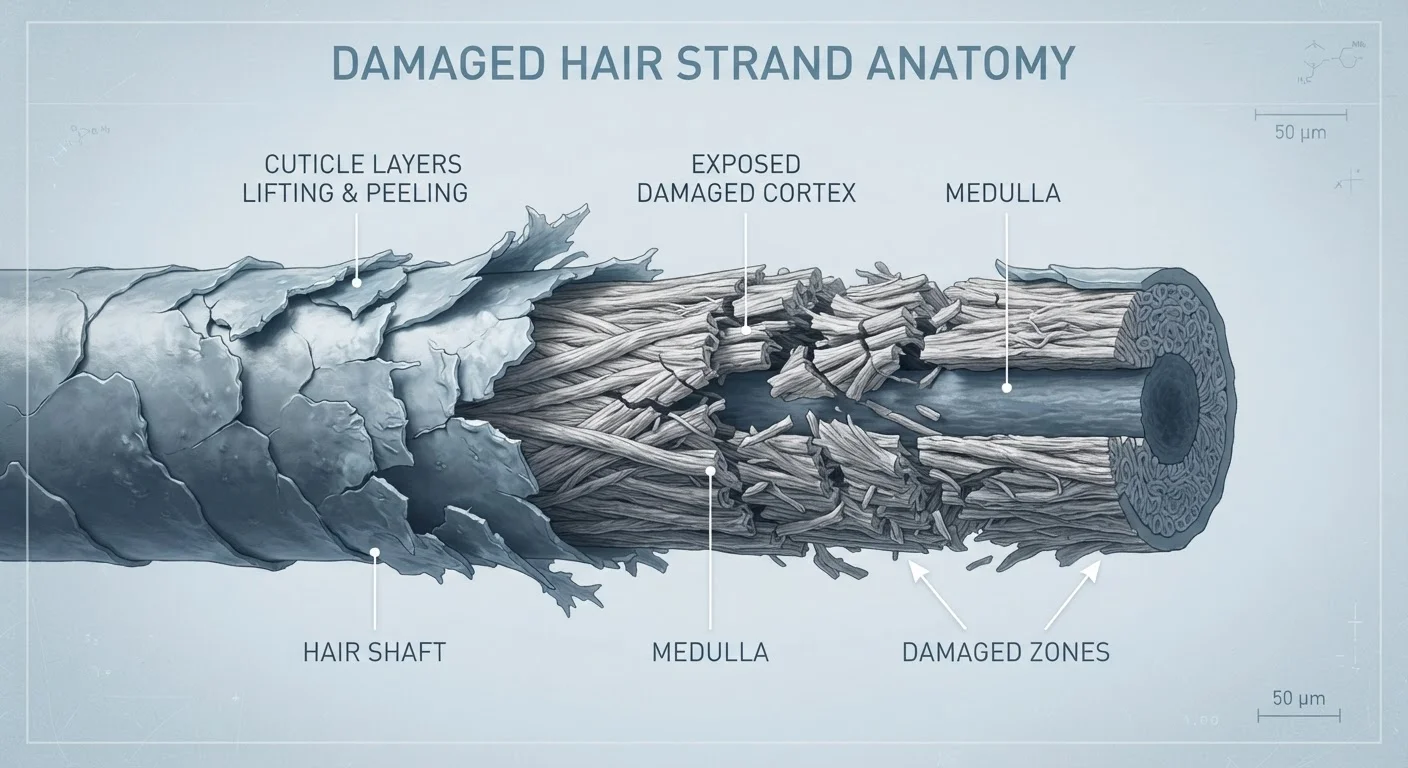
Hair damage refers to structural changes in the hair shaft that impair its integrity, appearance, and strength. Because the hair shaft is composed of dead, keratinized cells, damage is cumulative and largely irreversible without cutting it away. Damage typically begins at the outermost layer - the cuticle - and progresses inward to the cortex if stress continues.
At the molecular level, damage often involves the disruption of disulfide bonds in the hair's keratin protein network and the degradation of the lipid layer that coats the cuticle - a process measurable by techniques like scanning electron microscopy.
Hair Structure: What You're Actually Working With
To understand why hair gets damaged, it helps to first understand what hair is made of. Each strand consists of three concentric layers: the medulla (the innermost core, absent in many fine hair types), the cortex (the thick middle layer responsible for strength, elasticity, and color), and the cuticle (the outermost shield of overlapping, scale-like cells).
The cuticle's primary job is protective. When healthy, its flat, tightly overlapping scales reflect light evenly - which is why undamaged hair looks shiny - and act as a barrier against moisture fluctuation and chemical penetration. The cortex, meanwhile, is composed primarily of keratin proteins held together by disulfide bonds and hydrogen bonds. These bonds give hair its tensile strength and flexibility.
Critically, the hair shaft is dead tissue. Unlike skin, it cannot regenerate, recruit immune cells, or initiate repair processes. This biological fact is why damage accumulates rather than resolves on its own. It also means that every stressor - heat, chemicals, friction, UV radiation - leaves a permanent mark unless the damaged segment is physically removed.
Hair vs. Scalp: Two Different Systems
It's worth distinguishing between the hair shaft and the scalp, which is living skin tissue with its own biology. Conditions affecting the scalp - such as dryness, inflammation, or sebum production - are physiologically distinct from damage to the hair strand itself. A compromised scalp can indirectly affect hair growth and quality, but addressing scalp health is a separate conversation. For more on this distinction, see our article on scalp versus hair health.
Heat: How Temperature Disrupts Keratin
Heat is one of the most pervasive sources of hair damage in daily routines. When temperatures rise above roughly 230°F (110°C), hydrogen bonds in the cortex begin to break. At higher temperatures - typically above 350°F (177°C) - keratin proteins themselves begin to denature, meaning they lose their functional shape permanently.
The cuticle is the first structure to show heat-related deterioration. Scales lift, crack, or fuse unevenly, creating an irregular surface that scatters light (visible as dullness) and lets moisture escape unpredictably (which increases brittleness and frizz). Hair with high porosity - whether naturally or due to prior chemical processing - is particularly susceptible because its cuticle is already compromised.
Heat protectants work by forming a thin film over the cuticle surface that slows direct heat conduction and reduces friction, but they don't render hair immune to damage. They reduce the degree of harm - they don't eliminate it. Lower temperature settings, less frequent use, and ensuring hair is fully dry before applying direct heat are among the more impactful variables.
Match Heat Settings to Hair Condition
If your hair is already chemically processed, color-treated, or naturally high-porosity, consider using lower heat settings than you might otherwise reach for. High-porosity hair absorbs heat more rapidly and has less structural buffer against temperature stress. A lower setting applied less frequently tends to produce less cumulative damage than a high setting used daily, even if individual sessions feel less transformative.
Chemical Processing: Rewriting the Bonds
Chemical treatments - bleaching, permanent color, relaxers, and perms - achieve their effects by intentionally breaking and reforming bonds within the cortex. Bleach, for instance, uses an oxidative reaction to break down melanin, but this process simultaneously degrades the keratin protein matrix and strips the cuticle's protective lipid layer (specifically, a fatty acid called 18-MEA that is covalently bonded to the cuticle surface).
Relaxers and perms target disulfide bonds - the strongest structural bonds in keratin - using reducing agents to break them and then fixing agents to reset them in a new configuration. Even when performed correctly, this process leaves hair with altered porosity, reduced elasticity, and a measurably thinner cuticle.
The cumulative effect matters. Each subsequent chemical application acts on hair that is already structurally compromised, which is why over-processed hair becomes progressively more fragile. Understanding how product ingredients interact with chemically processed hair can help guide more informed product choices after treatment.
~80%
Of hair's dry weight is keratin protein
Research published in the Journal of Cosmetic Science identifies keratin as the dominant structural component, underscoring why protein integrity is central to hair health.
230°F+
Temperature at which hydrogen bonds begin to break
Studies on hair fiber thermodynamics indicate that keratin structural changes begin at temperatures commonly reached by standard flat irons set to medium-high.
Up to 45%
Reduction in tensile strength after bleaching
Research cited in cosmetic chemistry literature suggests heavily bleached hair can lose nearly half its tensile strength compared to unprocessed hair, depending on bleach concentration and processing time.
Mechanical and Environmental Stress: The Slow Accumulation
Not all damage is dramatic or immediate. Everyday mechanical stress - brushing, detangling, tight hairstyles, and friction from pillowcases - contributes to cuticle erosion and eventual cortex exposure over time. Even protective styles can cause breakage when tension is applied consistently to the same sections of hair.
Environmental stressors are similarly incremental. UV radiation degrades keratin proteins in the cortex and breaks down melanin, which is why outdoor exposure often produces hair that feels rough and looks faded over months. Hard water deposits mineral ions on the cuticle surface, which can increase friction and contribute to a dull, stiff texture. Humidity fluctuations cause the cortex to swell and contract, gradually stressing the cuticle - a particular concern for highly porous or textured hair.
These stressors rarely act in isolation. A typical day might combine UV exposure, heat styling, mechanical detangling, and product layering - each adding incrementally to structural wear. Recognizing that damage is cumulative rather than event-based is one of the more useful shifts in perspective for anyone building a more considered hair care routine. For context on how aging compounds these vulnerabilities, the article on how hair changes with age offers additional detail.