

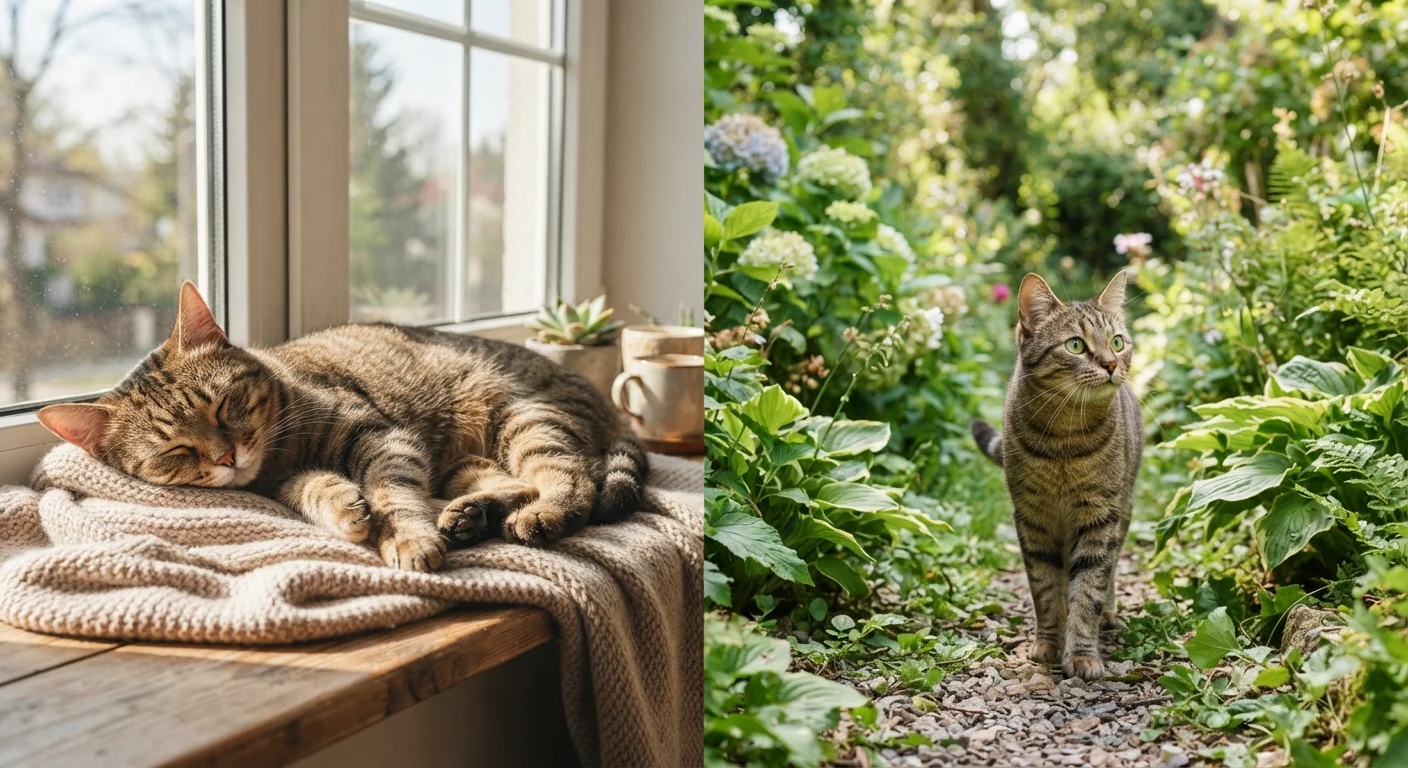
Key Takeaways
- Indoor cats typically live significantly longer on average than cats with outdoor access.
- Outdoor cats face greater risks from trauma, infectious disease, parasites, and predation.
- Indoor cats are more prone to obesity, urinary issues, and behavioral problems without adequate enrichment.
- Neither lifestyle is inherently superior - management and environment quality matter most.
- Veterinary guidance consistently recommends enrichment strategies for indoor cats to support mental and physical health.
- Supervised outdoor access can offer some benefits of both approaches for appropriate cats.
Option A
Indoor Cats
The sheltered, enrichment-dependent lifestyle.
Best for: Owners in urban environments or areas with high traffic, predators, or disease risk who want greater control over their cat's safety.
Option B
Outdoor Cats
The stimulation-rich, higher-exposure lifestyle.
Best for: Cats in lower-density rural or suburban settings where roaming risk is reduced and owners can accept a wider range of environmental variables.
If you live in a densely populated urban area with heavy traffic
Indoor Cats
Urban hazards including vehicles, toxins, and infectious disease spread from stray populations make outdoor access considerably more dangerous in cities.
If your cat shows signs of boredom, anxiety, or stress indoors
Indoor Cats with enrichment
Structured enrichment - puzzle feeders, climbing structures, and play sessions - can address behavioral and physical health needs without outdoor exposure.
If you live in a rural setting with low traffic and manageable predator risk
Outdoor Cats
Lower-density environments reduce some key outdoor hazards, and cats with outdoor access tend to engage more natural hunting and exploratory behaviors.
If you want to balance stimulation with safety
Indoor Cats with supervised outdoor time
Leash walks, enclosed catios, or supervised garden time can provide environmental enrichment while keeping major outdoor risks well controlled.
If you are adopting a cat with an established outdoor history
Outdoor Cats
Cats accustomed to outdoor life may experience significant stress if suddenly confined indoors; gradual transition with enrichment is recommended if a change becomes necessary.
Lifespan and the Numbers Behind Each Lifestyle
The lifespan gap between indoor and outdoor cats is one of the most cited statistics in feline veterinary medicine. Indoor-only cats live an average of 12-18 years, while cats with regular outdoor access average closer to 2-5 years in some studies - though estimates vary widely based on geography and traffic density. The American Veterinary Medical Association and major animal welfare organizations consistently note that outdoor access significantly increases mortality risk, primarily through vehicle trauma, infectious disease, and predation.
These figures don't mean every outdoor cat faces an early death, but they do reflect population-level risks that owners should weigh honestly. Geography, supervision level, and whether a cat has outdoor access at all versus partial supervised access all influence actual outcomes considerably.
12-18 yrs
Typical indoor cat lifespan
According to the American Veterinary Medical Association, indoor-only cats live significantly longer on average than cats with outdoor access.
~58%
US cats kept primarily indoors
The American Pet Products Association's pet owner surveys consistently show a majority of US cat owners keep their cats indoors or predominantly indoors.
2-3x
Higher obesity risk in indoor cats
Research published in veterinary journals indicates indoor cats are two to three times more likely to be overweight compared to cats with regular outdoor exercise.
Health Risks Specific to Each Environment
Outdoor cats encounter a broader range of pathogens. Feline leukemia virus (FeLV), feline immunodeficiency virus (FIV), feline upper respiratory infections, and intestinal parasites are all transmitted more readily through contact with other cats, contaminated soil, or wildlife. Regular parasite prevention and vaccination are essential for any cat with outdoor access. Injury from vehicle strikes, dog attacks, and territorial cat fights is also substantially more common.
Spaying and neutering reduces roaming behavior and lowers the risk of reproductive cancers - particularly important for outdoor cats who are more likely to encounter other animals.
Indoor cats face a different set of challenges. Reduced physical activity combined with calorie-dense diets is a leading driver of feline obesity. Overweight cats carry elevated risk for diabetes, joint disease, and urinary tract disorders. See our article on why excess weight matters for a deeper look at how body condition affects long-term health. Lower water intake - common in cats fed primarily dry food - can also contribute to urinary and kidney problems. Learn how diet choices intersect with these risks in our guide on wet food, dry food, and raw diets.
| Criterion | Indoor Cats | Outdoor Cats |
|---|---|---|
| Average lifespan | 12-18 years | 2-10 years (varies widely) |
| Infectious disease risk | Low (limited animal contact) | Higher (FeLV, FIV, URI exposure) |
| Parasite exposure | Low to minimal | Regular prevention required |
| Trauma risk | Low | High (vehicles, predators, fights) |
| Obesity risk | Higher without enrichment | Lower due to activity level |
| Behavioral stimulation | Requires active owner effort | Naturally higher |
| Veterinary monitoring ease | Easier - known environment | Harder - injuries may go unnoticed |
Behavioral and Mental Health Considerations
Mental stimulation is a genuine health variable for cats, not a luxury. Cats are predatory animals with strong instincts for hunting, territory exploration, and sensory engagement. Indoor environments that lack structured enrichment can lead to boredom-driven behaviors: destructive scratching, litter box avoidance, aggression toward housemates, or compulsive over-grooming.
Understanding your cat's communicative signals is a practical first step toward meeting their needs indoors - our guide to cat body language offers a useful framework. Rotation of toys, window perches, food puzzles, and daily interactive play sessions can meaningfully reduce stress indicators in indoor cats.
Outdoor cats exercise their predatory instincts more naturally but also experience their own stressors: territorial competition, seasonal temperature extremes, and encounters with unfamiliar animals. Not all outdoor cats live stress-free lives simply because they roam freely.
Transitioning an Outdoor Cat Indoors
If circumstances require moving an outdoor cat to an indoor-only life - such as a house move or a new health concern - expect an adjustment period. Gradual transition with increased enrichment, vertical space, and interactive play helps reduce stress. Some cats adapt readily; others require weeks of patient acclimatization. Your veterinarian can advise if behavioral signs of distress persist.
Finding the Right Approach for Your Cat
Veterinarians generally recommend keeping cats indoors where feasible, with enrichment strategies to support behavioral health. However, context matters. A confident, active cat in a low-traffic rural area with owner supervision may fare well with limited outdoor access. A timid cat in a dense city is likely better protected indoors. There is no universal prescription - the right decision involves honestly assessing your specific environment, your cat's individual temperament, and your capacity to provide enrichment or supervision.
Supervised outdoor options - leash training, enclosed catios, or screened porches - represent a practical middle ground that many veterinarians support. They allow cats to experience outdoor sensory stimulation while controlling exposure to the most serious hazards.
Whichever approach you choose, regular veterinary checkups, parasite prevention, and attention to diet remain foundational. Nutrition is a lever that applies equally to both lifestyles; exploring pet nutrition guidance can help you calibrate your cat's feeding to match their activity level and life stage.
This article provides general educational information about feline lifestyle and health. It is not a substitute for personalized veterinary advice. Consult your veterinarian about the best approach for your individual cat's needs, health status, and environment.