

Key Takeaways
- Cats knock objects off surfaces primarily out of curiosity and predatory instinct, not spite.
- The behavior is often reinforced when owners react with attention, even negative attention.
- Providing enrichment and dedicated playtime can significantly reduce object-knocking.
- Persistent or sudden increases in this behavior may occasionally signal understimulation or stress.
Why Cats Really Knock Things Over
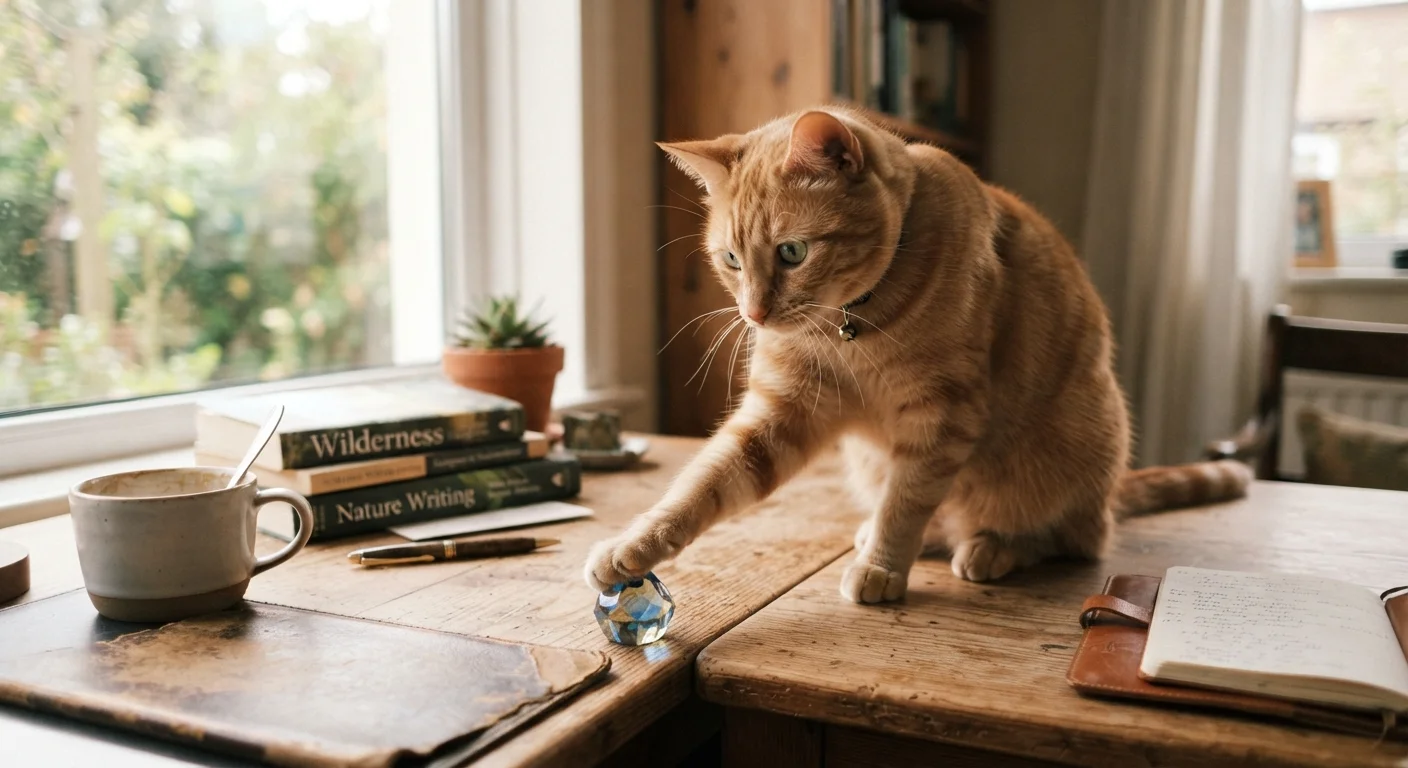
Few feline behaviors generate more amused bewilderment than watching a cat lock eyes with its owner, then calmly bat a glass off the counter. It looks deliberate - because, in a sense, it is. But the motivation is almost never what owners assume.
Cats are hardwired hunters whose brains are tuned to detect and investigate movement. When a cat swipes at an object on a table, it is activating the same neural circuitry used to test whether a potential prey item is alive, dead, or worth chasing. Tapping and nudging objects is how cats gather tactile and visual information about their environment - a form of sensory investigation that requires no human interpretation to make sense.
Understanding the genuine drivers behind this behavior puts owners in a much better position to respond helpfully. See also our guide to cat body language to recognize the broader signals your pet uses to communicate.
Myth
Cats knock things over to spite their owners or get revenge for perceived slights.
Fact
Cats lack the cognitive architecture for spite or revenge - the behavior is driven by instinct and learned reinforcement, not grudges.
Spite requires the ability to attribute mental states to others and to plan actions intended to cause displeasure - a level of social cognition not demonstrated in domestic cats. When a cat swipes your phone off the nightstand after you ignored it, the sequence feels retaliatory but is better explained by arousal, attention-seeking, and the fact that the behavior previously earned a reaction. Feline memory works through association, not narrative grievance.
Myth
Cats are just clumsy and accidentally knock things over without meaning to.
Fact
The behavior is typically deliberate - cats use their paws to investigate objects with focused, controlled movements.
A cat's paw pads are rich in sensory nerve endings. When a cat taps or nudges an object repeatedly, it is actively gathering information about texture, weight, and movement potential - the same sensory probing used when investigating prey. The slow, methodical paw push you often see is precise motor control, not a balance mishap.
Myth
Only bored or neglected cats knock things off surfaces.
Fact
Even well-stimulated cats exhibit this behavior because it is rooted in normal predatory and exploratory instinct.
While understimulation can amplify the frequency of object-knocking, the behavior itself is a normal expression of feline curiosity and sensory investigation. Cats in enriched environments still engage in it. The difference is that a sufficiently enriched cat typically has more outlets, so no single behavior dominates. Attributing it entirely to neglect can cause owners to feel unnecessarily guilty while missing the actual behavioral dynamic at play.
Myth
Cats knock things over because they want to watch objects fall - they enjoy the physics.
Fact
Cats are responding to movement cues that mimic prey behavior, not engaging in abstract appreciation of gravity.
The popular idea that cats are amateur physicists testing gravity is charming but misleading. What draws a cat's attention is the motion an object makes when disturbed - a wobbling pen or a rolling bottle triggers the same visual tracking response as a fleeing mouse. The fall is a byproduct of the investigation, not the goal itself. That said, if a falling object consistently triggers an owner's response, cats can and do learn to repeat the action for that social reward.
What You Can Actually Do About It
Once you understand the real drivers, the path forward becomes clearer. If the behavior is curiosity-driven and attention-reinforced, the most effective response is consistent, calm non-reaction combined with proactive enrichment.
~2-3×
Activity boost from daily interactive play
Behavioral research consistently shows that cats given structured daily play sessions display predatory behaviors like object-batting at lower frequencies in other contexts.
26 m/s²
Sensitivity of feline paw nerve endings
Studies on feline tactile receptors indicate cats' paw pads are among the most sensitive touch organs relative to body size, explaining why pawing is a primary investigative tool.
- Increase interactive play. Two or three short sessions daily with a wand toy or feather lure satisfies predatory drive and reduces the need to self-stimulate with household objects.
- Provide sanctioned exploration zones. Cat trees, window perches, and puzzle feeders give cats approved surfaces and activities that channel the same exploratory energy.
- Clear tempting objects strategically. For items that genuinely cannot be knocked over safely - medications, breakables - remove them from accessible surfaces rather than expecting the cat to self-regulate.
- Avoid reinforcing the loop. If your cat has learned that knocking things over earns your attention, even a scolding maintains the cycle. Redirect to a toy before the behavior starts, rather than reacting after.
A sudden, sharp increase in this or other attention-seeking behaviors can sometimes reflect environmental stress or understimulation. For context on how a cat's living environment shapes behavior overall, see our article on indoor vs. outdoor cats and long-term health. And just as litter box avoidance is rarely spite, object-knocking is rarely malice - our litter box troubleshooting framework illustrates how systematic thinking helps decode most feline behaviors.
If the behavior is extreme, compulsive, or accompanied by other signs of distress, consult a veterinarian or a certified applied animal behaviorist for individualized guidance.