

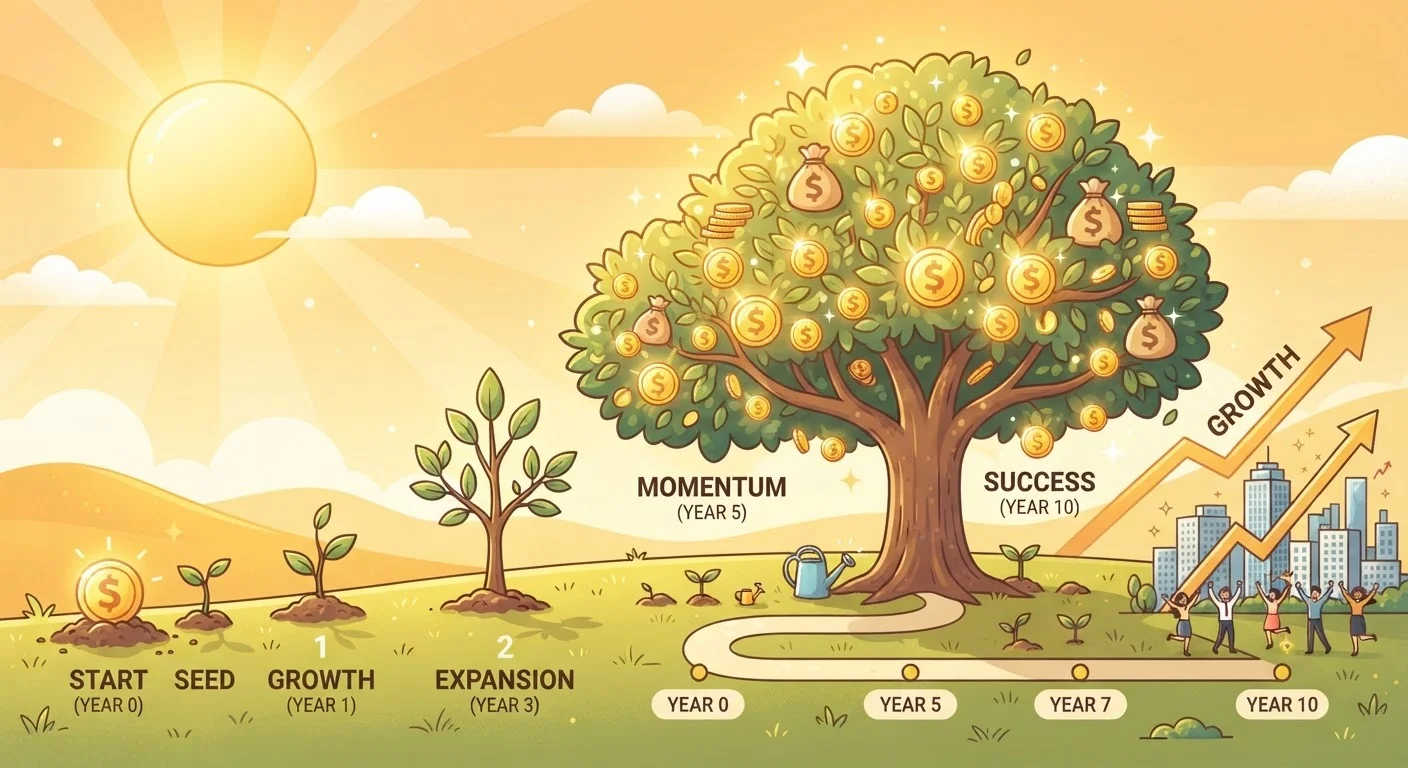
Key Takeaways
- Compound interest grows your money faster than simple interest by earning returns on previous returns.
- Starting early almost always outweighs investing larger amounts later.
- On debt, compounding works against you - unpaid interest gets added to the balance you owe.
- Compounding frequency (daily vs. monthly) affects how quickly a balance grows.
- Even modest, consistent contributions benefit significantly from long compounding horizons.
Compound Interest
Compound interest is interest calculated on both your original principal and the interest you've already earned (or owed). Unlike simple interest, which only applies to the original amount, compound interest causes your balance to grow - or grow against you - at an accelerating pace over time. It's the reason a small, early investment can outpace a larger, later one.
Compounding frequency matters: interest can compound daily, monthly, quarterly, or annually. More frequent compounding produces a slightly higher effective annual rate, captured by the Annual Percentage Yield (APY) figure.
How Compound Interest Actually Works
The core mechanic is straightforward: each period, interest is calculated on your entire balance - including interest already added. That means your balance grows faster with every cycle, not at a flat, predictable pace.
Consider a simple illustration. If you deposit $1,000 at a 5% annual interest rate:
- Year 1: You earn $50, ending with $1,050.
- Year 2: You earn 5% of $1,050 - that's $52.50, ending with $1,102.50.
- Year 10: Your balance has grown to roughly $1,629 - without adding a single extra dollar.
The extra $629 came entirely from interest earning interest. This acceleration is what distinguishes compounding from simple interest, where year after year you'd earn only $50 regardless of accumulated growth.
Rule of 72
Years to double your money estimate
Divide 72 by your annual interest rate to estimate how many years it takes to double a sum - a longstanding rule of thumb used by financial educators.
Daily
How often most credit cards compound interest
The Consumer Financial Protection Bureau (CFPB) notes that most credit cards use a daily periodic rate to calculate interest on carried balances.
Why Starting Early Beats Starting Big
Time is the single most powerful variable in the compound interest equation. This is often illustrated through the concept of a "head start" - an investor who begins earlier with less money can finish ahead of someone who invests more but waits.
Here's a simplified comparison: a person who invests $5,000 a year starting at age 25 and stops at 35 (10 years of contributions) will typically accumulate more by retirement than someone who starts at 35 and contributes the same $5,000 annually all the way to 65 (30 years of contributions), assuming identical rates of return. The early starter's money had more cycles to compound.
This isn't a reason to feel discouraged if you're starting later. It's a reason to start now - every year of additional compounding time still matters.
Automate to Stay Consistent
Setting up automatic transfers to a savings or retirement account removes the temptation to skip contributions during tight months. Consistent, automated investing - even in small amounts - keeps compounding uninterrupted. Most employer-sponsored retirement accounts allow automatic payroll deductions for exactly this reason.
When Compounding Works Against You
Compound interest is neutral - it rewards savers and burdens borrowers with equal indifference. On debt, the same mechanics that grow savings will quietly expand what you owe.
Credit cards are the most common example. Most cards compound interest daily on any carried balance. Miss a full payment, and next month's interest is calculated on the original balance plus last month's interest charges. Over time, even a modest balance can balloon significantly. The real cost of carrying a credit card balance illustrates how minimum payments extend this cycle for years.
Student loans, depending on loan type and repayment status, can also capitalize interest - meaning unpaid interest gets added to your principal. This is worth understanding for anyone managing education debt. See how debt type changes your strategy for a broader look at how different debts behave.
When tackling high-interest debt, the goal is to interrupt compounding - pay above the minimum, consistently, to shrink the balance that interest is calculated against. The debt avalanche and debt snowball methods offer two structured approaches for doing exactly that.
Putting Compound Interest to Work
You don't need a large lump sum to benefit from compounding. Consistent, recurring contributions - even small ones - add to the base that earns future interest. Three practical principles apply:
- Start as early as possible. Even contributions that feel too small to matter create a compounding foundation. Time is the variable you can't recover later.
- Reinvest earnings. In savings and investment accounts, this often happens automatically. Confirm that dividends or interest are set to reinvest rather than be paid out.
- Avoid interruptions. Withdrawing from a compounding balance resets the growth curve. Where possible, treat long-term accounts as untouchable until their intended purpose.
For those balancing savings goals with existing debt, the approach requires nuance. Managing debt and saving at the same time walks through how to advance both goals without abandoning either. And if certain habits are quietly slowing your progress, savings habits that undermine your progress is worth a look.
This article is for general informational and educational purposes only and does not constitute personalized financial, investment, or tax advice. Consult a qualified financial professional for guidance specific to your situation.