

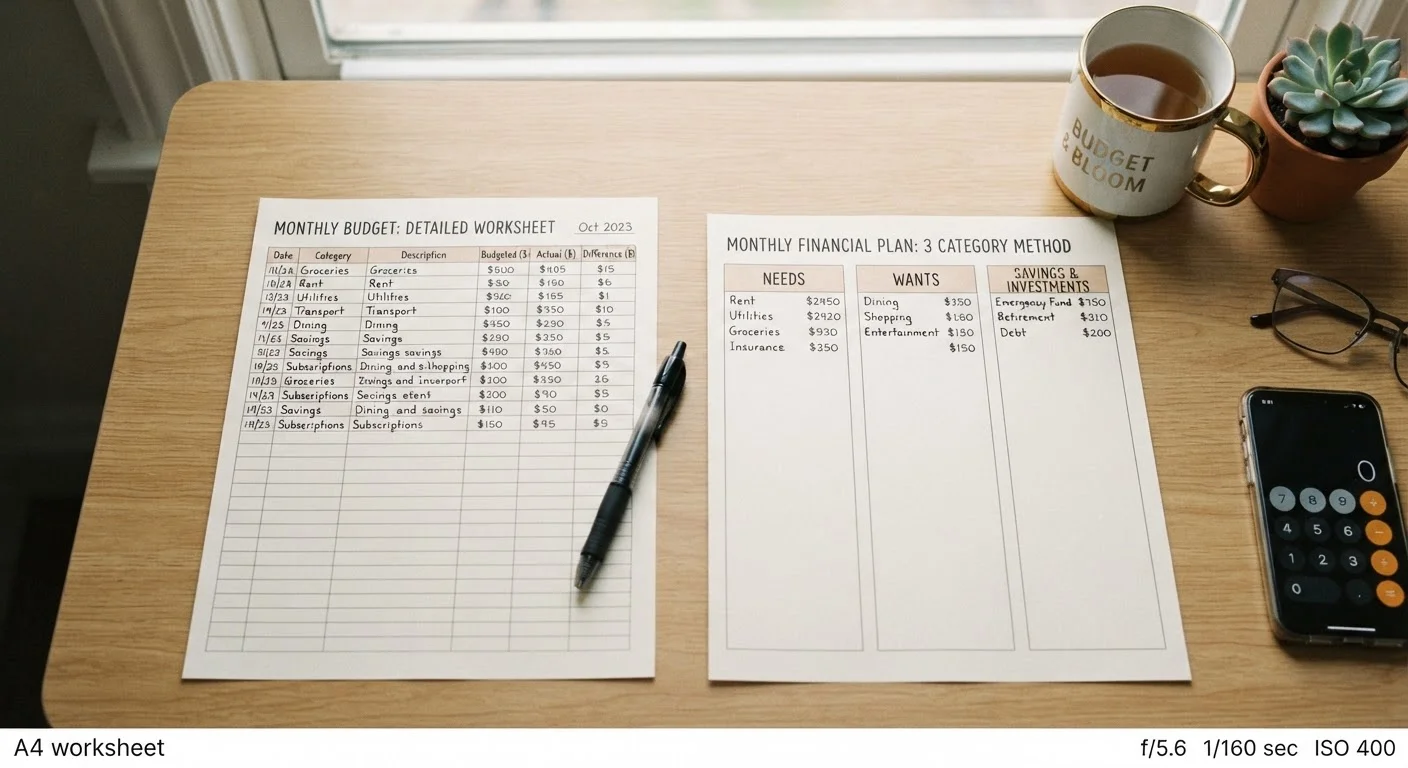
Key Takeaways
- Zero-based budgeting assigns every dollar a specific job before the month begins, leaving no income unaccounted for.
- The 50/30/20 method divides after-tax income into three broad buckets: needs, wants, and savings or debt repayment.
- Zero-based budgeting offers more precision but demands more time and active monthly upkeep.
- The 50/30/20 rule is easier to maintain but may not suit very tight budgets or high-cost-of-living situations.
- Neither method is universally superior - the right choice depends on your income stability, financial goals, and available time.
Option A
Zero-Based Budgeting
The meticulous, dollar-by-dollar approach.
Best for: People who want granular control over every spending category and are willing to invest time each month.
Option B
The 50/30/20 Method
The streamlined, percentage-based framework.
Best for: People who want a simple, low-maintenance structure that doesn't require tracking every individual expense.
If you want complete visibility into every dollar you earn and spend
Zero-Based Budgeting
Zero-based budgeting forces you to plan each category explicitly, leaving no income unassigned. This level of detail is valuable when you want to find and eliminate wasteful spending.
If you prefer a simple system you can set up in under 30 minutes
The 50/30/20 Method
The three-category structure requires minimal tracking and is easy to revisit monthly, making it a sustainable choice for people new to budgeting or with limited time.
If your income is irregular or varies month to month
Zero-Based Budgeting
Building a fresh budget each month based on actual projected income helps you adapt spending and saving targets to what you truly have available.
If you're tackling moderate debt while still building savings
The 50/30/20 Method
The 20% savings-and-debt bucket provides a clear, proportional target without requiring you to recategorize every line item each month.
How Each Method Works
Before comparing these two frameworks head-to-head, it helps to understand what each one actually involves. For a broader look at the full landscape of budgeting approaches, see budgeting methods worth knowing about.
Zero-Based Budgeting
With zero-based budgeting (ZBB), you start from scratch each month. Every dollar of your projected income is assigned to a specific category - rent, groceries, utilities, savings, entertainment, and so on - until your income minus your planned expenses equals zero. That zero doesn't mean you spend everything; it means every dollar has a designated purpose, including savings and debt payments.
The 50/30/20 Rule
The 50/30/20 method divides your after-tax income into three broad categories: 50% toward needs (housing, utilities, food, transportation), 30% toward wants (dining out, subscriptions, hobbies), and 20% toward savings and debt repayment. It was popularized as a flexible, accessible framework for people who want a structure without itemizing every purchase. For a full breakdown, see the 50/30/20 rule explained.
| Criterion | Zero-Based Budgeting | 50/30/20 Method |
|---|---|---|
| Structure | Every dollar assigned to a category | Income split into three broad buckets |
| Monthly time commitment | High - rebuilt each month | Low - percentages stay consistent |
| Level of detail | Very granular | Broad and flexible |
| Best income type | Variable or irregular income | Stable, predictable income |
| Ease for beginners | Steeper learning curve | Quick to set up and understand |
| Spending visibility | Very high | Moderate |
| Adaptability | Highly adaptable each cycle | Less adaptable in high-cost areas |
Key Trade-Offs to Consider
Each method carries genuine advantages - and real limitations. Understanding those trade-offs is more useful than declaring one approach universally better.
~33%
Americans without a monthly budget
Various surveys by organizations such as the NFCC suggest a significant share of U.S. adults do not follow any formal budgeting method.
50%
Income cap for 'needs' in 50/30/20
In high-cost cities, housing costs alone often exceed this threshold, making the rule difficult to apply without adjustments.
Time and Effort
Zero-based budgeting is more time-intensive. You're essentially writing a new financial plan each month, which typically means categorizing income, reviewing last month's actuals, and adjusting categories. The 50/30/20 method, by contrast, involves little monthly upkeep: once you know your after-tax income, the math is simple.
Flexibility vs. Control
The 50/30/20 framework trades granularity for ease. The broad categories mean you're not agonizing over whether a streaming subscription is a "want" down to the exact dollar. Zero-based budgeting gives you sharper visibility - especially useful when you're trying to identify where money is quietly slipping away.
Fit for Different Incomes
In high-cost areas, devoting only 50% of income to needs can be unrealistic. Rent alone can exceed that threshold. The 50/30/20 method can require adaptation in those circumstances. Zero-based budgeting is inherently adaptive - you work with whatever income you have. For a frank look at where the 50/30/20 approach can fall short, see why the 50/30/20 rule doesn't always work.
A Budget Method Is a Starting Point
No budgeting framework works perfectly out of the box for every household. Both zero-based budgeting and the 50/30/20 method are tools - not rules carved in stone. Most people find that adapting the underlying logic to their own income, obligations, and goals produces better results than following any single method rigidly. Starting with one approach and refining it over time is a sound strategy.
Which One Fits Your Situation?
There's no single correct answer - the best budgeting method is the one you'll actually maintain. If you're brand new to personal finance, starting with personal budgeting from the ground up can help you establish the foundations before committing to either framework.
Consider zero-based budgeting if you:
- Have a variable income and need to re-plan monthly
- Want to identify and eliminate specific spending leaks
- Are working through a period of tight finances where every dollar matters
- Enjoy the structure of detailed planning
Consider the 50/30/20 method if you:
- Have a stable monthly income and predictable expenses
- Want a sustainable system that requires minimal ongoing attention
- Are new to budgeting and prefer a gentle entry point
- Are comfortable with broad category targets rather than line-item precision
Some people combine elements of both - using the 50/30/20 percentages as guardrails while zero-basing certain high-spend categories like food or entertainment. You might also explore how envelope budgeting in a digital age compares as an alternative spending-control method. For a deeper look at the specific strengths and weaknesses of zero-based budgeting alone, see the case for and against zero-based budgeting.
This article is for general informational and educational purposes only and does not constitute personalized financial advice. Consult a licensed financial professional for guidance specific to your situation.