

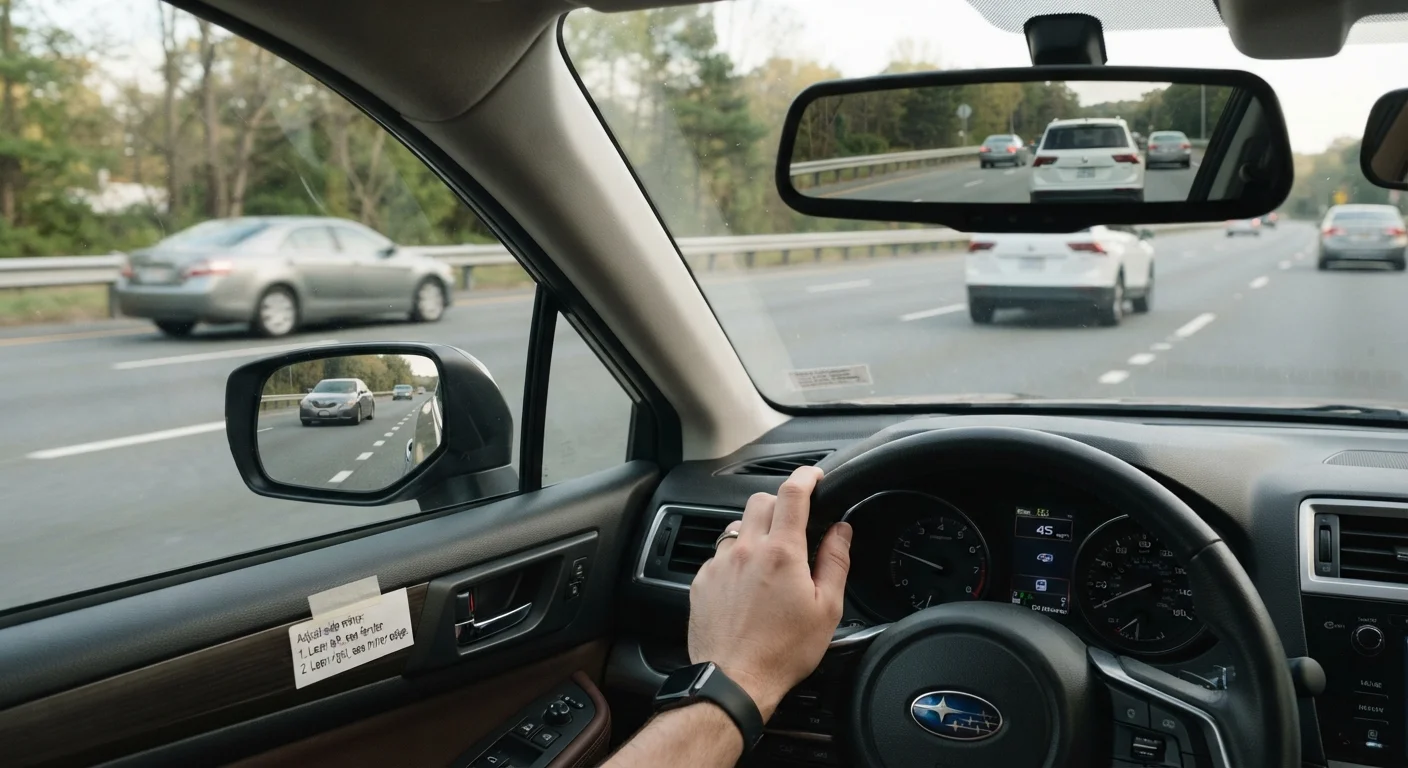
Key Takeaways
- The common habit of centering your own car in side mirrors creates dangerous blind spots.
- Evidence-based mirror positioning angles mirrors outward far enough to eliminate most blind zones.
- Rearview and side mirrors serve distinct purposes and should be adjusted independently each time you drive.
- Even correctly set mirrors have residual blind spots - a head check remains essential before lane changes.
The Mirror Habit Most Drivers Inherited
Ask most drivers why they position their side mirrors the way they do, and the honest answer is: they copied whoever taught them. The dominant habit - angling both side mirrors so you can see the rear corner of your own vehicle - feels intuitive because it gives you a reference point. It also gives you a significant blind spot alongside both rear quarters of the car, exactly where another vehicle is most likely to be when you're changing lanes.
This isn't a minor calibration issue. Research from the Society of Automotive Engineers has explored how outward-angled mirror positioning - sometimes called the Blindzone Glare Elimination (BGE) method - can substantially reduce the blind zone compared to traditional positioning. The core problem with the conventional method is that it duplicates coverage: both side mirrors end up showing largely the same rearward zone that your center rearview mirror already covers.
Understanding why the habit persists helps explain why fixing it takes deliberate effort. For more on how visibility challenges compound at night, see night driving visibility habits.
Common Mirror-Setting Mistakes - and How to Correct Them
The following mistakes apply to the vast majority of everyday drivers. Each one is easy to correct once you understand what the mirrors are actually meant to do.
Centering your own vehicle in both side mirrors.
Why it happens: Drivers are taught this way informally, and seeing their own car provides a reassuring reference point that feels like control.
Adjusting mirrors while the car is in motion or just before pulling into traffic.
Why it happens: Mirror adjustment feels like a quick task that can be handled on the fly, and many drivers don't think to do it before departure.
Setting the rearview mirror too low or at an angle that favors cosmetic use.
Why it happens: The rearview mirror is often touched when checking appearance, and it frequently ends up tilted slightly downward as a result.
Assuming factory-default mirror positions are correct for your seating height.
Why it happens: Drivers of different heights share vehicles without adjusting mirrors, or assume the previous position was set correctly.
Proper mirror coverage ties directly into safe lane-change execution. Once your mirrors are correctly set, the next skill layer is understanding signaling and timing - covered in depth in our guide to merging and lane change communication.
A Practical Reset: How to Set Your Mirrors Correctly
Correct mirror adjustment takes about 90 seconds and should be done every time you get behind the wheel, since mirrors shift when others use the vehicle.
Adjust Mirrors Before You Move - Every Time
Mirror positions shift between drivers and even between trips if someone else has used the vehicle. Adjusting mirrors while moving - even in a parking lot - diverts attention from the road and from your own body position, which affects the calibration. Make it a fixed pre-departure step, like buckling your seatbelt.
Center (rearview) mirror: Frame the entire rear window in the mirror. Your head should be in your normal driving position - not leaned in to get a better view.
Driver-side mirror: Lean your head until it almost touches the driver's window, then adjust the mirror so you can just barely see the left rear corner of your car. When you sit back upright, that corner disappears - and that's correct.
Passenger-side mirror: Lean toward the center console until your head is roughly over the center of the vehicle, then adjust the mirror so the right rear corner of your car is just visible. Again, from your normal driving position, it should disappear from view.
With this configuration, a vehicle moving up from behind should appear first in your center mirror, transition into one of the side mirrors, and then enter your peripheral vision - with minimal gap in between. Some overlap is fine; a gap is not.
~35%
Of crash-involved drivers reported not seeing the other vehicle
National Highway Traffic Safety Administration (NHTSA) data consistently identifies failure to observe as a leading pre-crash driver error.
2-3 sec
Time a vehicle spends in a typical blind spot
At highway speeds, a vehicle can travel through another driver's blind zone in as little as two to three seconds - enough time for a lane change to go wrong.
One caveat: No mirror configuration eliminates all blind spots entirely. A brief head check over your shoulder remains essential before any lane change, regardless of how well your mirrors are set.