

Key Takeaways
- Two dominant technologies - capacitive and optical - read fingerprints using completely different physical principles.
- Capacitive sensors measure electrical differences between ridges and valleys; optical sensors capture reflected light.
- Under-display optical sensors enabled full-screen smartphone designs by removing the need for a dedicated button.
- No fingerprint system is infallible; environmental factors like moisture or cuts can affect accuracy.
- Stored fingerprint data is converted into an encrypted mathematical template, not an actual image, on most devices.
Fingerprint Sensor
A fingerprint sensor is a hardware component that captures an image or electrical map of the unique ridge patterns on a fingertip and compares it against a stored template to verify identity. No two people - including identical twins - share the same fingerprint pattern. Sensors exploit this biological uniqueness to grant or deny access with high accuracy.
Fingerprint recognition systems typically operate on a false acceptance rate (FAR) of less than 0.001%, meaning the statistical chance of a random finger unlocking a protected device is extremely low under controlled conditions.
Why Fingerprints Are Uniquely Suited to Identity Verification
Human fingerprints form during fetal development through a combination of genetic factors and random physical forces - pressure, amniotic fluid movement, and the precise growth rate of skin layers. The result is a pattern of ridges and valleys that is statistically unique to each individual and remains stable throughout a person's lifetime. Even identical twins, who share DNA, develop distinct prints.
This combination of uniqueness, permanence, and accessibility makes fingerprints an almost ideal biometric identifier. A sensor only needs to reliably capture ridge topology - the shapes, endpoints, and bifurcations where ridges split - to distinguish one person from billions of others.
~80
Minutiae points used in a typical match
Most fingerprint recognition algorithms compare roughly 60-80 distinctive ridge features to establish a reliable identity match, according to published biometric standards literature.
0.001%
Typical false acceptance rate
Leading fingerprint sensor manufacturers cite false acceptance rates below 0.001%, meaning the odds of a random unauthorized finger unlocking a device are extremely low under standard testing conditions.
~500 dpi
Typical sensor resolution
Consumer-grade fingerprint sensors commonly operate at 500 dots per inch, sufficient to capture the ridge detail needed for accurate minutiae extraction on most adult fingertips.
Capacitive Sensors: Reading Electricity Through Your Skin
The capacitive sensor, long the standard in smartphones and laptops, works by measuring tiny differences in electrical capacitance across a fingertip's surface. The sensor surface is covered with a dense grid of microscopic capacitor circuits - often hundreds of thousands of them packed into a button-sized area.
When a finger presses down, the skin ridges make direct contact with some capacitors while the valleys remain slightly elevated, leaving an air gap. Because skin conducts electricity differently than air, each capacitor registers a different charge level depending on whether a ridge or a valley is above it. The processor aggregates these charge readings into a high-resolution map of the fingerprint.
Capacitive sensors are fast, accurate, and difficult to fool with a flat photograph because they require actual physical contact with conductive material. Their main limitation is sensitivity to moisture, heavy calluses, or cuts, which distort the electrical signal.
Enroll Multiple Fingers for Reliability
Most devices allow you to register more than one finger. Enrolling both your dominant and non-dominant index fingers - or a thumb and index finger - ensures you can authenticate even when one hand is occupied or a fingertip is temporarily damaged. Clean, dry fingers at enrollment produce the most accurate base template.
Optical Sensors: Taking a Picture Beneath the Glass
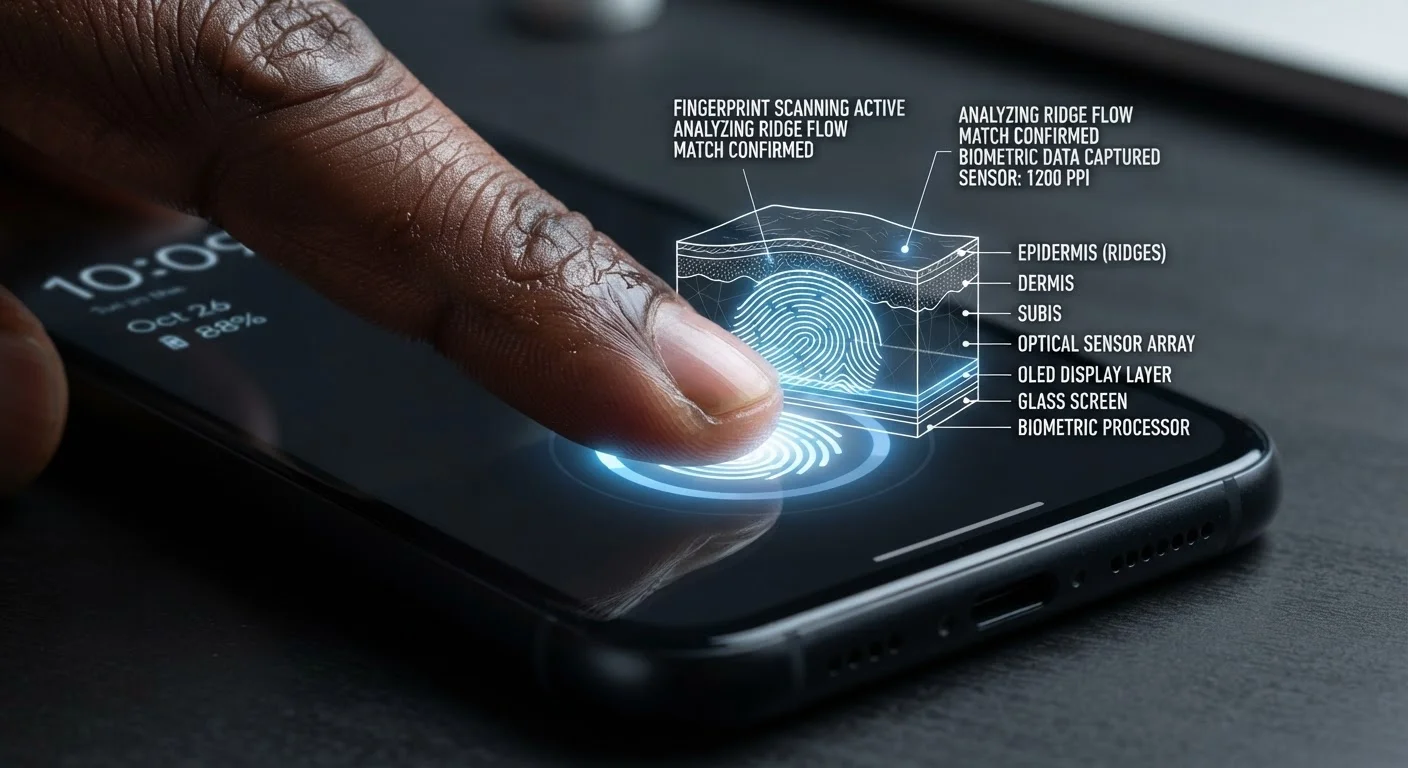
Optical fingerprint sensors work more like a miniature camera. A light source - typically LEDs or the display pixels themselves - illuminates the fingertip. The reflected light is captured by a photosensitive array beneath the surface, producing a high-contrast grayscale image of ridges (bright) and valleys (dark).
Early optical sensors were bulky and lived in physical buttons below the screen. The shift to under-display optical sensing - which uses the OLED screen's own light to illuminate and a thin-film photodetector beneath to capture - allowed manufacturers to extend screens edge-to-edge without sacrificing biometric authentication. This is the technology enabling full-screen designs on many modern smartphones.
Optical sensors are generally thinner and more flexible in placement than capacitive alternatives, but they can be more susceptible to high-quality 2D spoofs - a printed high-resolution image can sometimes fool an optical sensor that lacks liveness detection. Premium implementations address this with infrared scanning or multiple light wavelengths that detect blood-vessel patterns beneath the skin surface.
Ultrasonic Sensors: A Third Approach
Some flagship devices use ultrasonic fingerprint sensors, which emit high-frequency sound pulses and map the 3D surface of a fingertip from the echo pattern. Unlike optical sensors, ultrasonic systems can read through water, light debris, and even some screen protectors because sound penetrates materials that block light. They are currently less common due to higher manufacturing cost.
How Matching Actually Works
Capturing a fingerprint image or capacitance map is only the first step. The sensor's processor then extracts minutiae - the specific points where ridges end or bifurcate. These points, along with their spatial relationships and orientations, are encoded into a compact mathematical template.
At authentication, a new scan generates a fresh template and the system computes a similarity score against the enrolled template. If the score exceeds a set threshold, access is granted. The threshold represents a deliberate trade-off: lowering it reduces false rejections (your own finger failing) but increases false acceptances (a stranger's finger succeeding). Device manufacturers tune this balance toward security by default.
The enrolled template is stored in a secure enclave - a hardware-isolated region of the processor - and never transmitted to external servers during normal operation. For curious readers interested in how biometric data intersects with broader wearable sensor design, the sensor arrays found in smartwatches and fitness trackers offer an interesting comparison point for how consumer devices balance security, battery life, and hardware space.