

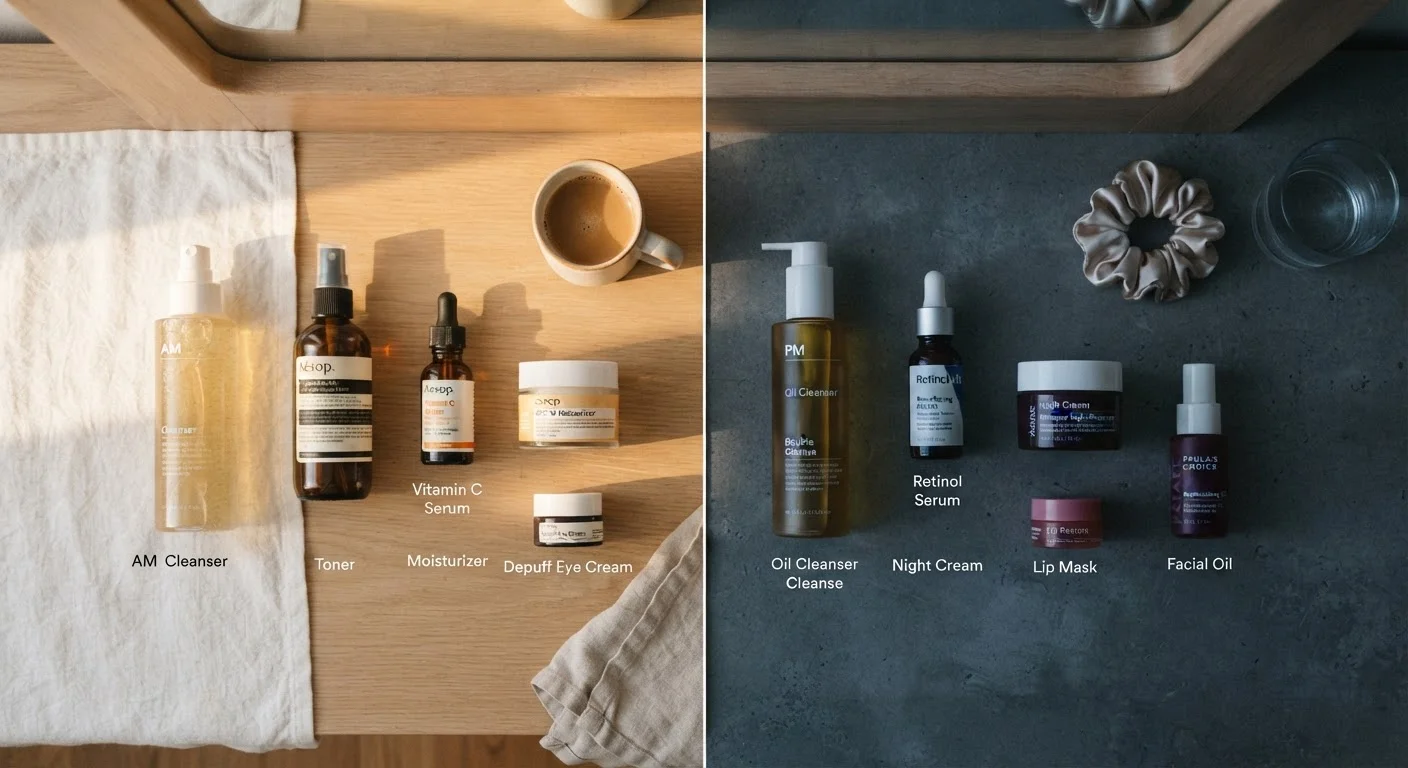
Key Takeaways
- Morning routines should focus on protection: antioxidants and broad-spectrum SPF are non-negotiable.
- Evening routines support repair and renewal, making them the right time for active ingredients like retinoids and exfoliating acids.
- Certain ingredients - especially retinol and AHAs - degrade in sunlight or increase photosensitivity, making nighttime use essential.
- Layering order matters in both routines: apply from thinnest to thickest consistency.
- Consistency over complexity is the most reliable predictor of long-term skin health.
Our Verdict
Neither the morning nor the evening routine is inherently more important - they are complementary systems designed around your skin's biology. A morning routine arms skin against daily environmental stressors; an evening routine gives it the conditions it needs to repair. Getting the timing and sequencing right isn't about following rigid rules, it's about working with your skin rather than against it.
| Best for | Recommended |
|---|---|
| Those new to skincare or simplifying | Morning Routine First |
| Those targeting specific concerns like hyperpigmentation or texture | Evening Routine prioritization |
| Those with sensitive or reactive skin | Gradual introduction, evening-first actives |
Your Skin Has a Schedule - and It Matters
Skin isn't a passive surface - it operates on a circadian rhythm, the same internal clock that governs sleep, hormone release, and cell division. Research published in dermatology journals has shown that skin cell turnover and DNA repair activity peak during sleep, while sebum production and barrier function are more active during waking hours. These biological patterns are precisely why skincare routines aren't interchangeable - morning and evening serve fundamentally different functions.
Understanding this distinction helps cut through the noise around ingredient timing. It isn't marketing. It's biology.
~11 pm
Peak skin cell mitosis window
Dermatological research indicates skin cell division is most active between roughly 11 pm and midnight, supporting the rationale for nighttime repair-focused routines.
Up to 80%
UV-induced free radical contribution to photoaging
Estimates from photobiology research suggest UV and pollution-generated free radicals account for a substantial majority of visible skin aging, underlining the importance of morning antioxidant and SPF use.
The Morning Routine: Defense Over Treatment
The primary goal of an AM routine is protection. During the day, skin is exposed to UV radiation, particulate pollution, and infrared light - all of which generate free radicals that damage collagen and impair barrier function. A well-structured morning routine creates a defensive shield against these insults.
Core AM Principles
- Cleanse gently: A light rinse or mild cleanser removes overnight oils without stripping the barrier rebuilt while you slept.
- Antioxidants first: Vitamin C (L-ascorbic acid) and niacinamide are most valuable in the morning, where they neutralize free radicals generated by UV and pollution exposure.
- Moisturize to reinforce the barrier: Humectants like hyaluronic acid and occlusives lock in hydration before SPF application.
- Broad-spectrum SPF - always last: Sunscreen is the single most evidence-supported intervention for preventing photoaging and reducing skin cancer risk. It belongs at the end of every morning routine, full stop.
Notably, actives like retinoids and chemical exfoliants have no place in a morning routine. Retinol degrades when exposed to UV light, reducing its efficacy. AHAs (alpha hydroxy acids) increase photosensitivity, elevating the risk of UV-induced damage and uneven pigmentation. See our guide on product layering order for more on why sequence mistakes can undermine even the right products.
The Evening Routine: Repair and Renewal
The PM routine operates in a lower-stakes environment - no UV, no pollution actively landing on skin - making it the optimal window for treatment. Skin's repair mechanisms are most active at night, and many potent actives are either photosensitizing or photounstable, making darkness a practical necessity.
Core PM Principles
- Thorough cleansing: Double cleansing (an oil-based cleanser followed by a water-based one) effectively removes SPF, makeup, and environmental residue that a single pass may miss.
- Exfoliating acids (2-3 nights per week): AHAs like glycolic and lactic acid encourage surface cell turnover. BHAs like salicylic acid penetrate pores and suit oily or acne-prone skin.
- Retinoids: Vitamin A derivatives - retinol, retinal, prescription tretinoin - work by increasing cell turnover and stimulating collagen. They must be used at night due to photodegradation and photosensitivity concerns.
- Richer moisturizers and occlusives: At night, a heavier moisturizer or facial oil supports the skin barrier recovery cycle that occurs during sleep.
Introduce Actives Gradually at Night
If you're new to retinoids or exfoliating acids, start with one active at a time and use it two nights per week before increasing frequency. Applying a moisturizer before a retinoid (the 'sandwich method') can help buffer initial sensitivity without eliminating efficacy. Never layer a retinoid and an AHA in the same routine until your skin has adapted to each individually.
Those managing reactive skin will benefit from a measured approach to evening actives. Our article on building a routine for sensitive skin outlines how to introduce actives without overwhelming the barrier.
Side-by-Side: AM vs. PM at a Glance
The table below summarizes the core distinctions across both routines to help clarify where each ingredient category fits and why.
| Morning Routine (AM) | Evening Routine (PM) | |
|---|---|---|
| Primary goal | Protection from environmental stressors | Repair, renewal, and treatment |
| Cleanser type | Gentle rinse or mild gel | Double cleanse to remove SPF and debris |
| Key actives | Vitamin C, niacinamide, antioxidants | Retinoids, AHAs, BHAs, peptides |
| SPF | Mandatory - broad spectrum, applied last | Not used |
| Moisturizer weight | Light to medium, under SPF | Medium to rich, supports barrier repair |
| Retinol / AHAs | Avoid - photodegradation and sensitivity risk | Appropriate - no UV exposure |
Consistency in both routines compounds over time. If you're still developing habits, our resource on building a body care routine that sticks applies many of the same sustainability principles to help routines become second nature.