
In-Network vs. Out-of-Network Care: Why the Distinction Can Cost You Thousands

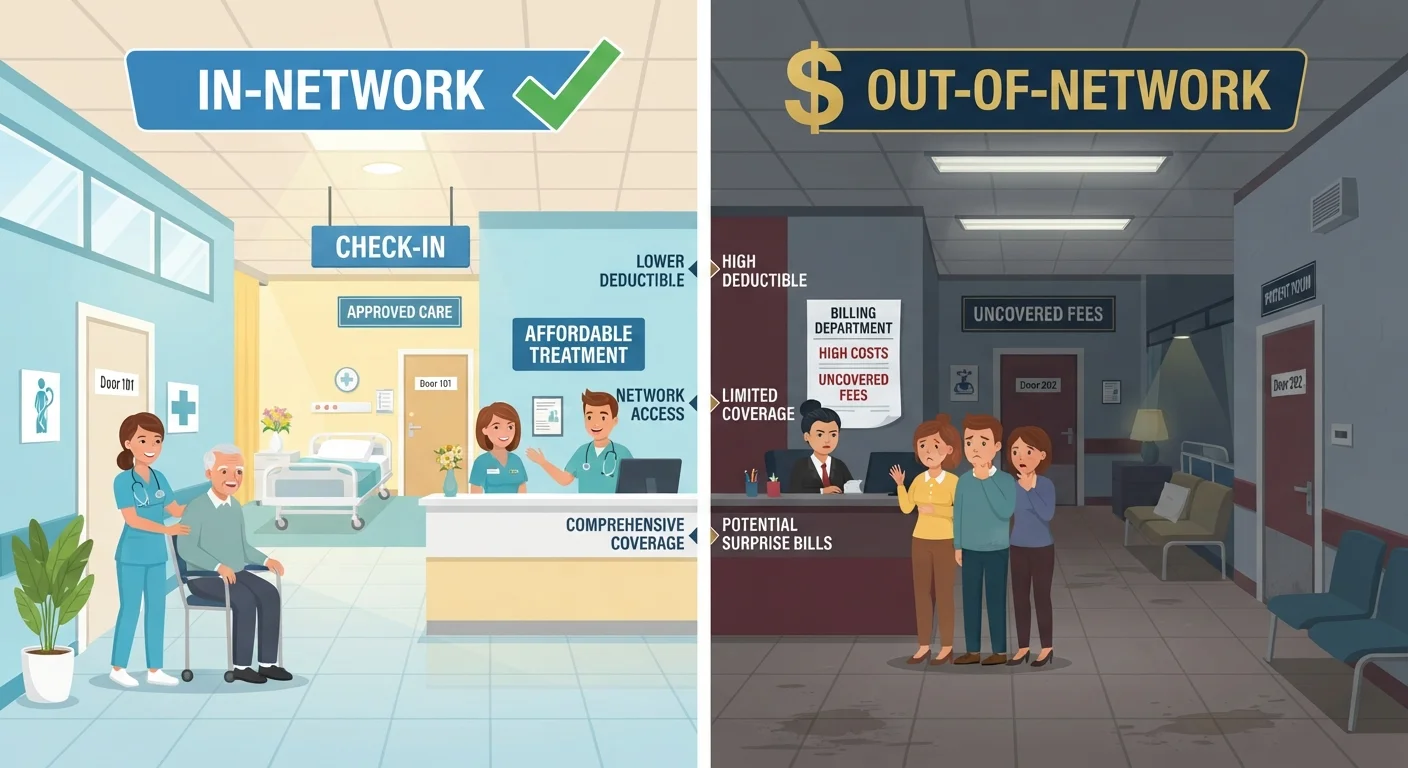
Key Takeaways
- In-network providers have negotiated rates with your insurer, significantly lowering your share of costs.
- Out-of-network care often triggers separate, higher deductibles and lower insurer reimbursement rates.
- Some plan types - like HMOs - provide little or no coverage for out-of-network care at all.
- Balance billing by out-of-network providers can leave you responsible for charges your insurer won't cover.
- Always verify a provider's network status directly with your insurer before scheduling non-emergency care.
- Federal surprise billing protections apply in certain emergency and facility-based situations, but not universally.
Option A
In-Network Care
The cost-controlled, plan-negotiated choice.
Best for: Patients who want predictable costs and plan to use providers their insurer has pre-approved.
Option B
Out-of-Network Care
The flexible but financially riskier alternative.
Best for: Situations where a specific provider is unavailable in-network, or when emergencies allow no choice.
If you want predictable out-of-pocket costs
In-Network Care
Negotiated rates and defined cost-sharing rules mean you can estimate your expenses before a visit with much greater accuracy.
If you need a highly specialized provider not in your plan's network
Out-of-Network Care
When a necessary specialist or facility isn't available in-network, out-of-network care may be unavoidable - just go in with a clear picture of potential costs.
If you have a true emergency and cannot control where you receive care
Out-of-Network Care
Emergency care protections under federal law generally require insurers to cover emergency services at in-network cost-sharing rates, though this varies - verify with your plan.
If you're on an HMO or EPO plan
In-Network Care
HMOs and EPOs typically provide zero coverage for out-of-network services outside of emergencies, making in-network use essential to any coverage at all.
If you're managing a serious or chronic condition requiring specialist care
In-Network Care
Repeated out-of-network visits for ongoing treatment can compound costs dramatically; requesting a network exception or plan change is worth exploring first.
What 'Network' Actually Means in Health Insurance
A provider network is the group of doctors, hospitals, labs, and other healthcare providers that your health insurer has contracted with to deliver care at pre-negotiated rates. When you use one of these contracted providers, you're receiving in-network care. When you go outside that contracted group, you're receiving out-of-network care - and the financial consequences can be significant.
Insurers build networks by negotiating discounted rates with providers. In exchange for patient volume, a hospital or physician agrees to accept a set fee schedule. Your cost-sharing - what you pay through deductibles, copays, and coinsurance - is calculated based on those lower negotiated rates. Understanding how these terms interact is foundational; see our guide to deductibles, premiums, copays, and coinsurance for a fuller picture.
Out-of-network providers have no such agreement. They can bill at their own rates, and your insurer may reimburse at a much lower amount - or not at all, depending on your plan type.
How the Cost Difference Plays Out
The gap between in-network and out-of-network costs isn't just a percentage difference - it can represent thousands of dollars on a single claim. Here's why:
| Criterion | In-Network Care | Out-of-Network Care |
|---|---|---|
| Provider agreement | Contracted rate with insurer | No contracted rate |
| Deductible | Standard plan deductible | Often a separate, higher deductible |
| Coinsurance | Typically 10-30% | Often 40-60% or higher |
| Balance billing risk | Not applicable | Provider may bill beyond insurer payment |
| Out-of-pocket maximum | Applies to in-network costs | Out-of-network costs may not count toward cap |
| HMO / EPO coverage | Fully covered per plan terms | Typically not covered (emergencies excepted) |
| PPO coverage | Standard cost-sharing applies | Higher cost-sharing, but coverage exists |
| Cost predictability | High - rates are pre-negotiated | Low - final costs often unknown upfront |
- Separate deductibles: Many plans carry a distinct, higher out-of-network deductible that must be met independently of your in-network deductible.
- Higher coinsurance: Where an in-network plan might require you to pay 20% after meeting your deductible, out-of-network coinsurance can be 40-50% or more.
- Balance billing: An out-of-network provider can bill you for the difference between their full charge and what your insurer pays - sometimes called a balance bill. This amount can be substantial and isn't counted toward your out-of-pocket maximum in many plans.
For a deeper look at how these surprise costs accumulate, our article on why people end up paying more than their plan suggests covers balance billing and other common cost traps.
Plan Type Matters: Not All Networks Work the Same Way
Your plan's structure determines how severely out-of-network use affects you - or whether it's covered at all.
Facility vs. Physician Network Status
Being treated at an in-network hospital does not guarantee that every provider involved in your care is also in-network. Specialists such as anesthesiologists, radiologists, and pathologists frequently operate independently and may not have contracts with your insurer - even when the facility itself does. Always ask about the network status of each provider involved, not just the facility.
- HMO (Health Maintenance Organization): Generally covers only in-network care, with very limited exceptions for emergencies. Seeing an out-of-network provider typically means paying the full cost yourself.
- EPO (Exclusive Provider Organization): Similar to an HMO in that out-of-network care is usually not covered, but you typically don't need referrals to see specialists.
- PPO (Preferred Provider Organization): Covers both in- and out-of-network care, but at different cost-sharing levels. Out-of-network visits cost more, but coverage exists.
- POS (Point of Service): A hybrid model requiring referrals for in-network specialists but offering some out-of-network flexibility, usually at higher cost.
Choosing the right plan structure for your care habits is its own important decision. Our comparison of HMOs vs. PPOs walks through the trade-offs in detail.
Federal Surprise Billing Protections: What They Cover
The No Surprises Act, which took effect in January 2022, provides meaningful but limited protection against unexpected out-of-network charges. Under this federal law, patients are generally protected from balance billing in these specific situations:
1 in 5
Emergency visits include an out-of-network charge
Research published in the New England Journal of Medicine found approximately one in five emergency visits resulted in at least one out-of-network charge, often from ancillary providers.
$750+
Typical balance bill amount in surprise billing cases
Studies examining surprise medical bills before the No Surprises Act found median balance bill amounts exceeding several hundred dollars, with many cases far higher.
2-3x
Higher out-of-pocket costs vs. in-network
Out-of-network cost-sharing obligations - combining higher deductibles, higher coinsurance rates, and balance billing - can result in costs two to three times greater than equivalent in-network care.
- Emergency care at any facility, regardless of network status
- Non-emergency care at an in-network facility when an out-of-network provider is involved without your knowledge (such as an anesthesiologist or radiologist)
- Air ambulance services provided by out-of-network companies
These protections mean your cost-sharing for such services should be calculated at in-network rates. However, the law does not cover all out-of-network scenarios - particularly when you knowingly choose an out-of-network provider for planned care. Always verify applicable protections with your specific insurer.
Knowing your out-of-pocket maximum is equally critical - especially since out-of-network costs may not count toward that cap.
How to Verify Network Status Before Any Visit
Assuming a provider is in-network because they're affiliated with an in-network hospital - or because they were in-network last year - is one of the most common and costly mistakes policyholders make. Networks change regularly.
Before scheduling any non-emergency appointment, take these steps:
- Call your insurer's member services line and ask them to confirm the specific provider's network status under your exact plan (not just the insurer's broader network).
- Ask the provider's billing office directly whether they accept your plan - and request that confirmation in writing when possible.
- Check whether any facility you'll use (surgery center, lab, imaging center) is also in-network, separately from the physician.
- For specialist referrals, have your primary care physician's office confirm network status before making the appointment.
Building these verification habits into your care routine can protect you from unexpected bills. Our guide to getting the most from your health coverage throughout the year offers additional year-round strategies for staying ahead of these issues.
This article is for general informational purposes only and does not constitute personalized insurance, legal, or financial advice. Coverage terms, network rules, and regulatory protections vary by plan and state. Always review your plan documents and consult a licensed insurance professional for guidance specific to your situation.