

Key Takeaways
- Feeding guidelines on pet food labels are starting points, not prescriptions - individual needs vary widely.
- Most veterinarians recommend two measured meals per day for adult dogs and cats rather than free-choice feeding.
- Treats can account for up to 10% of daily caloric intake without disrupting nutritional balance.
- Body condition scoring - not just weight - is the most reliable way to assess whether your pet is eating the right amount.
- Caloric needs change with age, activity level, reproductive status, and health conditions.
Why Overfeeding Is So Easy - and So Common
Overfeeding is one of the most widespread and preventable problems in companion animal health. Studies suggest that more than half of dogs and cats in the United States are overweight or obese, with excess caloric intake identified as the primary driver. Yet most owners who overfeed their pets do so without realizing it.
The reasons are understandable. Food is how many of us express care for our animals. Portion sizes on pet food packaging are often generous estimates designed for active, unaltered animals - and most household pets are neither. Add in daily treats, table scraps, and the natural tendency to respond to a begging pet with an extra handful of kibble, and caloric surplus accumulates quietly over months and years.
The consequences are serious. Excess weight is directly linked to joint disease, insulin resistance, cardiovascular strain, and a measurably shorter lifespan. For a deeper look at those risks, see our article on pet obesity and what the scale really signals.
Feeding Guidelines Are a Starting Point, Not a Rule
The portion recommendations printed on pet food packaging are calculated for a hypothetical average animal - typically active, unaltered, and at an ideal weight. Many household pets don't match that profile. Treat manufacturer guidelines as a rough starting range, then calibrate based on your individual pet's body condition and your veterinarian's input.
How to Estimate the Right Portion for Your Pet
There is no single universal portion that fits every dog or cat. The appropriate amount depends on your pet's current weight, ideal weight (which may differ), age, activity level, reproductive status, and the caloric density of the specific food you're using.
Start by checking the food's caloric content - listed in kilocalories (kcal) per cup or per can - and compare it to your veterinarian's recommended daily caloric target for your individual pet. Many owners skip this step and rely solely on the manufacturer's feeding chart, which can lead to overfeeding, particularly for smaller, less active, or spayed and neutered animals. (Spaying and neutering affects metabolic rate; for more on that topic, see what research says about the health effects of spaying and neutering.)
Your veterinarian can perform a body condition score (BCS) assessment - a standardized 9-point scale that evaluates fat coverage over ribs, waist definition, and abdominal tuck. A BCS of 4-5 out of 9 is generally considered ideal. This tool is far more informative than scale weight alone, because two pets can weigh the same while having very different body compositions.
59%
U.S. dogs assessed as overweight or obese
According to the Association for Pet Obesity Prevention's annual clinical survey, a majority of dogs seen in veterinary practices are above their ideal body weight.
61%
U.S. cats assessed as overweight or obese
The same Association for Pet Obesity Prevention data indicates that cats have an even higher prevalence of excess body weight than dogs in the United States.
10%
Maximum recommended treat calorie share
Veterinary nutritionists broadly recommend that treats contribute no more than 10% of a pet's total daily caloric intake to preserve nutritional balance.
Structured Feeding Schedules: Why Timing Matters
Free-choice feeding - leaving food out at all times - is convenient, but it removes one of the most powerful tools owners have: the ability to monitor intake. When food is always available, it's nearly impossible to notice early appetite changes that can signal illness, dental discomfort, or stress.
Most veterinarians recommend two measured meals per day for healthy adult dogs and cats. This approach supports stable blood glucose, makes portion tracking straightforward, and creates a predictable routine that many pets find reassuring. Puppies and kittens typically need three to four smaller meals daily to support rapid growth without overwhelming their digestive systems - a pattern that can be gradually reduced as they mature. For a full breakdown of how nutritional needs evolve, see our guide on pet nutrition across life stages.
Meal timing also matters for multi-pet households, where one animal may eat another's food. Feeding pets separately - or at least supervised - prevents inadvertent overfeeding and helps you identify which animal may be eating less.
Weigh food with a kitchen scale rather than estimating by volume.
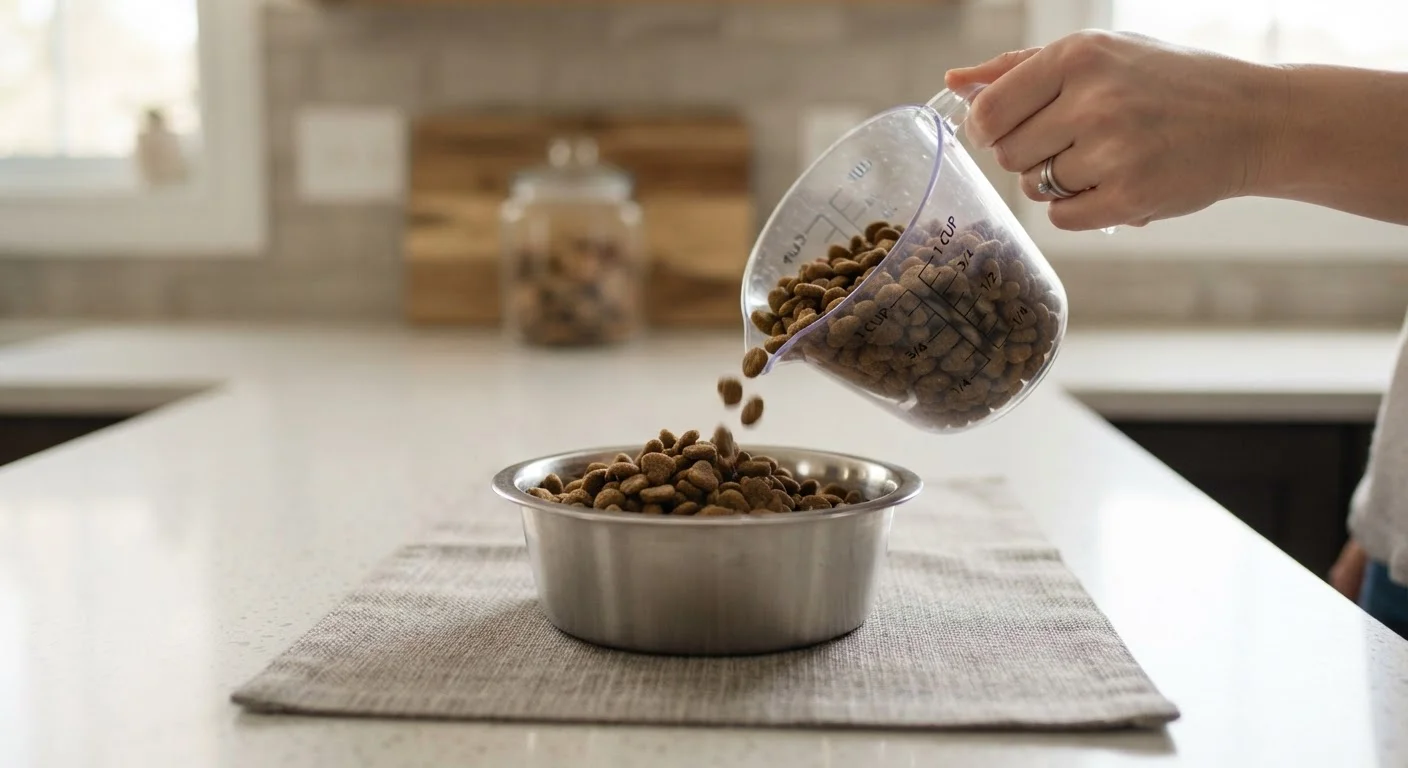
Measuring cups are imprecise - a loosely filled cup of kibble can differ from a packed one by 20% or more. Over weeks, this discrepancy adds up to meaningful caloric excess. A digital kitchen scale eliminates that variability entirely.
Use your veterinarian's caloric recommendation, not just the bag's feeding chart.
Manufacturer guidelines are calculated for active, unaltered adult animals at average weight - a profile that doesn't fit most household pets. Veterinarians can account for your pet's individual metabolic rate, health status, and activity level.
Track treat calories against the daily total, not separately.
Treating treats as 'extras' outside the daily budget is one of the most common pathways to gradual weight gain. Every calorie from a treat is a calorie that came from somewhere - and if the main meal isn't reduced, surplus accumulates.
Conduct a monthly at-home body condition check between vet visits.
Early weight creep is easiest to reverse. Waiting for an annual vet appointment to notice a problem means months of unchecked gain. Regular, brief physical checks keep you aware of subtle changes before they become significant.
Adjust portions whenever your pet's life circumstances change significantly.
Caloric needs are dynamic. Surgery recovery, seasonal activity shifts, aging, and changes in reproductive status all affect metabolism. A static feeding amount applied across changing life stages is a setup for gradual over- or underfeeding.
Treats, Toppers, and Hidden Calories
Treats are a legitimate part of training and bonding, but they carry calories that most owners don't factor into their pet's daily total. A general guideline from veterinary nutritionists is that treats should constitute no more than 10% of a pet's total daily caloric intake - and the remaining 90% should come from a nutritionally complete main diet.
High-calorie chews, dental treats, and food toppers (broths, mix-ins, wet food additions) are particularly easy to overlook. Read the label on every treat you give and track those calories the same way you track meals. If you give multiple treats throughout the day, reduce the main meal portion accordingly.
Table scraps present a separate layer of complexity - some human foods are safe in small amounts, while others are genuinely toxic. Our reference on human foods that are safe and dangerous for pets covers the most commonly shared items and what the evidence says about each.
When to Reassess - and Who to Ask
Portion needs are not static. A pet who was perfectly maintained at a given caloric intake at age two may begin gaining weight at age seven on the exact same amount, simply because metabolism slows with age and activity levels decline. Seasonal changes, illness, recovery from surgery, and changes in exercise routine all affect how much energy your pet actually needs.
A good practice is to weigh your pet every one to two months at home or at your veterinary clinic and compare that number to their previous body condition score. If you notice steady weight gain without a change in diet, that's a cue to revisit caloric targets - not to simply cut food abruptly, but to consult your veterinarian about a gradual, appropriate adjustment. Rapid caloric restriction, particularly in cats, carries its own health risks and should always be done under professional guidance.
For owners navigating food sensitivities or unusual dietary needs, the layer of complexity increases further. Our article on feeding a pet with food allergies or sensitivities explains how elimination diets work and when a veterinary-guided diagnosis is warranted.
This article provides general educational information about pet nutrition and is not a substitute for personalized veterinary advice. Always consult a licensed veterinarian before making significant changes to your pet's diet or feeding routine.