

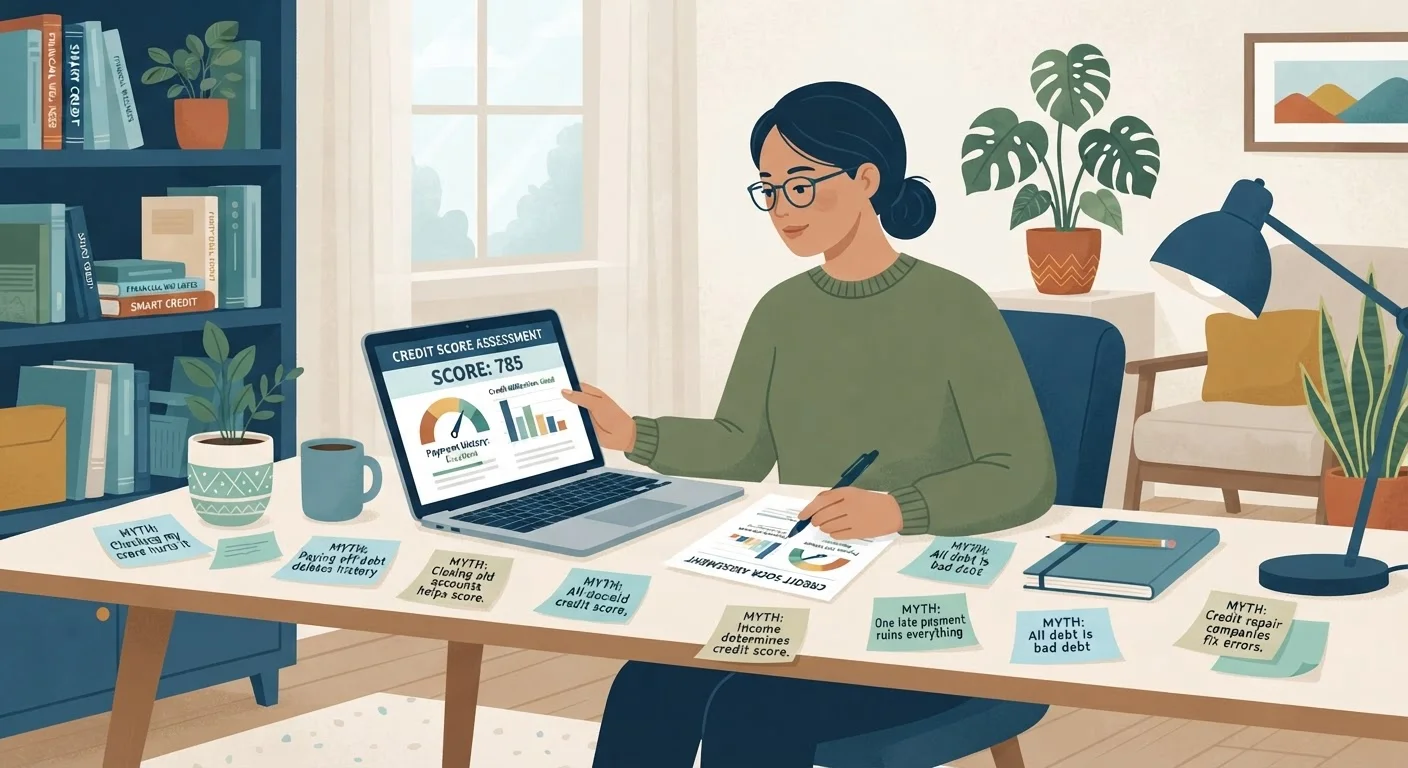
Key Takeaways
- Carrying a credit card balance does not improve your credit score - it only costs you interest.
- Checking your own credit score is a soft inquiry and never lowers your score.
- Closing an old credit card can hurt your score by reducing available credit and shortening history.
- Income is not a factor in FICO or VantageScore calculations - only your borrowing behavior is.
- You do not need to be in debt to build good credit; responsible, low-balance card use is enough.
Why Credit Myths Persist - and Why They Matter
Credit scores influence mortgage rates, rental applications, car loans, and sometimes even job offers. Yet many Americans make daily financial decisions based on outdated or simply incorrect beliefs about how scores actually work. Acting on these myths can stall progress, cost real money in unnecessary interest, or cause someone to avoid credit tools that would genuinely help them.
The following myth-and-fact pairs address the most persistent misconceptions - the ones credit counselors and financial educators encounter most often. Understanding what's actually true gives you a clearer path forward. If you're also questioning common assumptions about budgeting, see what the facts say about budgeting myths as well.
Myth
You need to carry a balance on your credit card to build your score.
Fact
Carrying a balance has no positive effect on your score - it only generates interest charges.
This is one of the most costly myths in personal finance. Credit scoring models like FICO reward utilization - the ratio of your balance to your credit limit - not the presence of ongoing debt. Paying your statement balance in full each month keeps utilization low, avoids interest entirely, and still demonstrates responsible credit use. See how interest on a carried balance accumulates to understand what this myth can actually cost you.
Myth
Checking your own credit score will lower it.
Fact
Checking your own score is a soft inquiry and has absolutely no effect on your score.
Credit inquiries fall into two categories: hard inquiries, which occur when a lender pulls your credit as part of an application and can temporarily reduce your score by a few points, and soft inquiries, which include your own checks, pre-approval screenings, and background checks by employers. Soft inquiries are invisible to lenders and never affect your score. Regularly monitoring your own credit is actually encouraged - it helps you catch errors and track progress.
Myth
Closing old credit cards you no longer use is always a smart move.
Fact
Closing an old card can hurt your score by increasing utilization and shortening your credit history.
Two important scoring factors are at stake when you close an account: credit utilization (closing a card removes that card's available credit limit, potentially raising your utilization ratio) and length of credit history (older accounts contribute positively to your average account age). If a card has no annual fee, keeping it open and occasionally using it for a small purchase - then paying it off - is often the smarter approach.
Myth
Your income directly affects your credit score.
Fact
Income is not a factor in any major credit scoring model. Only borrowing behavior is evaluated.
FICO and VantageScore - the two most widely used scoring frameworks - calculate scores based entirely on information in your credit report: payment history, amounts owed, length of credit history, credit mix, and new credit inquiries. Your salary, employment status, savings account balance, and net worth are not part of that calculation. A high earner who misses payments will score lower than a modest earner who pays on time consistently.
Myth
You only need to worry about your credit score when applying for a loan.
Fact
Credit scores affect landlord decisions, insurance underwriting in some states, and even some employment screenings.
Many people treat credit as a tool activated only when borrowing money. In reality, landlords routinely pull credit reports to evaluate rental applicants, insurers in many states use credit-based insurance scores when setting auto and homeowners premiums, and some employers (with your permission) review credit history during background checks. Maintaining a healthy score year-round is more valuable than scrambling to improve it only when a loan application is pending.
Myth
Having no credit is better than having bad credit.
Fact
No credit history creates real obstacles - lenders cannot assess risk without a track record, often resulting in denials or higher rates.
It's a common assumption that a blank slate is preferable to a damaged one. In practice, lenders rely on your credit history to make lending decisions, and the absence of data makes you an unknown risk. Many lenders decline applicants with no history entirely. Building even a thin, positive credit file - through a secured card or credit-builder loan - puts you in a stronger position than having no record at all. This is a solvable problem: starting from zero is achievable with the right steps.
Putting Accurate Credit Knowledge to Work
Most credit score improvement comes down to a short list of behaviors: pay on time, keep balances low relative to your limits, don't close old accounts unnecessarily, and apply for new credit only when you actually need it. None of those steps require carrying debt or gaming a system.
35%
Payment history's weight in FICO score
According to FICO, payment history is the single largest factor in your score, making on-time payments the most impactful habit to build.
30%
Portion of FICO score tied to amounts owed
FICO's scoring model weights credit utilization heavily, underscoring why keeping balances low relative to limits matters so much.
1 in 5
Americans with a credit report error
A Federal Trade Commission study found approximately one in five consumers had an error on at least one of their three major credit reports.
If your score has been dragged down by inaccurate information on your report, the dispute process is more accessible than many people realize - learn how disputing credit report errors actually works. And if you're starting with little or no credit history, building credit from zero is genuinely achievable with the right tools - secured cards, credit-builder loans, and authorized user status each offer a distinct path.
Credit utilization in particular trips up many otherwise careful borrowers - understand how utilization really affects your score before assuming a low balance always means a low-risk profile. The goal isn't a perfect score overnight; it's a consistent pattern of responsible behavior that compounds over time.
This article is for general informational and educational purposes only and does not constitute personalized financial or credit advice. Consult a licensed financial professional for guidance specific to your situation.