

Key Takeaways
- Refining strips away the bran and germ, removing most fiber, B vitamins, and minerals from the kernel.
- The glycemic response to refined grains is typically faster, leading to quicker blood glucose spikes than whole grain equivalents.
- Enrichment restores some B vitamins and iron, but does not replicate the full nutrient complexity of an intact grain.
- Consistent whole grain consumption is associated with lower risk of type 2 diabetes, cardiovascular disease, and certain digestive conditions in large observational studies.
- Ingredient labels can be misleading - look for 'whole grain' as the first ingredient, not just a brown color or 'multigrain' claim.
Option A
Whole Grains
The intact, nutritionally complete kernel.
Best for: People seeking higher fiber intake, steadier blood sugar response, and a broader micronutrient profile from carbohydrate foods.
Option B
Refined Grains
The processed, shelf-stable staple.
Best for: Contexts requiring longer shelf life, softer texture, or specific culinary applications - though with meaningful nutritional trade-offs.
If you want to support long-term cardiovascular and metabolic health
Whole Grains
Large cohort studies consistently link higher whole grain intake with reduced risk of heart disease and type 2 diabetes. The fiber and phytonutrient content of intact kernels appear central to these associations.
If digestive tolerance is a concern (e.g., during recovery from illness or certain GI conditions)
Refined Grains
Lower fiber content can be easier on a sensitive or recovering digestive system. Always discuss dietary adjustments for GI conditions with a registered dietitian or physician.
If blood sugar management is a priority
Whole Grains
Whole grains have a lower glycemic index than their refined counterparts, producing a more gradual glucose response - a relevant factor for people monitoring blood sugar levels.
If you rely heavily on fortified foods to meet micronutrient needs
Refined Grains
Enriched refined grains restore several key B vitamins and iron. However, a qualified dietitian can help determine whether this is the right strategy for your specific nutritional picture.
What Happens Inside the Mill
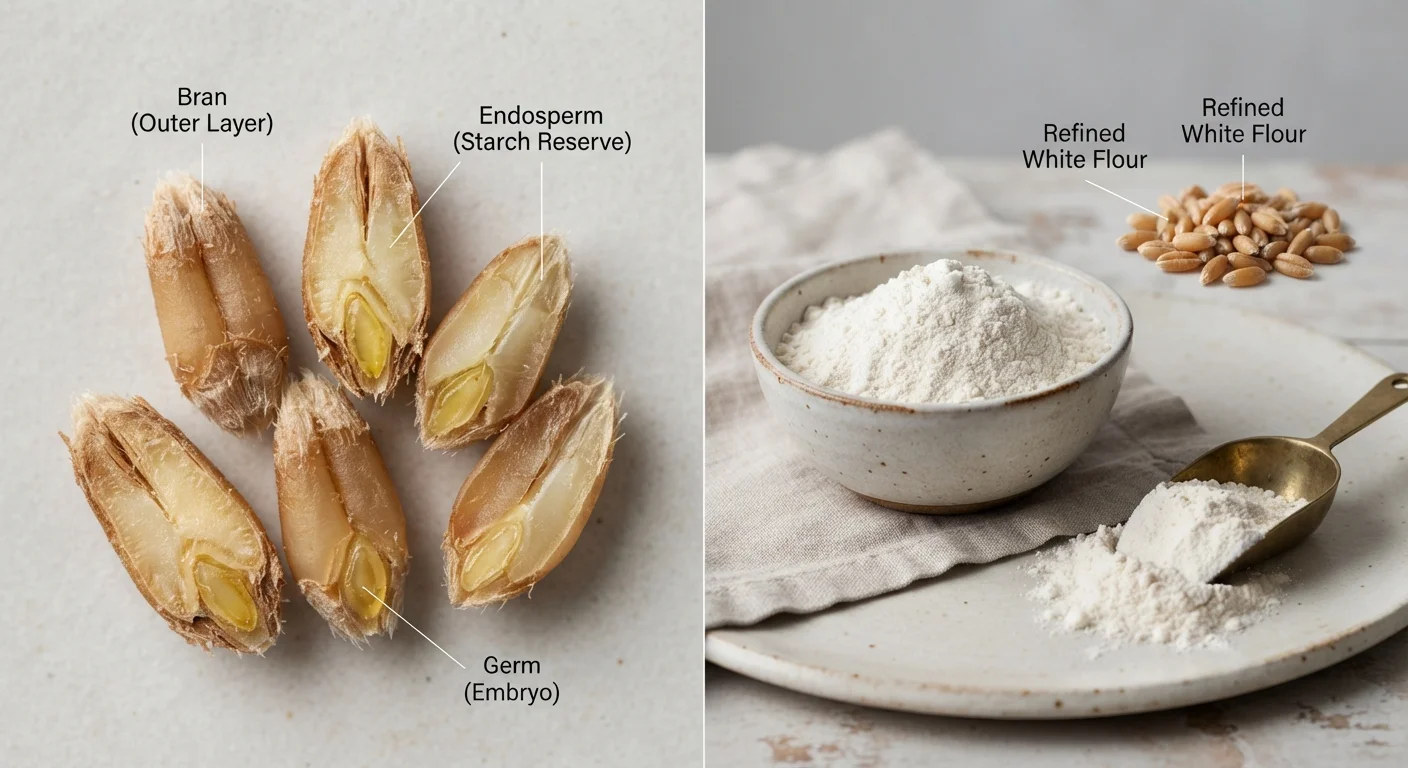
Every grain - wheat, rice, oats, corn - begins as a three-part kernel. The bran is the fibrous outer layer, rich in B vitamins, minerals, and antioxidants. The germ is the embryo of the plant, packed with vitamin E, healthy fats, and additional B vitamins. The endosperm is the starchy interior that fuels the seed's early growth - it makes up roughly 83% of the kernel by weight but contains comparatively little fiber or micronutrients.
Refining separates these layers. In milling white flour or white rice, the bran and germ are mechanically removed, leaving predominantly the endosperm. This dramatically changes the nutritional composition of the grain and extends its shelf life, since the oils in the germ are prone to oxidation.
What leaves with the bran and germ is substantial: the vast majority of the fiber, most of the B vitamins (thiamin, riboflavin, niacin, folate), and significant amounts of iron, magnesium, zinc, and phytochemicals. What remains is a carbohydrate-dense food that digests quickly and, in its unfortified form, delivers a narrower micronutrient profile.
| Criterion | Whole Grains | Refined Grains |
|---|---|---|
| Kernel layers retained | Bran, germ, endosperm (all three) | Endosperm only |
| Dietary fiber | High (e.g., ~3-4g per slice of bread) | Low (e.g., ~1g per slice of white bread) |
| B vitamins | Naturally occurring, full spectrum | Partially restored via enrichment |
| Vitamin E | Present (from germ) | Largely absent |
| Glycemic index | Lower (slower glucose response) | Higher (faster glucose response) |
| Phytochemicals | Broader range (lignans, phenolic acids) | Significantly reduced |
| Shelf life | Shorter (germ oils can oxidize) | Longer (germ oils removed) |
| Texture | Denser, chewier | Lighter, softer |
Enrichment: Partial Restoration, Not Full Replacement
To address nutrient losses, the U.S. has required enrichment of refined grain products since the 1940s. Enriched grains have thiamin, riboflavin, niacin, folic acid, and iron added back in regulated amounts. Folic acid enrichment in particular is credited with substantially reducing neural tube defect rates in the population.
But enrichment does not fully restore what milling removes. Fiber - perhaps the most consequential loss nutritionally - is not added back. Neither are the dozens of phytochemicals, vitamin E, magnesium, or zinc that resided largely in the bran and germ. The matrix of naturally occurring compounds in whole grains interacts in ways that isolated fortification cannot replicate. This is sometimes called the "food synergy" principle: nutrients in whole foods tend to work together in ways that supplementing individual components does not fully reproduce.
Decoding 'Whole Grain' on Packaging
A product labeled 'multigrain,' 'stone-ground,' '12-grain,' or even 'wheat bread' is not necessarily a whole grain product. The only reliable indicator is finding a whole grain (e.g., 'whole wheat,' 'whole oats,' 'whole rye') listed as the first ingredient. The Whole Grain Stamp, issued by the Whole Grains Council, is another useful visual shorthand, though it is voluntary and not universally used. When in doubt, the fiber content per serving on the nutrition label provides a practical proxy - whole grain products tend to deliver meaningfully more fiber per serving than their refined equivalents. For a broader guide to decoding labels, see how ultra-processed foods are classified.
For readers interested in understanding how to identify these distinctions on packaging, reading a nutrition label carefully is a critical first step.
Glycemic Response and Metabolic Effects
One of the most clinically discussed differences between whole and refined grains is glycemic index (GI) - a measure of how quickly a carbohydrate food raises blood glucose relative to a reference food. The intact fiber structure of whole grains slows both digestion and glucose absorption, producing a more gradual rise and fall in blood sugar. Refined grains, stripped of that buffering fiber, typically produce a faster and higher glucose spike for an equivalent carbohydrate portion.
Over time, repeated high-glycemic meals may contribute to insulin resistance - a state in which cells become less responsive to the hormone insulin - in susceptible individuals. Large prospective studies, including analyses from the Harvard T.H. Chan School of Public Health cohorts, have found that higher whole grain consumption is associated with meaningfully lower risk of type 2 diabetes and cardiovascular disease. These are observational findings and cannot establish cause and effect in isolation, but they are consistent across populations and methodologies.
~25%
Lower cardiovascular disease risk with whole grains
A meta-analysis published in the BMJ found that the highest whole grain consumers had approximately 25% lower risk of cardiovascular disease compared to the lowest consumers.
3 servings/day
Whole grain intake associated with benefit
Dietary guidelines in the US recommend at least three servings of whole grains daily, a threshold linked to reduced chronic disease risk in multiple large cohort analyses.
~70-80%
Of fiber lost during grain refining
Studies on flour milling estimate that refining removes the large majority of naturally occurring dietary fiber, which remains the single greatest nutritional loss in the process.
It's worth noting that how a grain is prepared also matters. Cooking method, particle size, and food combinations all influence glycemic response. Pasta cooked al dente, for example, has a lower GI than the same pasta cooked soft, regardless of whether it is whole grain or refined. For broader dietary context, see what nutrition research shows about overall eating patterns.
This article is for general informational and educational purposes only and is not a substitute for personalized medical or dietary advice. Consult a qualified healthcare professional or registered dietitian before making significant changes to your diet, especially if you have a chronic health condition.