

Key Takeaways
- A maintenance log creates a complete service history that helps you spot patterns and prevent costly repairs.
- Recording date, mileage, service type, cost, and shop name covers the essential information for every entry.
- A documented service history can strengthen a vehicle's resale value and buyer confidence.
- Both paper notebooks and digital apps can work - consistency matters more than format.
Why a Maintenance Log Pays Off
Most drivers know they should keep up with oil changes and tire rotations, but far fewer track when those services actually happened. A vehicle maintenance log closes that gap. It's a running record of every service, repair, and inspection your car receives - and it earns its value in several practical ways.
First, it removes guesswork. Instead of trying to remember whether the cabin air filter was replaced last year or the year before, you check your log. Second, it reveals patterns. If you're replacing the same component repeatedly or visiting a shop for the same complaint multiple times, a log makes that visible. Third, when it's time to sell, a documented service history signals to buyers that the vehicle was cared for systematically - not just reactively. As noted in our guide on reading a vehicle history report, service records are one of the key data points informed buyers look for.
~$1,200
Average annual vehicle maintenance cost per US driver
AAA's vehicle ownership cost studies consistently estimate routine maintenance in this range for a typical passenger car driven around 15,000 miles annually.
Up to 30%
Potential resale value impact from documented service history
Industry observers and used-car appraisers note that verifiable maintenance records can meaningfully influence buyer confidence and negotiated sale price, though exact figures vary by vehicle and market.
What to Record in Every Entry
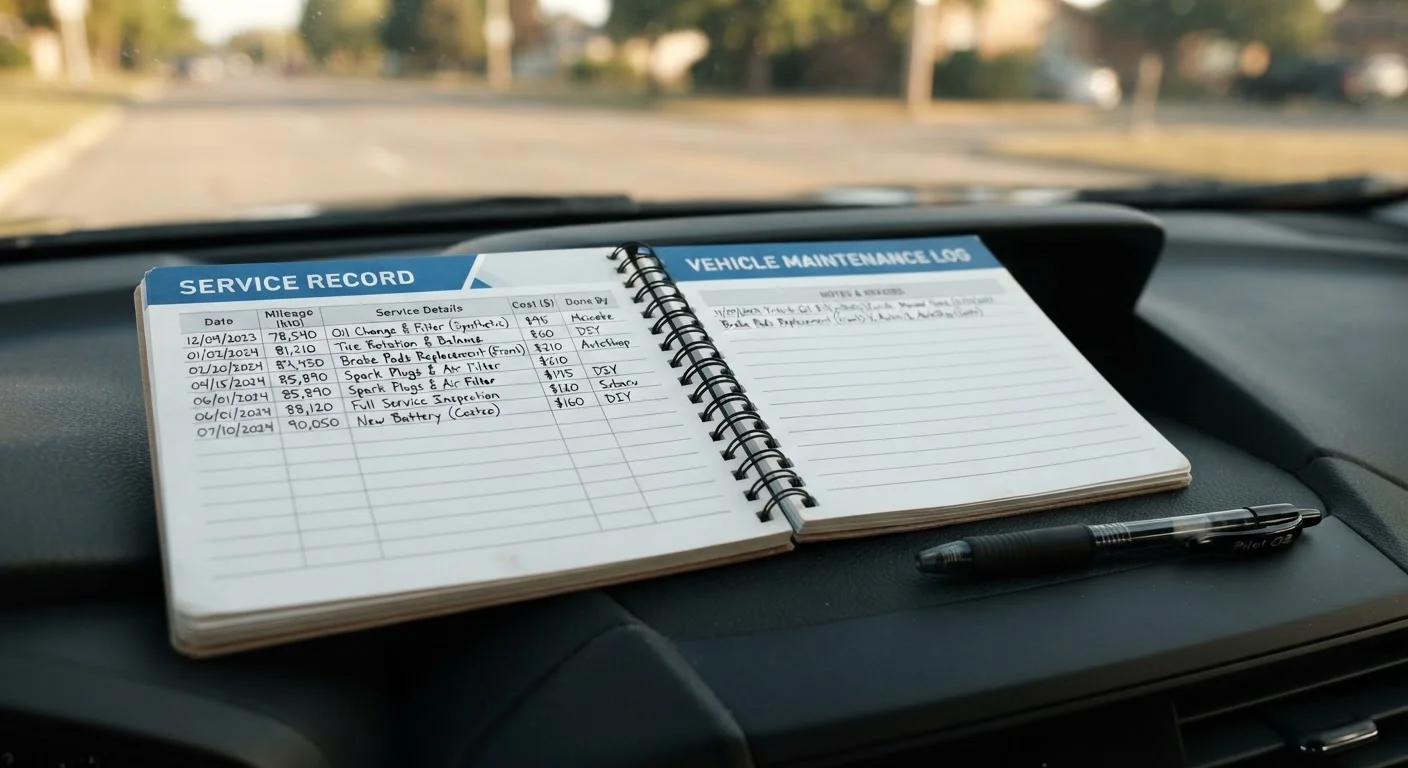
A useful log entry doesn't need to be lengthy - it needs to be consistent. For each service event, record the following:
- Date of the service
- Odometer reading at the time
- Type of service performed (e.g., oil and filter change, brake pad replacement, tire rotation)
- Parts replaced and their specifications if relevant (e.g., oil viscosity, filter part number)
- Shop name or notation that it was a DIY service
- Cost of parts and labor
- Next service due - either by mileage or date, whichever comes first
That last field is especially useful. It turns your log into a forward-looking planning tool, not just a backward-looking record. Pair it with the mileage-based intervals explained in our article on routine maintenance schedules to stay consistently ahead of service needs.
Include Your Owner's Manual Intervals
Cross-reference your log against your vehicle's owner's manual service schedule. Note the manufacturer-recommended interval next to each entry so you can instantly see whether you're on track or overdue. This is particularly useful for services like transmission fluid or coolant changes, which many drivers overlook.
Choosing a Format That You'll Actually Use
The best format is the one you'll stick with. There's no single right answer.
Paper logbooks are simple, require no battery or app, and travel easily in a glove box. A dedicated automotive logbook from an office supply store works well, as does a simple pocket notebook.
Spreadsheet files stored in a cloud service give you searchability and easy sharing - useful if multiple family members drive the same vehicle.
Mobile apps designed for vehicle tracking can automate reminders, calculate fuel economy, and store receipts as photos. They vary in complexity and cost, so evaluate what features you'll realistically use before committing.
Whatever format you choose, keep it accessible. A logbook buried in a box at home won't get updated after a shop visit. Keeping it in the vehicle - or using a phone app - reduces friction. For a broader view of how a maintenance log fits into full vehicle ownership, see our complete vehicle ownership overview.
Building the Habit: Practical Tips
Starting a log is easy; keeping it current is the real discipline. These practices make it sustainable.
Update your log within 24 hours of any service.
Memory fades quickly, and details like mileage or part specifications are easy to misremember a week later. Updating promptly ensures accuracy and prevents gaps from accumulating.
Attach or photograph receipts and link them to each log entry.
Receipts provide authoritative proof of service that your own notes alone cannot. They are especially valuable during resale, warranty claims, or disputes about work performed.
Record declined services as well as completed ones.
When a shop recommends a service and you defer it, logging that recommendation and the date creates an honest record of the vehicle's condition over time and reminds you to revisit it.
Set a recurring calendar reminder tied to your next service interval.
Relying on memory alone to recall upcoming service is unreliable, especially for intervals measured in months rather than miles. A calendar alert removes that dependency.
Review the complete log at least once a year.
An annual review helps you spot recurring issues, verify that no scheduled services were missed, and confirm that the log itself is up to date and legible.
Seasonal transitions are also a natural prompt to review your log. Our seasonal car care guide outlines what to inspect as conditions change - cross-referencing it against your log can reveal whether critical checks are overdue.