

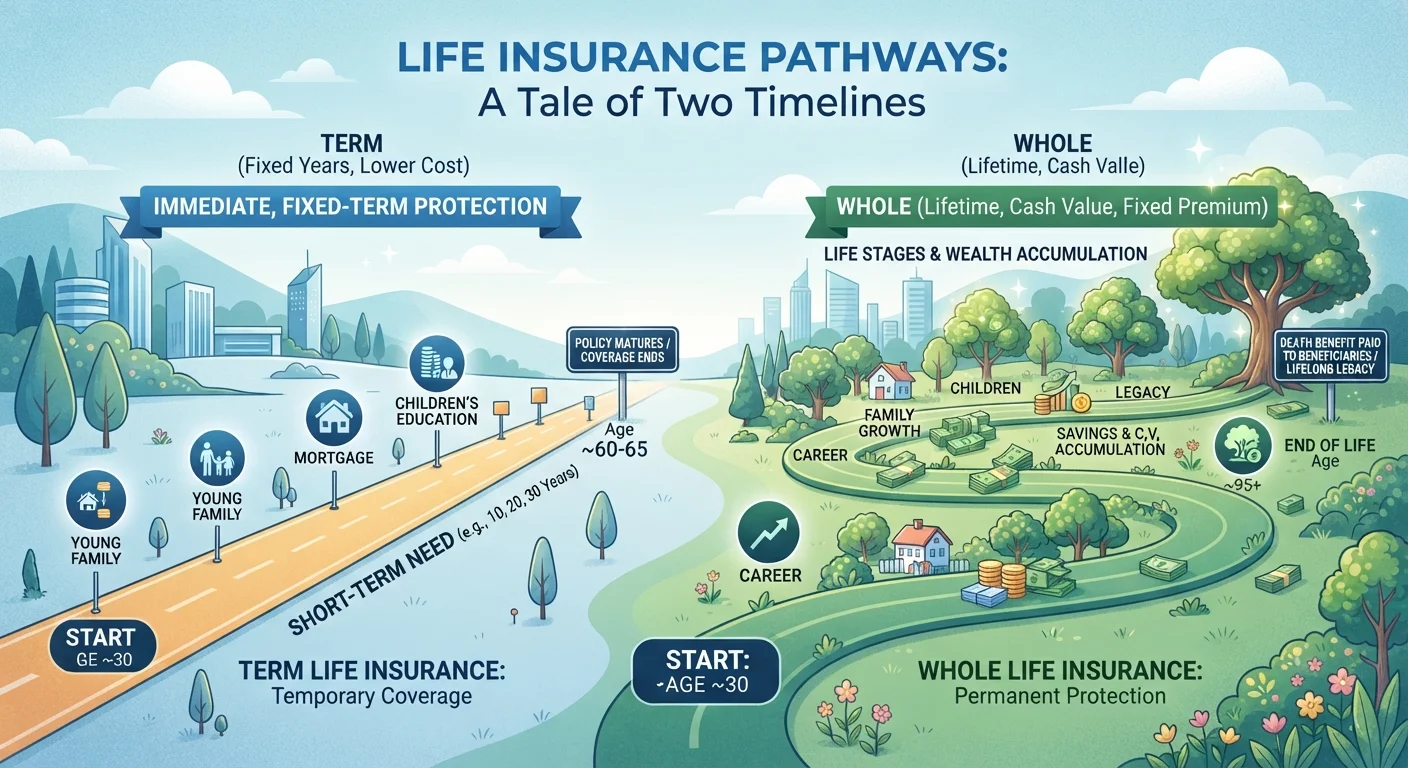
Key Takeaways
- Term life covers a set period - typically 10 to 30 years - and pays out only if the insured dies during that term.
- Whole life insurance never expires and builds cash value, but premiums are significantly higher than term policies.
- Neither policy type is universally superior; the right fit depends on your financial goals, budget, and timeline.
- Cash value in whole life grows slowly and accessing it has tax and policy implications worth understanding.
- Most financial and insurance professionals recommend consulting a licensed adviser before choosing a policy type.
Option A
Term Life Insurance
Straightforward, affordable protection for a defined period.
Best for: People seeking maximum death benefit coverage at the lowest possible premium during high-responsibility years.
Option B
Whole Life Insurance
Permanent coverage with a built-in savings component.
Best for: People who want lifelong coverage, guaranteed premiums, and a policy that accumulates cash value over time.
If you need affordable coverage during peak earning and family-raising years
Term Life Insurance
Term delivers the highest death benefit for the lowest premium, making it practical for covering a mortgage, income replacement, or child-rearing costs over a defined window.
If you want coverage that cannot expire regardless of how long you live
Whole Life Insurance
Whole life guarantees a death benefit whenever you die, which can be valuable for estate planning or leaving a legacy without worrying about outliving a term.
If accumulating a tax-deferred savings component within your policy matters to you
Whole Life Insurance
The cash value feature grows at a guaranteed rate inside the policy, offering a savings element - though growth is typically modest compared to other long-term savings vehicles.
If your primary concern is income replacement for dependents on a tight budget
Term Life Insurance
Dollar for dollar, term policies provide far more coverage per premium dollar, allowing you to match the death benefit to your actual financial obligations.
How Each Policy Type Actually Works
Understanding the structural difference between term and whole life insurance is the foundation for any meaningful comparison. For a broader overview of how both fit into the wider policy landscape, see our guide to term, whole, and universal policies.
Term life insurance is the simpler of the two. You select a coverage period - commonly 10, 20, or 30 years - and pay a fixed premium throughout that term. If the insured person dies during the term, the insurer pays a death benefit to the named beneficiary. If the term ends and the insured is still living, the coverage simply lapses (though some policies offer renewal or conversion options at higher rates). There is no savings element and no accumulated value.
Whole life insurance is a form of permanent life insurance, meaning it does not expire. As long as premiums are paid, coverage remains in force. Premiums are fixed and guaranteed never to increase. A portion of each premium goes toward the death benefit; another portion builds cash value - a tax-deferred savings component that grows at a guaranteed rate set by the insurer. Policyholders can borrow against or withdraw from this cash value, though doing so affects the death benefit and may have tax consequences.
| Criterion | Term Life | Whole Life |
|---|---|---|
| Coverage duration | Fixed term (10-30 years) | Lifetime (permanent) |
| Premium cost | Lower | Significantly higher |
| Premium stability | Fixed during term | Fixed for life |
| Cash value | None | Yes, grows tax-deferred |
| Death benefit guarantee | Only if death occurs in term | Guaranteed whenever death occurs |
| Policy complexity | Simple | More complex |
| Ideal time horizon | Short to medium term | Long term or lifetime |
This article is for general informational purposes only and does not constitute personalised insurance, financial, or legal advice. Coverage terms, eligibility, and premiums vary by insurer and individual circumstances. Always consult a licensed insurance professional before purchasing any policy.
The Real Cost Difference - and What Drives It
Premium cost is typically the most striking difference between these two policy types. Term premiums are substantially lower than whole life premiums for equivalent death benefit amounts. The gap can be dramatic: a healthy 35-year-old might pay several times more per month for a whole life policy than for a comparable term policy offering the same death benefit.
5-15×
Typical whole life premium multiple vs. equivalent term
Industry data consistently shows whole life premiums running several multiples higher than term for the same death benefit amount at comparable ages and health classifications.
~70%
Share of individual life policies sold that are term
According to LIMRA, a US insurance industry research organization, term life consistently accounts for the majority of individual life insurance policies sold by count in the United States.
30 years
Maximum common term length available
Most insurers offer terms up to 30 years, with some specialty products extending further, though availability varies by insurer and applicant age.
The higher whole life premium reflects what you are actually buying: a guaranteed death benefit that never lapses, fixed premiums locked in at the time of purchase, and the ongoing accumulation of cash value. Insurers price in the certainty that the policy will eventually pay out, which is not the case with term.
For many policyholders, particularly younger families managing mortgage payments and living expenses, the premium gap matters. A term policy can free up budget for other financial priorities. However, if cost comparisons are your primary framework, it helps to understand the key policy terms that determine how premiums and benefits are structured - including riders, which can add optional features to either policy type.
It is worth noting that cash value growth in whole life policies is typically conservative and guaranteed rather than market-linked. While the savings component is real, it generally grows more slowly than comparable long-term investment vehicles. Whether that trade-off makes sense depends heavily on your broader financial plan.
Which Policy Fits Which Life Stage?
There is no single correct answer to the term-versus-whole-life question - context determines fit. Here are the situations where each type tends to align well with a policyholder's needs.
When term life tends to align
- You have dependents relying on your income and want to cover the years until they are financially independent.
- You carry a significant mortgage or other debt that would burden your family if you died prematurely.
- Your budget is constrained and maximising the death benefit per premium dollar is the priority.
- You anticipate your insurance need diminishing over time - once the mortgage is paid and children are grown, the need for large coverage may lessen.
When whole life tends to align
- You want coverage that cannot lapse regardless of lifespan, often relevant for estate planning purposes.
- You are interested in a guaranteed, tax-deferred savings component within the policy structure.
- You have a lifelong financial dependent - such as a child with a disability - whose support must be guaranteed.
- You are in a higher income bracket and have already maximised other tax-advantaged savings vehicles.
If you are evaluating life insurance for the first time, our guide for first-time buyers walks through the foundational questions worth addressing before applying. It is also worth checking what employer-provided group life coverage you may already carry, as that can influence how much individual coverage you actually need.
Understanding how beneficiary designations work is equally important regardless of which policy type you choose - getting this detail right ensures the death benefit reaches the right people efficiently.