

Key Takeaways
- Wet food contains 70-85% moisture versus roughly 10% in dry kibble, significantly affecting hydration.
- Kibble is more calorie-dense per gram, making precise portion control especially important.
- Cats are particularly prone to inadequate water intake, giving wet food a hydration advantage for the species.
- Neither format is universally superior - individual health status, age, and species shape the better choice.
- Mixing both food types can balance convenience and hydration, but calorie counting remains essential.
Option A
Dry Kibble
The convenient, calorie-dense daily staple.
Best for: Active pets with healthy teeth, owners seeking cost efficiency and easy portion control.
Option B
Wet (Canned) Food
The moisture-rich, palatable alternative.
Best for: Cats with low thirst drive, senior pets, or animals needing extra hydration support.
If your cat drinks very little water throughout the day
Wet (Canned) Food
Cats evolved as low-thirst desert animals and often rely on food moisture for hydration. Wet food meaningfully increases daily fluid intake.
If you need a practical, budget-friendly option for a healthy adult dog
Dry Kibble
Kibble is lower in cost per calorie, easy to store, and straightforward to portion - well-suited to healthy dogs without special medical needs.
If your pet is a senior with reduced appetite or dental disease
Wet (Canned) Food
Wet food's soft texture is easier to chew, and its stronger aroma can stimulate appetite in older animals with diminished interest in eating.
If weight management is a priority for your pet
Dry Kibble
Kibble's lower moisture content makes calorie measurement more predictable, though portion discipline is essential. Consult your vet for a target intake.
The Moisture Gap: Why It Matters More Than You Think
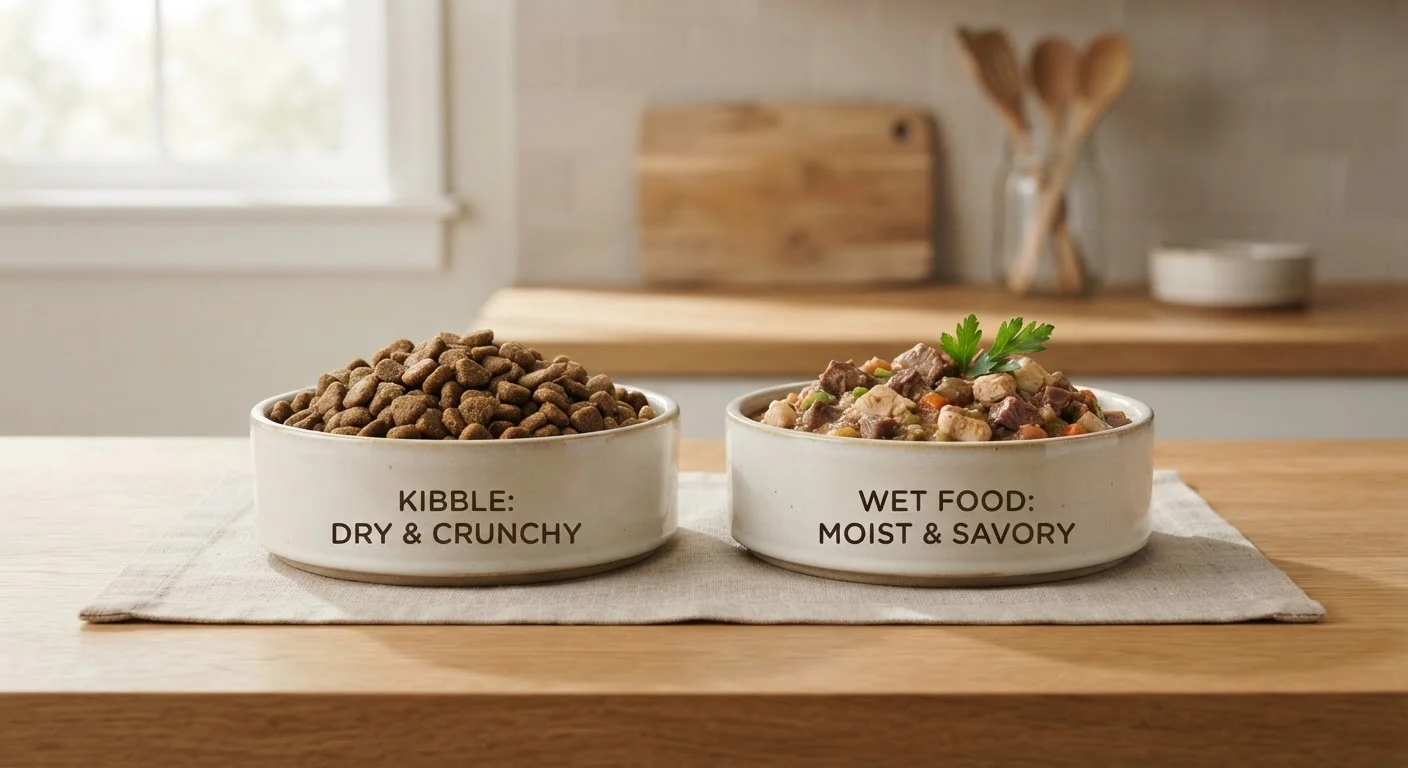
The most significant nutritional difference between dry kibble and wet food isn't protein or fat - it's water. Wet food typically contains 70-85% moisture, closely mirroring the water content of prey animals. Dry kibble, by contrast, usually contains around 10% moisture after processing.
This gap has real physiological consequences, particularly for cats. As obligate carnivores, cats evolved to obtain most of their hydration through food rather than drinking. A cat on an exclusively dry diet may chronically consume less water than its kidneys and urinary tract need. This is one reason veterinary nutritionists often link long-term dry-only diets in cats to a higher incidence of urinary issues - though diet is one of several contributing factors. For a deeper look at how species-level differences shape feeding decisions, see why cats and dogs have different nutritional needs.
Dogs are generally better at compensating with drinking water, but pets with kidney disease, urinary crystals, or constipation may benefit from the added moisture wet food provides regardless of species.
70-85%
Moisture content in wet pet food
Wet food's moisture level closely approximates that of whole prey animals, supporting natural hydration in cats and dogs.
~10%
Moisture content in dry kibble
The low moisture content of kibble means pets on dry-only diets must compensate with adequate drinking water throughout the day.
3-4x
More calories per gram in kibble vs. wet food
Because wet food is mostly water, owners switching formats must recalculate portion sizes to maintain appropriate caloric intake.
Nutrients, Calories, and Digestibility
Because wet food contains so much water, it delivers fewer calories per gram than kibble. This can be a genuine advantage for overweight pets - a larger volume of food for fewer calories creates a feeling of fullness. However, it also means owners switching from dry to wet food must recalculate portions carefully to avoid unintentional underfeeding.
Dry kibble is calorie-dense. A small cup of kibble can contain the same energy as a significantly larger portion of canned food. The processing method - high-heat extrusion for most kibble - can reduce some heat-sensitive nutrients like certain B vitamins and antioxidants, which manufacturers typically replace through fortification. Wet food is usually cooked at lower temperatures in sealed containers, which can preserve some nutrients better, though the difference in finished nutritional profiles between quality products in both formats is often modest.
Digestibility varies more by formula quality and ingredient source than by format alone. Both dry and wet foods can be highly digestible when formulated well. For guidance on what to look for on a pet food label, this structured checklist for assessing pet food nutritional quality is a practical starting point.
| Criterion | Dry Kibble | Wet (Canned) Food |
|---|---|---|
| Moisture content | ~10% | 70-85% |
| Calories per gram | Higher (calorie-dense) | Lower (water dilutes calories) |
| Hydration support | Minimal | Significant |
| Palatability | Moderate | Generally higher |
| Cost per calorie | Lower | Higher |
| Storage convenience | Easy (room temperature) | Requires refrigeration once opened |
| Texture suitability | Better for pets with healthy teeth | Better for dental/jaw issues |
| Nutrient preservation | Fortified post-processing | Sealed cooking may retain some nutrients |
Dental Health, Palatability, and Practicality
A widely repeated claim is that dry kibble cleans teeth through mechanical abrasion. The evidence for this is limited. Studies by the American Veterinary Dental College indicate that most kibble shatters without significant tooth-surface contact, offering minimal plaque reduction. Dedicated dental diets with specific texture designs are a different matter, but standard kibble should not be relied upon as a dental hygiene strategy.
Wet food is generally more palatable - its higher fat content, aroma, and texture appeal to most pets. This makes it particularly useful for finicky eaters, recovering animals, or seniors with reduced appetite. Its soft texture also benefits pets with missing teeth, mouth pain, or jaw issues.
On the practical side, dry kibble wins on convenience and cost. It stores easily at room temperature, doesn't spoil quickly once opened, and is significantly less expensive per calorie than wet food. Wet food must be refrigerated after opening and used within one to two days.
Many owners feed a combination - kibble as the base ration with wet food as a topper or occasional meal. This can work well, but it requires tracking total caloric intake carefully. Nutritional needs also shift across a pet's life, so the right balance isn't static. Nutritional needs across life stages explains how feeding priorities change from puppyhood and kittenhood through the senior years.
Mixing Formats: A Common Middle Ground
Feeding both dry and wet food in combination is a common and generally acceptable approach. The key is calculating the total daily calorie target and apportioning each format accordingly. Guessing portions when mixing formats is one of the most common causes of accidental overfeeding. Your veterinarian or a board-certified veterinary nutritionist can help you set appropriate targets based on your pet's weight, age, and health status.
This article provides general educational information about pet food formats and is not a substitute for personalized veterinary nutrition advice. Always consult your veterinarian before making significant changes to your pet's diet, especially if your pet has a health condition.