

Key Takeaways
- Many dogs labeled 'aggressive' are actually responding defensively to fear, not attacking offensively.
- Fear and aggression share a neurological pathway - the fight-or-flight response - which is why they so often overlap.
- Early warning signals like growling and lip curling are communication, not defiance; suppressing them can escalate risk.
- Punishment typically increases fear-based aggression rather than reducing it.
- A veterinary behaviorist or certified applied animal behaviorist is the right professional to consult for persistent aggression.
Fear-Based Aggression
Fear-based aggression occurs when a dog uses aggressive behaviors - growling, snapping, or biting - as a defensive response to something it perceives as threatening. Unlike predatory or territorial aggression, it is driven by the dog's need to create distance from a perceived danger, not by dominance or hostility. The aggression is a symptom of emotional distress, not a character flaw.
Veterinary behaviorists classify fear-based aggression under the broader category of defensive aggression. The motivating emotional state is typically assessed through body language clusters - posture, eye contact, ear and tail position - rather than the aggressive behavior alone.
When 'Aggressive' Is the Wrong Word
A dog that snaps when a stranger reaches over its head, or growls when backed into a corner, is often described as aggressive - and the label sticks. It shapes how owners respond, how family members interact with the dog, and sometimes whether the dog keeps its home. But labeling a behavior without understanding its cause misses something critical.
The distinction between fear and aggression isn't just semantic. Fear-based aggression and predatory or offensive aggression have different triggers, different body language profiles, and - importantly - different responses to intervention. Treating them the same way can make the situation worse.
Understanding why 'dominance' explanations fall short is a useful starting point. Most dogs that owners describe as aggressive are not trying to control their environment through force - they are trying to feel safe.
The Neuroscience Behind Fear and Aggression
Fear and aggression share the same underlying architecture in the brain. When a dog perceives a threat - real or imagined - the amygdala triggers a cascade of stress hormones that prime the body for fight, flight, freeze, or fidget. The choice between fleeing and fighting is often situational: a dog that cannot escape a threatening person or animal may shift from attempting to flee to defending itself through aggression.
This is why context matters so much. The same dog may bolt from a stranger in an open yard and snap at that same stranger in a narrow hallway. The behavior changed; the emotion driving it did not.
~70%
Dog bites linked to fear or anxiety
Research published in veterinary behavior literature consistently finds fear and anxiety among the most common motivating factors behind dog bites presented to clinical behaviorists.
4.5 million
Dog bites reported annually in the US
According to the American Veterinary Medical Association, approximately 4.5 million people are bitten by dogs each year in the United States, underscoring the public health importance of understanding bite motivation.
Owners often misread this escalation as unpredictability. In reality, the dog communicated its distress throughout - through yawning, lip licking, looking away, a stiffened body - before the snarl or snap. These are known as calming signals, a term introduced by Norwegian dog trainer and behaviorist Turid Rugaas to describe the displacement behaviors dogs use to manage social stress. Recognizing them early gives owners time to intervene before the dog reaches its threshold.
Reading the Signals: Fear vs. Offensive Aggression
Body language is the primary tool for distinguishing a fearful dog from one displaying offensive aggression. Neither category is perfectly clean - dogs can experience mixed emotional states - but the general patterns are consistent enough to be useful.
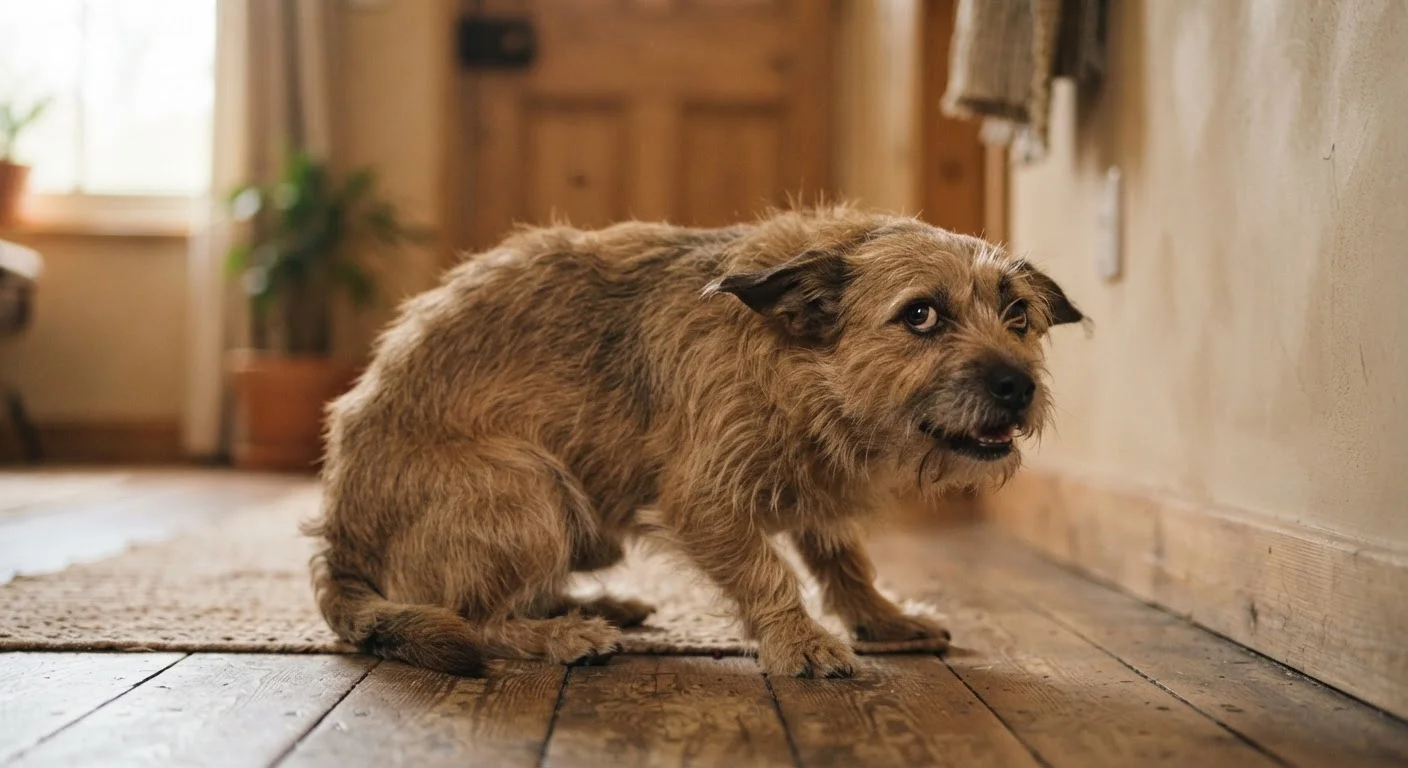
- Fear posture: Body lowered or crouching, tail tucked or held low, ears pinned back, avoiding direct eye contact, attempting to retreat or create distance.
- Offensive aggression posture: Body weight shifted forward, tail raised and stiff, direct hard eye contact, upright ears, piloerection (raised hackles along the back and shoulders).
A dog that growls, then tries to back away, is asking for space. A dog that growls while moving toward a target is expressing something different. These distinctions matter when deciding how to respond in the moment and how to address the behavior long-term.
Treat the Warning as Information
When a dog growls or stiffens, resist the urge to correct it immediately. Instead, calmly remove the stressor - create space, move the dog away from the trigger, or ask a stranger to step back. This response addresses the fear rather than punishing its expression, and it preserves the dog's ability to communicate before escalating.
For a broader look at how emotional distress expresses itself in dogs and other pets, our overview of anxiety and stress across pet species offers helpful context.
What Not to Do - and Why It Matters
The instinctive response to a growling or snapping dog is often to correct it - raise your voice, use a firm "no," apply physical pressure. This approach is understandable, but with fear-based aggression it tends to backfire. Punishment adds another aversive experience to an already-overwhelmed nervous system, confirming the dog's belief that the situation is unsafe.
Crucially, punishing a growl does not address the fear behind it. It teaches the dog that warning signals lead to bad outcomes - which, for many dogs, results in bypassing those signals entirely. A dog that has been corrected repeatedly for growling may bite without any preceding warning, because it has learned that warning does not help.
Pain Can Trigger Sudden Aggression
A dog that becomes aggressive suddenly - especially with no prior history - should be evaluated by a veterinarian before any behavioral intervention begins. Conditions like arthritis, ear infections, dental pain, or neurological issues can dramatically lower a dog's tolerance threshold. Treating the underlying pain often reduces or eliminates the aggression.
The same logic applies to separation anxiety: behaviors that look like defiance are almost always rooted in emotional distress. Responding to the emotion, not the surface behavior, is where durable change begins.
If your dog's aggression is frequent, escalating, or has resulted in a bite, consult a veterinarian first to rule out pain-related contributors. Pain is a well-documented trigger for sudden aggression in otherwise stable dogs. From there, a referral to a veterinary behaviorist or certified applied animal behaviorist is the appropriate next step. This is not a problem to manage through trial-and-error alone.
This article is for general educational purposes only and does not constitute veterinary or behavioral advice. If your dog is displaying aggression, consult a licensed veterinarian or certified animal behavior professional for guidance specific to your situation.