

| Statement Frequency | Monthly (most common) |
| Error Reporting Window | 60 days from statement date (Federal Regulation E) |
| Key Sections | Summary, transactions, fees, interest, check register |
| Retention Recommendation | Keep statements at least 1 year; 7 years for tax-related records (IRS general guidance) |
| Statement Format | Paper mail or electronic (online/mobile banking) |
What a Bank Statement Actually Is
A checking account statement is an official record your bank produces - typically monthly - summarizing every transaction, fee, and balance change within a defined period. It's not just a receipt; it's a snapshot of your financial activity that serves as a legal document you can reference for budgeting, dispute resolution, and tax preparation.
Statements are delivered by mail or, more commonly today, accessed digitally through online banking portals. Either way, the structure is standardized enough that once you know what each section means, you can read any statement with confidence. For a broader look at how different account types differ, see how checking, savings, and money market accounts work.
Opening Balance
The amount of money in your account at the very beginning of the statement period. It should match the closing balance from your previous statement.
Closing Balance
The amount remaining in your account at the end of the statement period after all debits and credits have been applied.
ACH Transfer
An Automated Clearing House transfer is an electronic movement of funds between bank accounts, commonly used for direct deposits and bill payments.
Annual Percentage Yield (APY)
The real rate of return on a deposit account over one year, accounting for compound interest. A higher APY means more interest earned on your balance.
Regulation E
A federal rule enforced by the Consumer Financial Protection Bureau that protects consumers against unauthorized electronic fund transfers and sets rules for error resolution.
Breaking Down Each Section of the Statement
Most checking account statements follow a consistent layout. Here's what you'll find and what each part tells you:
| Statement Frequency | Monthly (most common) |
| Error Reporting Window | 60 days from statement date (Federal Regulation E) |
| Key Sections | Summary, transactions, fees, interest, check register |
| Retention Recommendation | Keep statements at least 1 year; 7 years for tax-related records (IRS general guidance) |
| Statement Format | Paper mail or electronic (online/mobile banking) |
Account Summary
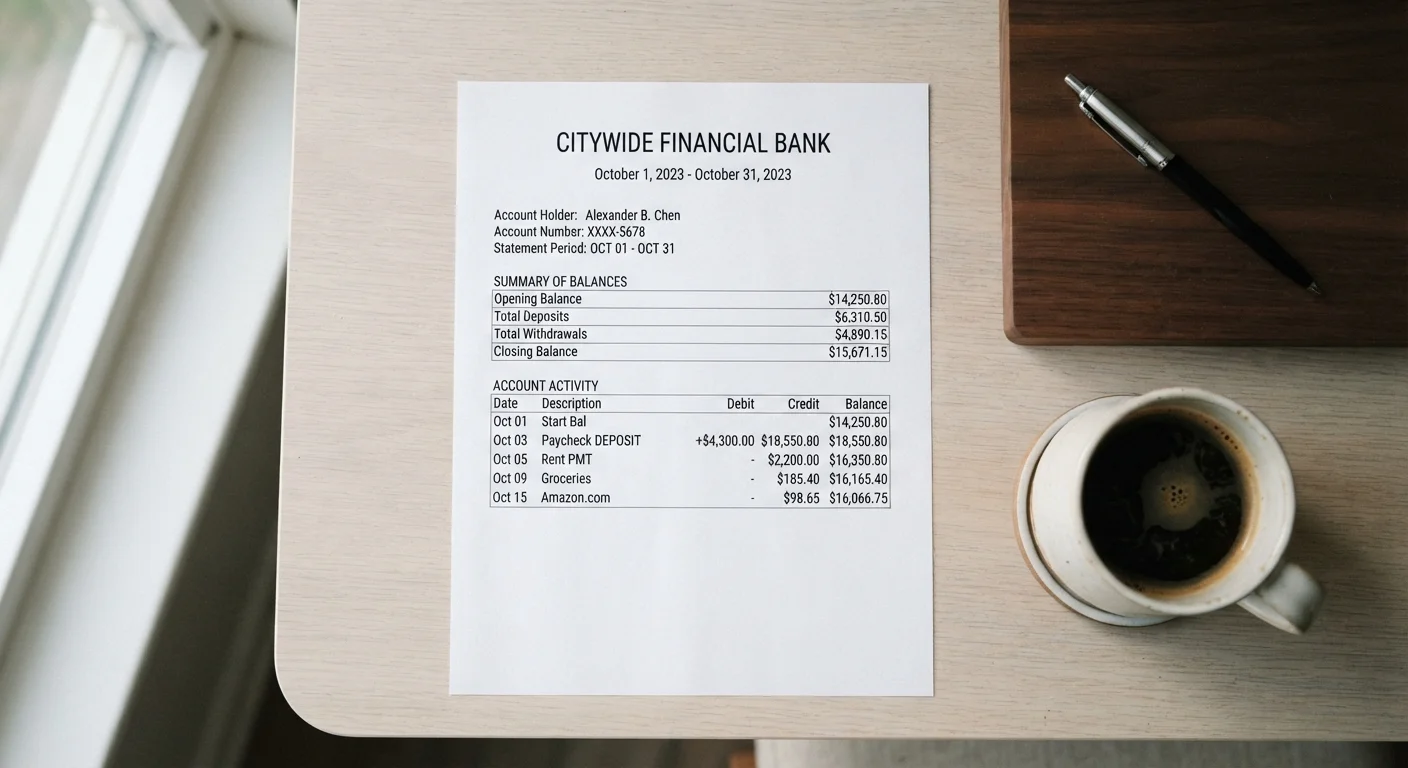
At the top of every statement is an account summary showing your opening balance (what you had at the start of the period), closing balance (what remained at the end), total deposits, and total withdrawals. This section gives you a quick financial health check for the month.
Transaction History
This is the bulk of the statement - a line-by-line record of every debit and credit posted to your account. Each entry typically includes the date, a description of the transaction (merchant name, ACH transfer label, or check number), and the amount. Debits reduce your balance; credits increase it.
Fees and Charges
Banks are required to itemize fees separately. You may see monthly maintenance fees, overdraft charges, out-of-network ATM fees, or wire transfer costs listed here. Reviewing this section monthly is one of the most practical ways to spot unnecessary charges. For a full explanation of how these fees work, see understanding common bank fees.
Interest Earned (If Applicable)
Interest-bearing checking accounts will show any interest credited during the period, along with the applicable Annual Percentage Yield (APY). This amount is typically modest on checking accounts compared to savings products.
Check Images or Check Register
Many statements include images of cleared checks or a numbered register listing each check that was cashed. Cross-reference these against your own records to catch any unauthorized transactions early.
Why Reviewing Your Statement Matters
Many people glance at their closing balance and move on - but that habit leaves a lot of useful information on the table. A thorough monthly review helps you:
- Catch errors and fraud early. Banks generally require you to report unauthorized transactions within 60 days of the statement date to receive full protection under federal Regulation E. Missing that window can limit your recovery.
- Spot billing irregularities. Duplicate charges, unexpected subscription renewals, and erroneous fees are common - and they're easy to miss if you don't look.
- Track spending patterns. A statement provides an unfiltered record of where your money actually goes, which is more accurate than memory alone.
- Verify payroll and direct deposits. Confirm that your employer's direct deposits are hitting on schedule and for the correct amounts.
Statement literacy also complements other financial habits. Just as you'd review a credit report to understand your borrowing history - see reading your credit report for the first time - reviewing your bank statement regularly gives you a clear picture of your day-to-day cash flow.
Going Paperless? Keep Your Records
Switching to electronic statements is convenient, but ensure you download and save PDFs regularly. Banks may only retain accessible digital statements for 12-24 months before archiving them. Keeping your own copies protects you if you ever need to verify past transactions or resolve a dispute.
This article is for general informational and educational purposes only and does not constitute personalized financial, banking, or legal advice. For guidance specific to your situation, consult a qualified financial professional.