

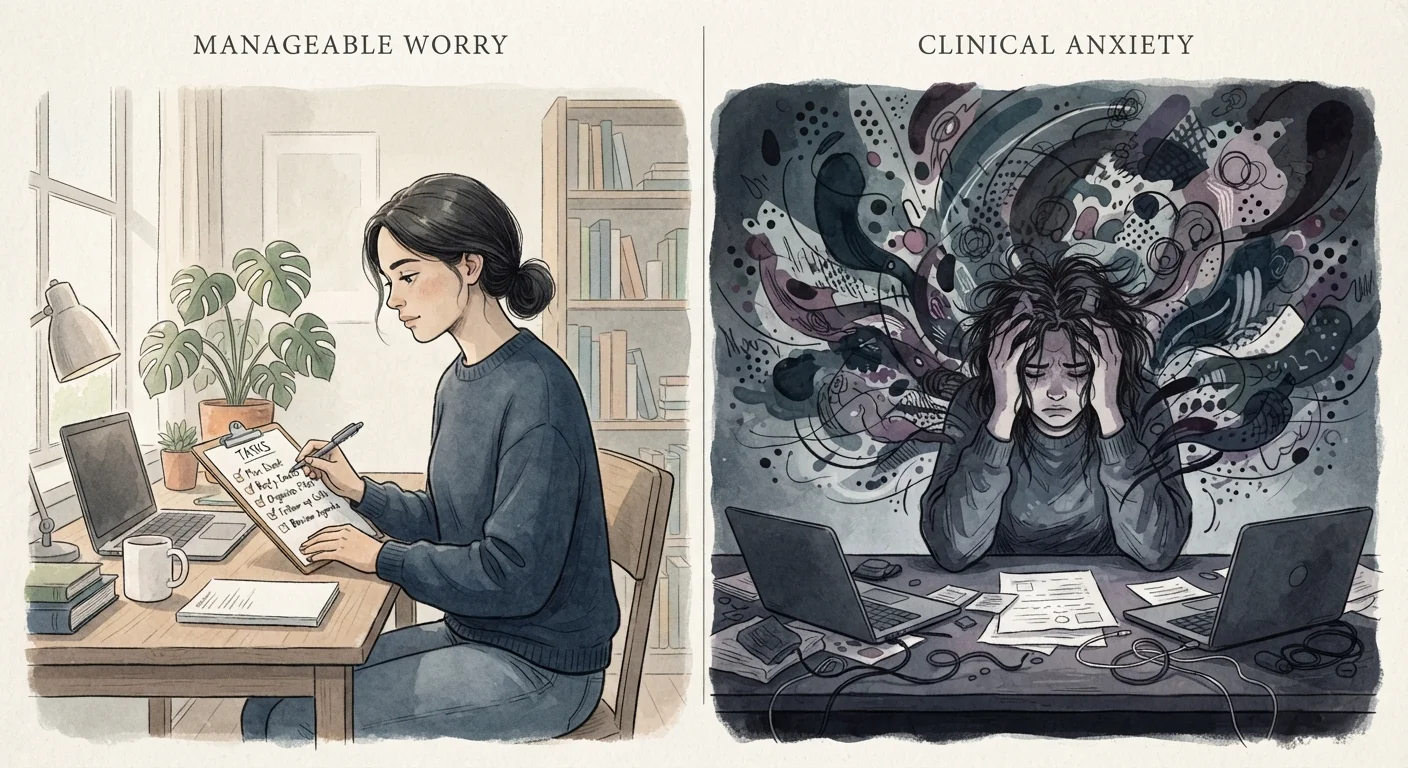
Key Takeaways
- Everyday worry is temporary, situation-specific, and typically resolves on its own.
- Anxiety disorders involve persistent, disproportionate distress that interferes with daily life.
- Duration, intensity, and functional impairment are the key factors clinicians use to distinguish the two.
- Self-identifying symptoms is useful for awareness, but a licensed professional must make any clinical assessment.
- Effective, evidence-based treatments for anxiety disorders exist and are widely accessible.
Option A
Everyday Worry
A normal, functional response to real-life uncertainty.
Best for: Understanding transient concern tied to identifiable stressors that resolves once the situation passes.
Option B
Anxiety Disorder
A clinically recognized condition with persistent, disproportionate distress.
Best for: Recognizing when worry has crossed into territory that impairs daily functioning and warrants professional support.
If you feel nervous before a presentation or major life event
Everyday Worry
Situational concern that fades after the event is a normal part of emotional life and does not typically require clinical intervention.
If anxious feelings persist for weeks, feel uncontrollable, or stop you from doing normal activities
Anxiety Disorder
Persistent, impairing distress that exceeds the triggering situation is a hallmark of clinical anxiety and warrants evaluation by a mental health professional.
If you want to support a friend or family member showing signs of distress
Anxiety Disorder
Understanding the clinical distinction helps you approach the conversation with empathy and encourage professional help where appropriate.
What Worry Actually Is - and Why It Exists
Worry is a cognitive process - a chain of "what if" thinking that the brain uses to anticipate and prepare for potential problems. From an evolutionary standpoint, it is adaptive: scanning for threats helped our ancestors survive. In everyday modern life, worry serves a similar function, prompting us to prepare for a job interview, double-check important plans, or consider the feelings of people we care about.
The defining features of normal worry are that it is proportionate to the situation, time-limited, and ultimately resolves once the stressor passes or is addressed. A person might lie awake the night before a difficult conversation, feel some stomach tension, and then move on once the conversation happens. That cycle - stimulus, concern, resolution - is healthy emotional functioning, not a disorder.
Worry also tends to stay in the realm of conscious thought. Most people can redirect their attention away from worrying thoughts when distracted by work, conversation, or activity. This flexibility is a meaningful sign that worry has not crossed into clinical territory.
How Clinical Anxiety Differs
Anxiety disorders are among the most common mental health conditions, affecting roughly 19% of U.S. adults in any given year, according to the National Institute of Mental Health. What separates them from everyday worry is not just intensity - it is the pattern of persistence, disproportionality, and functional impairment.
| Criterion | Everyday Worry | Anxiety Disorder |
|---|---|---|
| Trigger | Identifiable, real-life stressor | Often disproportionate or unclear |
| Duration | Resolves when situation passes | Persistent, often 6+ months |
| Controllability | Can redirect attention | Feels uncontrollable, intrusive |
| Physical symptoms | Mild, temporary | Recurring: tension, insomnia, fatigue |
| Functional impact | Minimal disruption to daily life | Impairs work, relationships, activities |
| Clinical status | Normal emotional response | Diagnosable mental health condition |
| Intervention needed | Self-care often sufficient | Professional evaluation recommended |
In clinical anxiety, the worried thoughts do not track neatly with real, identifiable threats. Someone with Generalized Anxiety Disorder (GAD), for example, may experience near-constant worry that cycles across multiple domains of life - health, finances, relationships, safety - regardless of whether objective circumstances warrant concern. The worry feels uncontrollable, intrusive, and exhausting. Physical symptoms - muscle tension, disrupted sleep, irritability, difficulty concentrating - are also characteristic features that clinicians assess.
Crucially, anxiety disorders impair functioning. A person may avoid social situations, call in sick repeatedly, or be unable to concentrate at work. This level of disruption is what distinguishes a clinical condition from the ordinary friction of a stressful week. For context on how poor sleep and anxiety mutually reinforce each other, see our guide to sleep and mental health.
This article is general health information and is not a substitute for professional medical or mental health advice. If you are concerned about your own mental health, please consult a qualified healthcare professional.
Key Dimensions Clinicians Use to Evaluate the Difference
~19%
U.S. adults with an anxiety disorder annually
According to the National Institute of Mental Health, anxiety disorders are the most common mental health conditions in the United States.
6 months
Minimum duration for GAD diagnosis
DSM-5 criteria require excessive anxiety and worry occurring more days than not for at least six months to qualify as Generalized Anxiety Disorder.
~40%
Adults who receive treatment for anxiety
Despite being highly treatable, a significant proportion of people with anxiety disorders do not access professional care, per NIMH data.
Mental health professionals do not rely on a single symptom to distinguish anxiety disorders from everyday worry. Instead, they assess across several dimensions:
- Duration: Has the distress been present most days for six months or more? Sustained patterns are clinically significant; a rough two-week period usually is not.
- Proportionality: Is the level of concern roughly in line with what the situation objectively warrants?
- Controllability: Can the person redirect their attention, or do worrying thoughts feel impossible to stop?
- Physical symptoms: Are there somatic signs - sleep disruption, tension headaches, gastrointestinal distress - that appear consistently alongside the mental distress?
- Functional impact: Is the distress preventing the person from working, maintaining relationships, or engaging in daily activities?
No checklist replaces a trained clinical assessment. These dimensions are shared here to build awareness, not to enable self-diagnosis. If you recognize these patterns in yourself or someone close to you, a licensed mental health professional is the right next step. Our grounded approach to talking with someone you're worried about offers practical guidance on having that conversation.
What Helps - and When to Seek Support
When to Consult a Professional
If anxious feelings have persisted for several weeks, are interfering with your ability to work or maintain relationships, or are accompanied by physical symptoms you cannot explain, it is worth speaking with a qualified healthcare provider. A primary care physician is often a practical first contact who can refer you to a mental health specialist. You do not need to be in crisis to seek support - earlier evaluation generally leads to better outcomes.
For everyday worry, evidence-informed self-care strategies can be genuinely effective. Regular physical movement, consistent sleep habits, and structured problem-solving (writing down the concern and one realistic step) all reduce the cognitive load that fuels worry. Mindfulness-based practices - focusing attention on present-moment experience rather than hypothetical futures - have a solid evidence base for reducing worry frequency and intensity over time.
For anxiety disorders, the picture is different. Cognitive Behavioral Therapy (CBT) is considered a first-line treatment with strong research support across multiple anxiety diagnoses. Other evidence-based approaches include Acceptance and Commitment Therapy (ACT) and, in some cases, medication prescribed and monitored by a physician or psychiatrist. These are not "last resort" options - early intervention tends to produce better outcomes.
The most important message: experiencing anxiety that disrupts your life is not a character flaw or a failure of willpower. Anxiety disorders are well-understood, treatable conditions. Reaching out to a primary care physician or a licensed mental health professional is a practical, informed first step - not a dramatic one.